Use this dropdown to select your preferred language.
The case for an employee-centric culture
Culture as a competitive advantage: Leveraging the power of an employee-centric culture for organisational success
Culture as a competitive advantage: Leveraging the power of an employee-centric culture for organisational success
Organisational culture is more important than ever and the case for prioritising an employee-centric culture has never been stronger. The market for talent has never been as competitive, and it is changing with an ever-changing business landscape. Culture is now continuing to be a critical driver of sustainable business success, especially when it is employee-centric. Culture can be understood to be the collective heartbeat of the organisation. It shapes how employees engage with their work, make decisions, solve problems and view their workplace.
What is an employee-centric culture
An organisation with an employee-centric culture is one that not only welcomes but encourages open communication, encourages feedback and provides psychological safety to all employees. It is a culture that recognises and accepts that people are people and that these employees are multifaceted individuals with lives beyond the office.
According to Forbes, one of the most important aspects of creating a people-first workplace starts with creating a strong employee experience that can act as a firm foundation to support a sustainable culture. It is a culture that enables people to work in the best way that suits their needs and preferences, rather than requiring them to adhere to standard hours or procedures.
An employee-centric culture reenvisions the way that companies look to achieve success. An organisation will not succeed if it does not prioritise the needs of its people and an employee-centric culture recognises this and actively utilises its people to succeed.
Why organisational culture matters
A strong organisational culture acts as the operating system for every function within a company. Culture sets the tone. It influences everything from how meetings are run to how customers are treated. Companies that intentionally cultivate a positive culture see measurable benefits, from employee engagement to bottom-line results. The impact of culture should not be underestimated.
The link between employee-centric culture and employee engagement
Employee engagement refers to the emotional commitment an employee has toward their organisation and its goals. It encompasses both employee satisfaction, how content employees are in their roles and a deeper understanding of your employee’s sense of purpose, motivation, and connection at work.
An employee-centric culture drives engagement by making people feel valued, heard, and supported. When employees perceive that their thoughts and opinions matter while their wellbeing is prioritised, they are more likely to demonstrate discretionary effort, stay longer with the company, and act as ambassadors for the brand. In effect, that means that organisations can put more effort into upskilling and supporting employees.
There is a well-documented correlation between employee-centric practices and increased job satisfaction, engagement, andretention. Organisations with high levels of engagement consistently outperform their peers in productivity, profitability, and innovation.
Organisations should leverage tools like employee engagement surveysand pulse surveys to track and continuously improve engagement. These provide real-time insights into employee sentiment, highlight areas for improvement, and demonstrate a genuine commitment to listening and responding. It should be noted that just doing these surveys is not enough. HR teams need to take meaningful steps to engage with the feedback and make changes that reflect the needs of their employees. That requires an action plan that, as explained by insync, is not the focus of this article but will improve an organisation’s performance.
5 key components of an employee-centric culture
Organisations wanting to implement an employee-centric culture need to consider five key components, including:
1. Communication & feedback
Open, transparent, and two-way communication is the bedrock of trust. This includes formal mechanisms—such as structured feedback cycles—and informal touchpoints like check-ins or listening sessions. Leaders must actively listen, model openness, and useemployee feedback examples to close the loop and take meaningful action.
2. Recognition & rewards
Recognising and rewarding employee contributions fosters a culture of appreciation. This extends beyond financial incentives to include verbal recognition, peer-to-peer programs, and team celebrations. A consistent focus on recognition of employees boosts morale, builds loyalty, and reinforces desired behaviours.
3. Growth & development
A growth culture empowers employees to expand their skills, explore new roles, and envision a long-term future with the organisation. This includes offering learning programs, mentorship, and clear pathways for career progression. Investment in development signals to employees that their success is a shared priority.
4. Wellbeing & work-life balance
Support for physical, emotional, and mental wellbeing is no longer optional. It’s a necessity for organisations wanting success in the current competitive landscape. From wellness programs and mental health resources to flexible work arrangements and respecting personal time, prioritising wellbeing results in healthier, more engaged teams.
5. Inclusivity & belonging
A culture of inclusion ensures that every employee feels valued, respected, and safe to bring their full selves to work. This requires proactive efforts to address bias, build diverse teams, and foster a sense of community where all voices are represented and heard.
In 2023, Paola Bottaro, People Director at Top Employers Institute, discussed how we’ve been able to attract, engage and retain top talent by having an employee-centric culture. You can watch that webinar session to get more real-world examples of how these components come together to create this kind of culture.
5 benefits of an employee-centric approach
Adopting an employee-centric approach delivers measurable organisational benefits:
Improved morale and retention: engaged employees are more loyal, reducing turnover and its associated costs.
Increased productivity and performance: employees who feel supported and motivated are more likely to perform at their best.
Enhanced employer brand and talent attraction: a reputation for valuing employees attracts top-tier talent in a competitive labour market.
Greater innovation and adaptability: empowered employees are more likely to contribute new ideas and adapt to change.
Better customer experience: satisfied employees create a ripple effect that leads to more positive and consistent customer interactions.
Final thoughts
Creating an employee-centric culture is not just an internal project; it’s a strategic imperative whose impact goes beyond the office. It affects the overall organisation’s performance. It aligns people’s practices with business goals and drives long-term performance to position a company as an employer of choice. Investment in a culture that allows employees to feel connected and empowered allows organisations to create a sustainable company that attracts, engages and retains top talent.
In our annual World of Work Trends 2025 report, we explore more of the tactics and practices that HR teams can utilise to navigate the rapid changes in the workforce and remain resilient in the face of the wider world of unpredictability. It outlines how organisations can engage their employees. Download it for free now!
The globally recognised Top Employers Certification Programme, along with our data-led insights, enables over 2,400 organisations across the world to advance their talent attraction, development, engagement and retention strategies. Are you ready to become an employer of choice? Start your Top Employers journey.
World of Work Trends 2025: The Collective Workforce
In a world shaped by economic uncertainty, generational shifts, and rapid technological change, organisations must evolve to remain resilient. The World of Work Trends 2025 report from Top Employers Institute shows how HR leaders play a vital role in this transformation. By adopting a more collective approach—defined by interconnected, adaptive, and inclusive strategies—organisations can thrive in this new era.
The trends outlined in The rise of the Collective Workforce: Act now for a resilient future highlight how leaders can move beyond isolated initiatives and embrace a systems-thinking mindset. Those who act now will be better equipped to build long-term relevance, resilience, and competitive advantage. So, what are these key trends driving the rise of the collective workforce? You can download and explore the full report by filling out the form below.
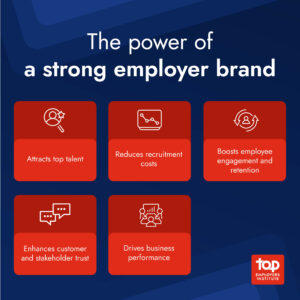
Top 5 benefits of creating a strong employer brand
The talent market has never been more competitive. For companies, having a strong employer brand is more than just a marketing asset. It is a strategic advantage. HR leaders who invest in employer branding enhance their company’s reputation and drive tangible business outcomes. In this article, we explore the top five benefits of a strong employer brand and why it should be a priority for organisations looking to attract, engage, and retain top talent.
5 benefits of a strong employer brand
1. Attracts top talent efficiently
A compelling employer brand helps position your organisation as an employer of choice. Candidates gravitate toward companies with strong reputations, positive workplace cultures, and clear career growth opportunities in a competitive job market. LinkedIn says organisations with a strong employer brand receive 50% more qualified applicants. This leads to:
Faster hiring cycles: Job seekers actively seek out companies with strong employer brands, reducing the time required to fill vacancies.
Reduced recruitment costs: Lower dependence on recruitment agencies and paid advertisements as candidates approach the company organically.
Increased access to high-calibre candidates: Top performers prefer to work for reputable organisations, increasing the overall quality of the talent pool.
Greater diversity in applications: Strong employer brands appeal to a broader range of candidates, fostering inclusivity and diversity. Diverse teams have been found to outperform their competitors by 35%.
2. Reduces recruitment costs
One of the key benefits of employer branding is cost efficiency. Companies with deep-rooted employer brands spend less on paid recruitment advertising and external agencies. When your brand speaks for itself, candidates proactively seek opportunities at your company, reducing reliance on expensive talent acquisition strategies. Investing in employer branding results in the following:
Lower cost-per-hire: According to LinkedIn, companies with strong employer brands reduced their cost-per-hire by 50%.
Improved return on investment (ROI) in recruitment marketing: Resources spent on employer branding provide long-term value rather than short-term hiring fixes.
Greater reliance on organic talent attraction: Employee referrals and social proof from current employees enhance recruitment efforts.
Enhanced employer reputation in the industry: A strong employer brand can lead to increased recognition and credibility within the talent market.
3. Boosts employee engagement and retention
A strong employer brand not only attracts talent but also keeps employees engaged. When employees resonate with their company’s mission, values, and culture, they are more likely to stay long-term. According to Universum Global’s research, organisations with strong employer brands experience up to 28% lower turnover rates. Benefits of good employer branding in this context include:
Higher job satisfaction: Employees feel more aligned with company values, leading to increased motivation and productivity.
Stronger workplace culture: A clearly defined employer brand fosters a positive and inclusive work environment.
Enhanced employee advocacy: Engaged employees become brand ambassadors, promoting the company externally.
Reduced turnover rates: A well-structured employer brand reduces attrition, saving costs associated with employee replacement and training. A study by Glassdoor found that 69% of employees believe that it is either very or extremely important that their employer is a brand they are proud to support.
4. Enhances customer and stakeholder rust
Employer branding extends beyond recruitment; it influences business reputation. Customers, investors, and stakeholders tend to trust companies that are known for treating employees well. A survey by CareerArc found that 64% of customers have stopped shopping with a brand after hearing that they treat their employees unfairly. A positive employer brand can lead to:
Stronger brand credibility in the market: A company recognised for ethical practices and employee well-being gains consumer trust.
Increased customer loyalty: Consumers prefer to engage with businesses that treat their employees well, leading to higher retention rates.
Greater investor confidence: Investors view companies with strong employer brands as more sustainable and well-managed, increasing investment potential.
Stronger partnerships and collaborations: Other businesses and industry leaders are likelier to collaborate with companies with a positive brand image.
5. Drives business performance
A well-established employer brand correlates with higher business performance. Engaged employees drive innovation, productivity, and customer satisfaction. Companies that invest in employer branding outperform competitors in key business metrics such as revenue growth, operational efficiency, and overall market position. The benefits of employer brand in business include:
Improved employee productivity: Motivated employees contribute more effectively to organisational goals.
Increased profitability: A strong employer brand leads to reduced hiring costs and higher workforce efficiency, boosting overall financial performance.
Stronger competitive advantage: Companies with strong employer brands attract better talent, making them more resilient in the market.
Greater adaptability to market changes: Organisations with a strong employer brand foster a loyal workforce, improving organisational agility and innovation.
Creating a positive employer brand is not just about getting top candidates; it’s about keeping them, driving business performance, enhancing customer trust, boosting employee engagement and more.
How to build a compelling employer brand
1. Conduct an audit on your existing employer brand:
Before rethinking your employer brand, it is best to assess how your organisation is currently perceived by employees, potential candidates and the wider world. To do this audit, you can conduct surveys with current and potential candidates, analyse recruitment metrics, and evaluate employer review sites like Glassdoor to identify gaps between your desired brand perception and reality.
2. Define your company values and culture:
The key to a strong employer brand is making sure that it is based on clear values and an authentic workplace culture. Working with all the employees in the organisation and not just leadership will help to communicate core values that reflect the company’s mission, purpose and vision.
3. Build your employer brand based on your employer’s Employer Value Proposition (EVP):
An organisation’s EVP should define what makes the company a good workplace. The EVP should highlight aspects that matter to candidates and employees, like career development, work-life balance, benefits, and company culture while aligning them with business goals.
4. Engage C-suite and employees:
A powerful employer brand is most effective when it is supported by every employee in the organisation, including leadership. Employees should be encouraged to act as advocates for the brand in the office, outside of it and through thought leadership opportunities.
5. Showcase your company values and vision:
Demonstrate your organisation’s employer brand with a multi-touchpoint approach through storytelling, social media, career pages and recruitment efforts. You can also use employee testimonials, behind-the-scenes content, and company achievements to reinforce the employer brand you’ve refined and strengthen your values.
Final Thoughts
For HR leaders, employer branding should not just be a trend; it is imperative for the business. The benefits of a strong employer brand impact every aspect of an organisation, from talent acquisition to employee retention and overall business success.
Explore our case study with Certified Top Employer Zahid Group to discover a real-life example of an organisation prioritising its employer brand to get measurable results and get inspired to start building a powerful employer brand.
The globally recognised Top Employers Certification Programme, along with our data-led insights, enables over 2,400 organisations across the world to advance their talent attraction, development, engagement and retention strategies. Are you ready to become an employer of choice? Start your Top Employers journey.
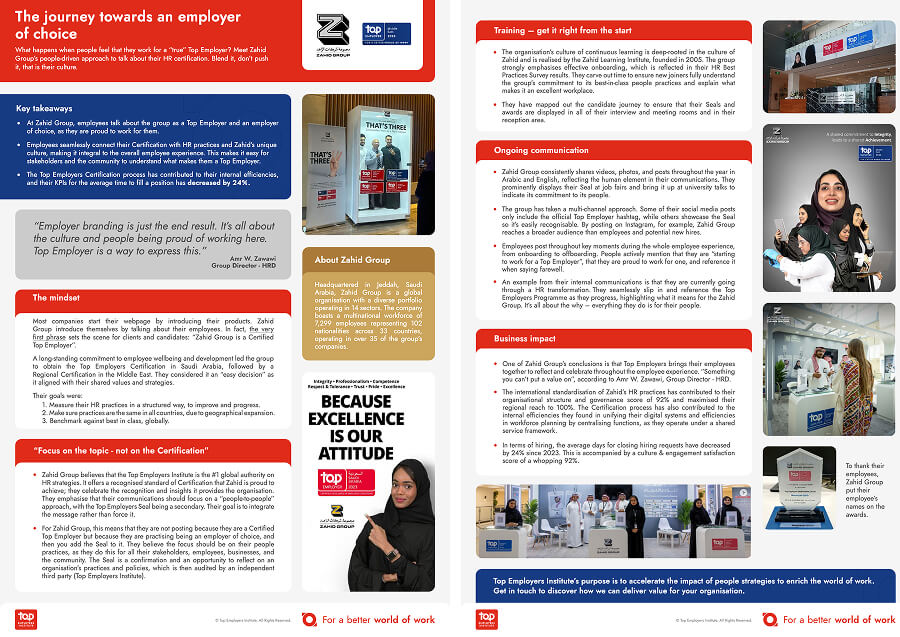
The journey to become an employer of choice with the Zahid Group
“Employer branding is just the end result. It’s all about the culture and people being proud of working here. [Becoming a] Top Employer is a way to express this.” – Amr W. Zawawi, Zahid Group Director – HRD.
Zahid Group, a Certified Top Employer, wanted its employees to seamlessly connect their Top Employers Certification status to the company’s unique culture. While most organisations’ websites start by introducing their products, Zahid Group has a different approach. They introduce themselves first by talking about their employees. You will see on their website that the first sentence sets their people-first culture: “Zahid Group is a Certified Top Employer”.
The group’s long-standing commitment to employee wellbeing and development initially led it to obtain the Top Employers Certification in Saudi Arabia. It was an “easy decision” for them as it aligned with their shared values and strategies.
When they became Top Employers, they had three goals:
Measure their HR practices in a structured way to improve and progress.
Make sure practices are the same in all countries due to geographical expansion.
Benchmark against best in class, globally.
Download the value story for free and discover their complete story to learn how:
The Top Employers Certification process has contributed to Zahid Group’s internal efficiencies, and their KPIs for the average time to fill a position has decreased by 24%.
How the international standardisation of Zahid’s HR practices has contributed to their organisational structure and governance score of 92% and maximised their regional reach to 100%.
The overall business impact of the Top Employers Certification to Zahid Group’s employees.
Best practice ethical AI: Our Top Employers in action
Our new whitepaper Ethical AI in the world of work: A framework for success explores the key role of ethical AI in the workplace. It emphasises HR’s vital role in its implementation and includes our ethical AI framework, which must always rest on three pillars:
AI decisions should be human-centric.
Considerations must be evidence-backed.
A long-term lens should be applied to its use, benefits and costs.
The whitepaper shows how Top Employer organisations from around the world are already harnessing AI’s potential effectively with impressive results.
Accenture Poland, for example, has used AI to help promote employee connection and engagement. Through their initiative ‘Change @ Work,’ they developed an AI tool called ‘Remesh,’ which allows for real-time input from their 250 employees. Its human-centric approach demonstrates how AI can increase a sense of community and improve employee satisfaction.
The South African Breweries demonstrates ethical AI through a collaborative approach between a diverse team of stakeholders and different perspectives when assessing, implementing and managing AI tools.
Evidence-backed
Airbus has embraced AI as a key strategic partner in their organisation. Since 2023, new AI tools suggested by employees are carefully assessed by a Trustworthy AI Steering Committee to ensure they are implemented responsibly. This shows why it’s essential to have transparent AI and for key stakeholders and HR professionals to be involved from the beginning.
JTI Switzerland introduced an AI-powered HR assistant called ‘Ayumi’ in early 2024. Before launching it across the organisation, though, their HR team piloted the tool and used it in their daily tasks. This early testing meant they could collect feedback and develop relevant training materials for colleagues.
Virtusa Corporation committed to an 18-month long HR digital transformation by integrating all their HR processes into one platform to drive the improve employee experience. It has shown how AI can successfully create a smoother and more supportive environment for employees by making sure technology suits both theirs and the organisation’s needs.
Long Term Lens
The impact of AI on Verisure’s UK people practices and DEI efforts has been extremely positive. The business noticed the pitfalls of using gendered language in job adverts that could stop women from applying. To address this bias, it began using AI to improve the hiring process and promote equal opportunities for all candidates.
Our view
Our Top Employers report ‘Ethical AI in the world of work: A framework for success,’ demonstrates how AI can drive business success while respecting employees and contributing to the wider society. The practical examples explored show that with thoughtful and careful implementation, all businesses are capable of harnessing AI’s potential to create more collaborative, inclusive and transparent workplaces.
Ethical AI in the world of work: A framework for success
The use of AI in the world of work is full of both opportunities and challenges.
It has been one of the critical drivers of change in 2024 – and its impact will be just as substantial in 2025. Organisations that harness the benefits of AI will enjoy faster product innovation, agile business models, increased profitability and improved customer experience. However, its introduction is also bringing many challenges, the most obvious of which is the impact on the workforce, with some jobs becoming obsolete and fears on an adverse impact on career paths.
The question that many business leaders are asking themselves is: How can AI be leveraged to drive business success in a way that is respectful to employees and responsible to society overall? And how can it help the future workforce realise its career potential?
This whitepaper therefore looks how to adopt an ethical approach to AI to drive business success, considers HR’s role in bringing this alive and introduces our Top Employers Institute Framework for its successful implementation.
Want to explore the research? Download it now for free! Just fill in the form for instant access to this exciting research!
Our Ethical AI Framework is built on three pillars.
AI decisions should be human-centric. This means that the needs of individual employees are considered alongside the business opportunities that new technologies provide.
AI must be evidence-backed. There needs to be a clear visibility on the way AI tools function, given the rapid evolution of technology.
Use a long-term lens. The use, benefits, and costs of AI should be evaluated with a long-term perspective, acknowledging that their full impact, including unforeseen consequences, may only become apparent over time.
In this whitepaper, we will not only outline what it means to leverage AI ethically, but also provide some examples of Top Employer organisations that are already applying these values. These include Accenture Poland, The South African Breweries, Airbus, JTI Switzerland and Virtusa Corporation.
Discover all the insights by downloading the report via our form.
Subscribe
Keep up to date with trends, best practices and news in the world of HR
We use cookies to improve your experience.
Learn more >