Use this dropdown to select your preferred language.
Best Practice | UST’s Step IT Up Programme
Best Practice | UST’s Step IT Up Programme
Step IT Up, a UST proprietary programme, helps organisations hire more diverse employees by directly addressing the global IT skills gap. The programme offers underrepresented candidates a customised four- to seven-month curriculum focusing on technology careers. Graduates can enter a new job market with a higher salary promise. UST client companies benefit from the programme by creating a more diverse and inclusive workforce.
Why the practice was needed
Computer Science graduates have surpassed engineering graduates as the highest-paid undergraduates right out of university, but in the United States in 2021, only about 21% of Computer Science majors are women. In another study, they found that when you look at Computer Science majors by ethnicity, 64.2% are White, 18.8% are Asian, 6.9% are Latino, and 4.2% are Black
Additionally, about 10 years ago, UST also noticed that even Computer Science majors weren’t necessarily receiving the same number of focused learning hours needed to be effective in entry-level IT positions; typical (American) undergraduate education offers classes more generally, covering several topics. New IT hires must go through months of on-the-job training to be more effective in their work.
UST realised they needed to change the landscape and focus on a talent pool outside of Computer Science. They started looking at graduates with more general academic backgrounds and have created a new talent pool from which to hire.
How the practice was implemented
The Step IT Up training programme was created about 10 years ago and has been successful ever since. UST’s idea is to find, recruit, pay, and train candidates who have graduated from four-year degree programmes and help place them within their client companies.
Details on Recruiting
Candidates for the programme are recruited within the geographical area in which the client companies would like them to work. The client company usually specifies what types of candidates they’d like to consider and the requirements for the role. UST then sets out to find applicants for a new programme. Candidates are usually recruited through UST’s Alumni network, partner organisations, military bases and other outside referrals. Each applicant passes an assessment test that measures reading, math and analytics. If candidates do well on the assessment, they move on to the interview phase with both UST and the client company, and together, they select who will join the programme.
Details on Programme Participation
The UST programme is different from some others in the market in that they try to eliminate any financial obstacles candidates may face to enter the programme; candidates are guaranteed a job if they start the programme and are paid from the start of their training. Wages vary depending on geographic area, but the goal is to give them space to focus and study for the programme when enrolled. Once they’ve completed the training, candidates are given a salary increase. When they are hired into the client company, they receive a higher salary upon conversion.
This programme and the skill set earned will also set a candidate up for the potential of a six-figure salary in the future as they have entered into an industry that they may not have otherwise considered. All participants finish as technologists with the equivalent of a Computer Science degree.
Details on the Programme
The Step IT Up programmes are given onsite and virtually.
UST has executed the programme across the US, Europe, Asia, Australia and Central America.
Each training programme has an instructor with collegiate and industry experience and a Coach/Mentor.
Training can run from four to seven months, depending on the skill set requested from the client company.
The training programme is customised; UST uses a curriculum the client company has looked at and approved for an entry-level job.
The client company adds their software tools to the curriculum.
The programme usually runs with homework assignments from 8:00 to 17:00 from Monday to Friday.
To pass, candidates need at least a 70% overall and to successfully complete a final capstone project.
Results of the practice
Many women and other minority groups have been able to work in a field they did not otherwise think was for them, either due to a lack of positive role models in IT or advice/guidance to the contrary. These programme graduates help break stereotypes and break down barriers in the industry by offering a new and different voice.
90% of the individuals who start training graduate from the programme.
87% of those who start to work onsite at a client company get converted/hired directly after 12 months.
You can also learn more about UST’s social and DEI efforts in the video below.
Best Practice | Accenture Accentuates the Employee Experience
The programme «Change @ Work, Poland edition» started in 2019 as the first One Accenture initiative to promote a sense of belonging within the organisation. The programme aims to improve employee satisfaction by helping them feel more valued and connected to the organisation.
Using a dedicated AI tool, Accenture Poland engaged approximately 250 employees in real time to shape their culture of belonging. Based on extensive research, they have determined four main areas that most influence employees’ sense of belonging. Under this programme, Accenture Poland is running 15 amazing projects to shape a better world for more than 9 000 employees.
This is just a snapshot of Accenture’s innovative best practice. You can find the entire practice in our HR Best Practices database, which is exclusively available to Top Employers. Get inspiration and insight into the approach, challenges and learnings experienced by certified Top Employers.
Why the practice was needed
During difficult and unpredictable times, Accenture Poland believes that leaders must act alongside younger colleagues to co-create the best solutions. Involving employees at all levels of an organisation can also help them feel engaged with the organisation in a meaningful way and could, therefore, help retain talent.
How the practice was implemented
Accenture’s Change @ Work, Poland edition consisted of three main steps:
Accenture Poland conducted research using individual in-depth interviews with approximately 50 employees to understand the main factors that determine a feeling of belonging within Accenture.
The analysed dataset included:
The anonymised personal data of respondents was obtained from internal human resource management systems.
Qualitative data – statements of respondents obtained based on the interview discussion guide.
Quantitative data – responses to questions asked using a five-point Likert scale.
Based on the research, the organisation designed four main activities that were most important for employees in terms of belonging.
Using an AI tool, Remesh, Accenture Poland involved approximately 250 employees in shaping final solutions that best met employees’ expectations.
The co-creation method was used, and the initiative was run by employees for employees as a way to understand and focus on their real needs.
Results of the practice
More than 300 employees gave feedback to shape the final solutions.
15 initiatives are being implemented to increase employee satisfaction.
Accenture Poland is moving from talent consumption toward talent creation, with Gen Z pushing for this change.
Insights from the People Summit 2024
Today, 84% of the organisations are defining a vision for how technology contributes to the overall employee experience. That was the focus of the People Summit 2024, hosted by SAP and the Top Employers Institute, which took place on June 12, 2024, at the SAP Labs Campus in Bengaluru, Whitfield in India.
And we’re delighted to share some of the resources shared during the People Summit:
World of Work Trends 2024
Top Employers Institute’s World of Work Trends 2024 analyses the latest trends in people strategies and practices from leading organisations globally. In the report, our analysis showed five significant trends affecting workplaces in 2024. Those trends are:
Empower through AI
The Future Defined with Purpose
Dialogue for Transformation
Evolution of Wellbeing Effectiveness
Broaden the Horizon of DEI
These trends were unpacked by Adrian Seligman, Executive Board Member at the Top Employers Institue. You can download the report here, and watch Adrian’s Keynote here:
Throughout the People Summit, insights were shared by SAP which also featured many insights from the research they’re doing into the future of work. SAP have identified future of work trends three strategic dimensions. You can access an array of resources shared by SAP during the conference here:
Future-Proofing HR: Trends and Transformations in India
The People Summit also featured a wonderful panel discussion on future-proofing HR and discussing trends and transformations in the Indian Landscape. On the panel was Kavita Kurup, Global Head HR and Corporate Communications at UST, Shilpy Sharma, Regional HR Head at Empower, Kiran Sn, Vice President – HR, HCLTech, Shweta Mohanty, Head of Human Resources: India at SAP and Billy Elliott, Regional Director Asia-Pacific, Top Employers Institute.
They addressed the integration of technology, the distinction and enhancement of employee experience vs. engagement, the importance of diversity, equity, and inclusivity (DE&I), and strategies for skills development and talent management.
Key points included:
Technological Integration: Shilpy Sharma highlighted the evolving role of technology in HR, emphasizing advancements that boost organizational efficiency while considering potential drawbacks like job displacement and privacy concerns.
Employee Experience vs. Engagement: Kavita Kurup differentiated between the two concepts, sharing successful UST initiatives to enhance both through personalized approaches and flexible work arrangements.
Skills Development and Talent Management: Kiran SN discussed HCLTech’s approach to upskilling and reskilling, aligning talent initiatives with strategic goals, and addressing challenges like budget and time constraints.
Diversity, Equity & Inclusivity: Shweta Mohanty shared effective strategies and impactful programs at SAP to promote DE&I, acknowledging challenges like unconscious bias and tokenism.
3 Employee Insights Your Organisation Needs to Succeed
Despite their industry and offerings, organisations rely on their people more than anything else. That is why it is important for organisations to understand their employees as much as they understand their clients .
In this blog post we are exploring everything from what employee insights are to the three employee insights organisations need to prioritise.
What are employee insights?
Employee insights are valuable information and understanding from analysing people’s behaviour, attitude, and organisational feedback. They form the foundation upon which people strategies are built. As can serve as a starting point for information and a way for teams to monitor the success of their strategies.
Employee insights encompass aspects such as employee motivations, job satisfaction, work-life balance, professional development needs, and perceptions of the workplace culture. By systematically gathering and interpreting data through surveys, performance reviews, feedback sessions, and other tools, HR teams can use this data to comprehensively understand what drives their people.
How employee insights benefit and support organisations
Employee insights have a number of benefits for organisations, especially when it comes to learning what drives employee satisfaction. Some of those benefits include:
Enhanced employee engagement: when employees feel positive engagement it is reflected in the quality of their work as it becomes more than just a job for them. They show a level of dedication that means they are more likely to take pride in their work and that means that organisations can rely on them to go the extra mile for business success.
Improved retention of employees:recruiting and training new people is expensive and time-consuming and expensive. By retaining existing employees, organisations can save on recruitment costs, training programs, and the loss of productivity associated with new hires.
An improved work culture and environment to support employees:a positive work culture and supportive environment are essential for fostering employee well-being and productivity. When employees fee valued, respected and supported at work they are more likely to feel satisfied at work, and satisfied people are more likely to stay with the organisation and perform at their best.
Enable organisations to make more informed decisions:organisations that can make data-driven decision-making will find that it is crucial for strategic planning and operational efficiency. This alignment leads to better outcomes and a more motivated workforce.
Reduced costs: high turnover of employees can lead to hidden costs such as lost productivity, lower employee morale, and decreased customer satisfaction. By improving retention, organisations avoid these costs.
3 employee insights your organisation needs to know
Now that it is clearer about the benefits of identifying employee insights, we are going to go deeper into the ones your organisation needs to identify:
How are the employee motivations within your organisation:Knowing what motivates your employees is key to fostering a productive and engaged workforce. While compensation is important, intrinsic motivators such as recognition, meaningful work, career growth opportunities, and a positive workplace culture often significantly impact long-term engagement. HR teams that can identify what motivates their people will be better able to align these needs with organisational goals, creating a work environment that supports the organisation while ensuring that employees are supported.
How employees feel about their sense of belonging within the organisation:A sense of belonging is essential for a positive employee experience. Employees who feel included and part of the organisation are more likely to be engaged and committed. Organisations that have data and insights on these feelings will be able to make decisions to better engage their people and support them so that they are more engaged at work.
How employees feel about their personal and professional growth opportunities at work:People want to feel that their careers are progressing and that their company supports their growth. Organisations also want to invest in the people they have rather than continually looking for new employees to fill their gaps. That is why investing in professional development through training programs, workshops, and continuous learning opportunities benefits employees and the organisation. HR teams prioritising getting data and insights into this area of their employees’ lives will feel more equipped to support their people while also boosting their loyalty and commitment to the organisation.
5 ways to gain employee insights
Employee insights can be gained through a combination of quantitative and qualitative methods designed to gather comprehensive data on employees’ overall experiences, attitudes, and behaviours. Some of the methods that organisations can use to gain these insights include:
Regular surveys and questionnaires:frequent use of surveys and questionnaire, can be an effective way for organisations to get a general picture of how employees are feeling at work. These can be annual engagement surveys, pulse surveys, or targeted questionnaires focusing on specific areas such as job satisfaction, work-life balance, and career development. These tools can also be effectively implemented using digital tools that will allow data to be analysed and trends to be easily identified.
Regular one-on-one meetings and check-ins:regular perfomarmance reviews, like stay inteviews, provide valuable insights into employee performance, strengths, and areas for development. These discussions also offer an opportunity for employees to share their career aspirations, challenges, and feedback on their roles and the organisation. When using this method to gain employee insights, attention must be paid to creating a psychologically safe environment for employees to share their feelings.
Exit interviews:Exit interviews with departing employees can reveal critical insights into why employees leave and what could have been done to retain them. This feedback helps identify systemic issues, areas for improvement, and opportunities to enhance the employee experience for current and future staff.
Anonymous feedback channels:Providing anonymous ways to give feedback, like suggestion boxes or confidential online platforms, encourages employees to share honest opinions without fear of retaliation. This can surface issues that employees might be reluctant to discuss openly.
HR Analytics:HR departments can leverage data analytics to track and analyse various metrics such as turnover rates, absenteeism, performance metrics, and employee engagement scores. Advanced analytics tools can uncover patterns and trends, providing actionable insights for strategic decision-making.
Organisations that use a combination of these methods can gain a holistic understanding of their employees’ experiences, needs, and concerns. This can enable them to have a comprehensive approach to gathering employee insights.
Employee insights: final thoughts on their value
Employee insights are essential for building a resilient and high-performing organisation in a competitive business landscape. It is critical that HR teams prioritise understanding and leveraging these insights to drive organisational success.
The Top Employers Certification Programme recognises excellent people practices to help organisations grow as an employer of choice. These excellent people practices are often improved by identifying important employee insights to know where to make impactful changes.
Learn more about joining the Programme and how it can help you make data-driven decisions: get in touch today, become employer of choice!
HR Practices to Elevate Your Workforce: Insights from Asia-Pacific’s Top Employers 2024
This year, we’ve certified 369 organisations in Asia-Pacific as Top Employers, and we have curated a selection of best practices from these esteemed organisations to inspire you. In this comprehensive resource, you’ll find insights and exemplary practices that have not only raised the global standard of HR excellence but also set the benchmark for others to follow.
Download the ebook now to uncover invaluable insights. Here are some highlights you’ll find inside:
Learning and Development – Discover how AstraZeneca fosters a culture of lifelong learning to support its 2030 Bold Ambition. Learn how their 3Es Learning Framework (Experience, Exposure, and Education) empowers employees to embrace a ‘learning mindset,’ focusing on real-time application and long-term development through coaching and feedforward. Explore how initiatives like Degreed, P100, LEAP 50, and the Accelerate program enhance skills, broaden perspectives, and accelerate leadership development. Discover how AstraZeneca’s commitment to everyday development experiences drives innovation and delivers life-changing medicines to patients, reflected in high engagement scores and strong business performance.
Onboarding – Discover how NN Life Insurance Japan has transformed its onboarding process by integrating digital tools with personal communication. Learn how new hires benefit from instant access to essential information and e-learning resources, coupled with personal interactions such as welcome sessions with senior management. Explore how these efforts enhance talent retention and engagement by fostering strong connections within the organization.
Performance – Discover how Lyreco Thailand’s Performance Development Review (PDR) promotes ongoing learning and development. Learn how this holistic procedure integrates self-assessments, open communication, constructive feedback, and personalized development plans to align individual goals with company objectives. Explore how Lyreco’s PDR process, implemented through the Workday platform, has enhanced employee growth, reduced turnover, and increased engagement and satisfaction.
Sustainability – Discover how CHEP Australia fosters a culture of sustainability throughout the employee lifecycle. Learn how their sustainable practices are embedded from recruitment to onboarding and beyond, promoting a nature-positive economy through their pooling model. Explore initiatives like their annual Sustainability Week and Helping Hands program, which support employee engagement and community involvement, contributing to their ambitious sustainability goals.
Leadership – Discover how Servier Philippines anchors its leadership on the company value of CARE, fostering a highly inclusive and psychologically safe working environment. Learn how their transformation journey prioritizes acting on feedback, with initiatives like «You spoke, we listened» promoting open communication and continuous improvement. Explore how their psych safety training programs and workshops have built trust and collaboration, leading to high engagement and recognition as a Top Employer.
Talent Acquisition – Discover how GSK Indonesia’s Talent Pipeline strategy shifts from reactive to proactive recruiting, building relationships with passive external talent for future opportunities. Learn how this approach has streamlined the hiring process, reduced costs, and improved the quality of hires. Explore the steps of identifying, assessing, and engaging potential candidates, ensuring a ready pool of talent for critical roles.
Career Development – Discover how DLMI Malaysia supports employee career development through initiatives like Personal Development Plans, continuous dialogue, and career coaching programs. Learn how their internal digital career marketplace facilitates mobility and advancement, enhancing employee engagement and satisfaction. Explore how their annual Talent Reviews and Succession Planning process ensure the development of talents for critical leadership roles.
Offboarding – Discover how GEP India’s Alumni Network on LinkedIn keeps ex-employees connected to the organization. Learn how this professional network facilitates brand advocacy, rehiring of boomerang employees, and networking opportunities. Explore how GEP maintains relationships with former employees through engaging content and periodic alumni events.
Meet the New Top Employers
Earlier this year, Top Employers Institute proudly announced that over 2 300 Top Employers had received the Top Employers Certification in 2024. Those Top Employers were recognised across 121 countries and regions.
In June, we are excited to share that 58 new Regional Top Employers and one European Top Employer joined our global community of organisations committed to excellence in people practices. This recognition underscores these organisations’ commitment to fostering outstanding HR strategies and people practices globally.
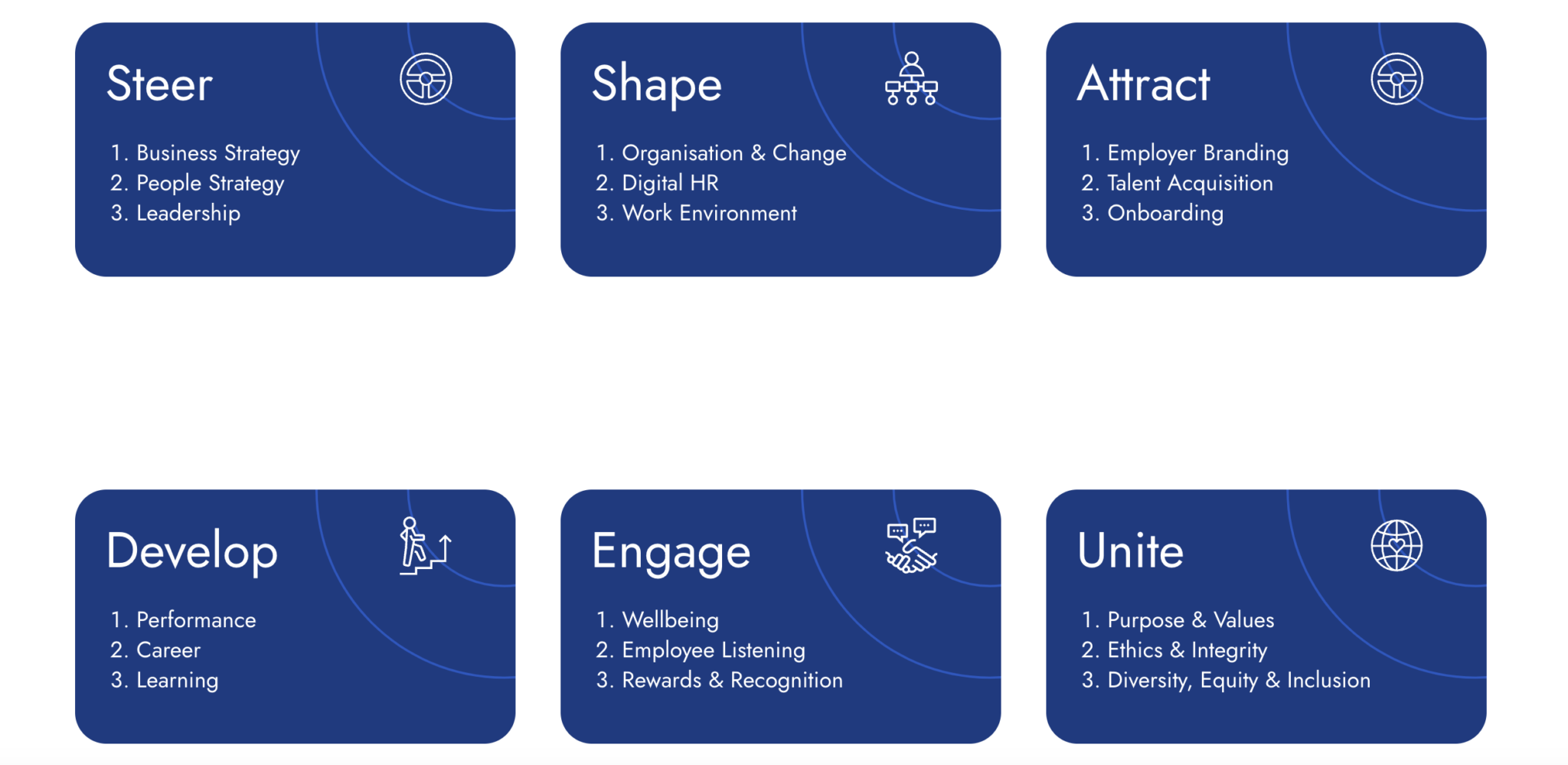
As the global authority in recognising excellence in people practices, the Top Employers Institute Certification Programme is an extensive process involving an independently audited and fact-based HR Best Practices Survey and validation to ensure truthful answers. The survey covers six domains and 20 subtopics:
In 2023 and 2024, organisations and leaders had much to consider, with many things in flux. David Plink, CEO of Top Employers Institute, observed: “In a world where geopolitical, societal, and macro-economic developments follow each other in rapid succession, the Top Employers 2024 are showing once again that they are a beacon of stability and reliability. Top Employers have shown that despite turbulent times, their focus remains on creating the best workplace possible for their people to thrive.”
When asked what makes a Top Employer, David Plink shared: “In my 16 years with the company, there are two characteristics that I have observed consistently within the members of the Top Employers community. First, certified Top Employers go above and beyond for their people. They are the embodiment of people focus. Secondly, not a single Top Employer got certified without always striving for more. To learn, to become better and to stay curious at all times. People-focused and a growth mindset. It sounds so simple in summary, but it takes a lot to consistently live up to these principles.”
See the full list of the newly Certified Top Employers, below: