Global Work from Home Day 2024
It is safe to say that the way we work has changed fundamentally. Today’s workforce has expanded through digital connectivity and remote collaboration.
As organisations all over the world adapt to new work models, we celebrate Global Work from Home Day as the vehicle through which employees and employers celebrate the flexibility and productivity obtained through remote work.
What are some of the key benefits of working from home?
When allowing the flexibility to work from home, organisations are creating a positive work environment for all kinds of living situations, life phases, and personal preferences, this takes out of the equation the exclusion that happens when you dictate how people should relate themselves to work.
Inclusivity brings multiple advantages to adopting a work from home model because it benefits both the employee and the employer.
Employers see a bigger pool of people who can be successful at the organisation. For professionals, an enhanced opportunity to choose how they work is offered. The added autonomy of working at home, office, or shared workspace increases their wellbeing. Moreover it conveys a employee-centric approach, which can boost engagement and therefore improve overall company performance.
How do employees relate themselves to work?
We see high engagement at Top Employers, even with people working from home, but we know the key is to make sure we maintain this level of engagement. We must continually gather information to develop ways to stay connected as the organisation grows. That is why we focus on the importance of creating a programme that is intentional by design.
To create an intentional programme, we must first know the relationship between employees and their work. This is possible, through hr analytics and employee insights.In organisations with a human-centric approach, there is the employee, then the team, then the company, and this needs to be well defined.
At Top Employers Institute, we continue to develop the process of defining how the employee relates to the team and the company to offer them a journey that is aligned throughout the world.
This explains how we look at variables like work location and decide what needs to be in place no matter where you work to keep high levels of engagement.
Download Now: Navigating a Dynamic Workforce
How do we stay connected working from home?
Intentional connection is the key. By making connectivity a goal, we see how working from home fits into the bigger picture of how professionals work and how this shapes the employee-employer relationship.
Connection can’t be left up to chance. It must be worked into an organisation’s goals, and these goals should answer questions like what the relationship between the employees and the employer should look like. How do the employees relate to the work at hand and to the overall goals of the organisation?
Working from home should not equal working in isolation. There should always be opportunities for employees to learn from each other and model behaviours that create the corporate culture, not in a forced way, but because they like it.
Practical examples include:
- Creating an environment that promotes the exchange of information.
- Fostering efficient processes that support an employee’s best performance.
- Encouraging a sense of belonging through shared rituals like traditions or team events that improve the employee experience.
- Providing opportunities for employees to contribute to the company’s narrative and identity.
- Understanding that this is a work in progress and that growth and change are vital to creating a good programme for the employees.
What are some things to be aware of when working from home?
Employees must have what they need to perform their role. This is not just in physical items like computers and desks but also in processes that allow for connection with colleagues and managers, including periodic connections to evaluate performance and ensure goals are being met.
Keeping a work-life balance can sometimes be harder. One surprising fact is that many people tend to work more when working from home because they’re relaxed and forget the time.
Finding the balance when working from home is an important part of why this arrangement must be intentionally planned as it is important to the employee’s wellbeing.
How can an employee advocate for remote work accommodations?
An employee’s work environment needs to match their own beliefs and vision to bring about the best work. It’s a very personal decision, and it won’t look the same for all employees. Our belief at Top Employers Institute is that everyone we hire is a professional and is motivated.
The organisation and the employee should work as a team to make sure the employee has what they need to be successful because the motivation is already there. It’s hard to believe that providing employees with what they need to fulfil their duties doesn’t link to better financial results for the company because people are happier, and happier people perform better.
When advocating for this type of work arrangement, the organisation must be able to see how this is of mutual advantage. The culture in the organisation must be the type that believes that giving people autonomy will produce better employees, so making a business case for this type of work set-up must show how it will improve productivity.
What advice do you have for companies deciding on their policy for a work from home programme?
For us, the priority is getting the right person for the job rather than the right person, in the right place, in the right time zone, and in the right phase of their lives for the job. The model is simple, but the effect is huge. There are a lot of systems to hold up this style of working but having a productive workforce should be the goal.
Organisations are hiring professionals, and the expectation is that they should know what they need to be successful. This can only happen once the definition of success inside the organisation has been explained. A certain balance in autonomy, sense of belonging, and a clear picture of what is expected of the professional is the key to developing a great work from home programme.
Part of it is, of course, where the employee is physically doing the work. The other part is how they are staying engaged. Are they collaborating? Do they feel connected? Many elements that can be used to create the right work from home environment, and this is where we should focus on the philosophy or point of view and not where a person is physically working.
The role of the organisation is in coordinating the matrix that facilitates the connections to happen between employees. Reinforcing the culture, common language style, ad hoc encounters, and building relationships are some of the tools an organisation can use to facilitate connections between employees.
Organisations that keep a human-centric approach must continually ask if policies are still working for the wellbeing of the employees and for reaching the organisation’s goals. We need to make sure we take care of each other; if one sees the other is not doing well in our definition of success, it’s my responsibility to help you out.
Your success is my success. The human-centric approach towards working from home is just one element of a whole approach to a person-centric work culture and it’s what we believe is the right thing to do for a successful company.
During Top Employers Inspire 2023, we got an insider’s view of how Top Employers Institute is becoming a human-centric organisation. Paola Bottaro, People Director at Top Employers Institute, talked to Wouter van Ewijk about how the business has adapted to support its employees better while learning to be mindful, empathetic, and purposeful. You can watch that session here.
Final thoughts: the shift to remote work has significantly enhanced the digital employee experience
As technology becomes the primary means of communication, collaboration, and productivity, working from home has increased reliance on digital tools, like video conferencing, project management software, and virtual collaboration platforms.
This shapes the way employees interact with colleagues and complete their tasks.
This digital transformation has not only made work more flexible but also redefined workplace culture, as organizations invest in fostering engagement, well-being, and professional development through digital channels.
As remote work continues to evolve, the digital employee experience will likely play an even more central role in shaping organizational success and employee satisfaction.
Best Practice | Virtusa’s Talent Digital Transformation
Certified Top Employer, Virtusa, committed to an 18-month-long HR digital transformation to dramatically change the digital experience for their employees, covering everything from recruiting and onboarding to learning and development, inclusion, and rewards. The organisation did not simply make small incremental changes; they reimagined all their processes and radically transformed them into a single, fully integrated, hyper-personalised employee platform.
This is just a snapshot of Virtusa’s innovative best practice. You can find the entire practice in our HR Best Practices database, which is exclusively available to Top Employers. Get inspiration and insight into the approach, challenges and learnings experienced by certified Top Employers. Access it now via the Top Employers Programme if you are certified or learn more about it here!
Why the practice was needed:
Although technology is at the core of their business, Virtusa struggled to make technology work correctly for their employees. They had too many disjointed systems that were not creating a seamless employee experience. The systems were not driving engagement or speaking to one another. Eranga Pathirage, VP & Head of HR for the UK, Europe, and the Middle East + the Global Head of HR Tech Transformation, helped the organisation dramatically improve its talent understanding and engagement through a digital HR transformation.
Pathirage recalls that they already had all this valuable data about their 35 000 employees across 25 countries. As a provider of technical services, they respected and knew the power of technology. They saw a solution in centring the relationship between technology and their employees to drive adoption and employee loyalty.
Read More: Best Practice | Momentum Metropolitan’s Offboarding Practice
How they implemented the practice:
Pathirage recalls that the most challenging part of their HR digital transformation was the beginning, as he and his team wanted to be bold and did not know exactly how to start; they wanted to involve everyone in the business and obtain their buy-ins as well. Pathirage and his team took on the enormous task of reviewing all their processes to truly reimagine a digital solution offering their people an optimal employee experience. As he explained, they were not making incremental changes to some of their HR systems but instead re-hauling the entire process. In thinking through the right solution then, they followed some important grounding principles:
- There would be one single source of truth.
- Their HR digital solution would be fully integrated within Virtusa’s IT system.
- The technology they picked would also give the company the ability to evolve. The technology selected and implemented should allow Virtusa to stay agile and guide the business accordingly.
- As a technology services organisation, Virtusa also wanted to put technology first.
With these grounding principles, the organisation set out to pick a Software as a Service (SaaS) solution for each element of the employee experience. The solution as a whole was born in the cloud.
Download Now: World of Work Trends 2024
The results of implementing the practice
The results of this HR digital transformation can already be seen. The company now has an AI chatbot to assist in a personalised candidate experience, providing a consistent company story for prospective employees. SkillPrism, powered by AI, can create an employee profile from multiple data points to fully understand competencies within the business. The company can now also offer a personalised learning journey for their employees and, through Edge, can offer their own internal “LinkedIn,” giving each employee one to three personalised job openings across customers, domains, and countries.
Once this digital solution was offered, Virtusa employees adopted it quickly, with an 85% adoption rate in the first two weeks.
Learn more about the Top Employers Certification here.
Navigating a Dynamic Workforce
Top Employers Institute’s Navigating a Dynamic Workforce analyses the latest trends in the changing nature of the workforce and how employers can navigate and adapt to a dynamic workforce while maintaining employee engagement and success.
In the report, our analysis offers organisations a look at how they can unlock business success by leveraging and empowering their contracted, non-traditional talent with four recommendations. Those recommendations are:
- Include contingent workers: Successful organisations value and respect every contributor, including contingent workers. They should be included in opportunities that normal employees would experience, such as access to various HR processes, practices, and deliverables.
- Support employees with directing their own career evolution: Organisations should empower employees to chart their career paths and provide resources for self-directed learning. This can be done through online self-service resources, interactive career portals, internal digital career marketplaces, and mentoring/coaching for career development.
- Provide resources that promote self-directed learning to all employees: The speed at which skills and skill demands are evolving requires ongoing reskilling. Organisations should offer online training programs, personalised learning portals, and micro-learning content integrated into everyday activities and facilitate opportunities for employees to learn from one another through online learning communities.
- Facilitate a smooth transition into and out of the organisation for all employees: With a dynamic workforce, onboarding and offboarding become important ways to leave a lasting impression on employees. Organisations should optimise the onboarding experience and implement meaningful offboarding practices, including a fit-for-purpose offboarding experience and gathering feedback from departing employees.
You can read more about each recommendation and gain a better understanding of the trends affecting the world of work by completing the form on the left and downloading the analysis for free.
Paradigm Shifts: Agile HR Practices and Skills-Based Organisations
To close the 2023 Top Employers Inspire event, I sat down with my colleague Quinton van Es, Director of Research & Insights for Top Employers Institute, to discuss two closely linked topics –the funadamental shifts in HR practices and the rise in skills-based organisations.
These ideas are reaching a tipping point in business practices and creating paradigm shifts.
At Top Employers Institute, we certify organisations based on best practices, which requires us to look ahead at developing industry trends and consider those that are proven successful.
Agile HR practices and skills-based organisations are becoming more mainstream when there are many disruptions and uncertainties. From a business perspective, now more than ever, organisations need to be resilient, adaptive, and human-centric.
We discussed how these two practices are enabling organisations to do just that.
From the basic tenets of each to the more significant industry implications to our personal employee experiences with each principle, our discussion covered a lot of ground.
In this article, I’ll summarise the highlights of our conversation. You can watch our discussion in full at the end of the article.
What Are Agile HR Practices?
Working agile has long been established as a best practice for IT where rapid innovation was a necessity. Gradually, the ability to quickly adapt has become a strategic imperative for organisations, causing agile practices to spill over into other areas and functions.
In HR, operations are moving away from a rules- and planning-based approach toward a simpler model based on feedback.
Organisations can struggle with agile HR operations because many things, like payroll, feel fixed–there is no trial and error. However, the application is more of a big-picture consideration. Quinton explained, “When it comes to working agile, we are used to seeing these principles applied to projects.
In the context of operating models, a lot of organisations are more agile than they realise because they already have a continuous feedback loop in place.”
The essence of this approach is about regularly receiving and responding to feedback rather than specific tasks.
There are considerable variations in how organisations apply agile principles to their HR operations. Quinton gave examples, “some organisations focus on the mindset and values.
Other organisations are taking a more methodological approach and just implement scrum.” Each approach has its pros and cons. There is no one solution, which is part of what makes this paradigm shift so interesting.
Skills-based Organisations
Historically, jobs were the dominating structure for work. Job descriptions and titles defined who did what and how their work was managed and evaluated.
This approach is falling out of favour because it hinders many organisational objectives, including growth, innovation, agility, and the ability to offer employees a positive work culture.
“A job-based approach is very linear and predictive but it’s also a reductive view of work and the individual. In contrast, skills-based organisations zoom in on specific skills and the whole person to consider how an employee’s talents may best be applied. It’s a more employee-centric approach,” Quinton said to highlight why this paradigm shift is happening. Another reason it’s gaining popularity is that it offers a great deal of flexibility and adaptability.
As jobs shift from being the primary construct for work to being one of many factors, organisations must adapt their HR practices. HR writes job descriptions, sets compensation, and manages performance reviews–all tasks based on defined jobs.
Skills-based organisations thoroughly shake up this model, reimagining employee management, which is partly why agile HR practices and skills-based organisations are often closely linked.
Benefits of Shifting
Working agile means iterations happen quickly–things are done slightly better each time. Employees do not have to wait long to see their feedback in action. Additionally, employees get used to adapting and a certain level of ambiguity.
This model fosters a culture of continuous improvement and creates better employee engagement.
A human-centric skills-based approach supports employee well-being. It considers the whole individual, not just their education and experience. As a result, organisations can tap into larger talent pools, and current employees have a greater sense of mobility. “A famous example here is Google,” explained Quinton, “They acknowledged that they made a mistake by just relying on credentials because performance dropped. They figured out that they needed to consider motivation and individual skills more than specific credentials.”
Advice for Getting Starting
Starting small always helps ease the transition–it creates less of a shock to the system. “Why not put someone from IT that’s used to working agile on the HR project team and see what comes from that,” Quinton suggested.
It is also helpful to identify your value proposition. A clear understanding of your business case for making these changes will justify the required resources. A valuable next step could be a readiness assessment. This process will let you see if your organisation is ready to move into that domain and identify potential challenges.
From my experience during transitions, the art of letting go is essential for leadership. As you guide your organisation through significant operational changes, accepting uncertainty is a requirement. If you don’t, progress is seriously inhibited.
I invite you to watch our complete discussion to hear more examples of how organisations that are Certified Top Employers put these principles into action. The applications are quite varied and continuously evolving, making agile HR operations and a skills-based approach to work exciting trends to follow.
Key Takeaways | World of Work Trends 2024
Top Employers Institute’s World of Work Trends 2024 analyses the latest trends in people strategies and practices from leading organisations globally. The report, which came out recently, is available to download now. The report showed the five most significant global workplace trends in 2024. Those trends are:
- Empower through AI
- The Future Defined with Purpose
- Dialogue for Transformation
- Evolution of Wellbeing Effectiveness
- Broaden the Horizon of DEI
The release of our annual World of Work Trends 2024 was followed by an online live briefing on the 7th of December 2023, with Quinten van Es and Emily Cook delving deeper into the trends. In their discussion, they touched on real-life examples of the trends and broke down the tactics organisations will need to take in 2024 to succeed.
If you missed out on the session, you can watch it now by filling in the form on the side of the page.
Make sure to unlock the core HR trends affecting organisations across the globe. Watch the session now.
World of Work Trends 2024 – Report
Top Employers Institute’s World of Work Trends 2024 analyses the latest trends in people strategies and practices from leading organisations globally. In the report, our analysis showed five significant trends affecting workplaces in 2024. Those trends are:
- Empower through AI
- The Future Defined with Purpose
- Dialogue for Transformation
- Evolution of Wellbeing Effectiveness
- Broaden the Horizon of DEI
Read more about each trend in our article below or get in-depth insights by completing the form on the left and downloading the report for free.
The speed of innovation in AI has opened doors to a revolution in how we work. The shifting cultural landscape has enabled leaders and employees to drive meaningful societal impact. And the growing awareness of different identities and wellbeing needs has made inclusion non-negotiable. The organisations that will be most successful in this new world of work capture these opportunities purposely, thoughtfully, and ethically.
The sweeping global financial, technological, and political changes that have been happening worldwide will bring attention to people’s complexities and unique value. The year 2024 will see people firmly recentred at the heart of the workplace – and the five key trends of the coming year reflect the growing realisation that whilst AI will support and optimise, the real competitive advantage is found in the creativity, passion, and partnership between employees.
Trend 1: Empower through AI
The release of ChatGPT in November 2022 prompted a wave of excitement about the potential of generative AI and considerable concerns about its impact on employment. As we enter 2024, the conversation will become more grounded. Organisations will look to implement more ethical stewardship of their potential in the year ahead and start with a clear vision for human-AI synergies.
Many organisations are still in the exploratory stages with AI, and in 2024, the discussion will shift from what you can do with AI to what you should do with AI. An ethical framework for AI adoption will, therefore, become central to HR Digital strategies – and we see this happening in three ways:
- Organisations take a responsible approach to how data is used to track employee behaviour or sentiment. HR leaders must prioritise AI’s ethical, explainable, and transparent roll-out.
- HR will see how technology can be used and deployed around the employee experience. When poorly implemented, AI could cause employees to lose a sense of meaning in their work.
- HR will look to see how AI can support, rather than challenge, the interaction between humans. Humans want to work with humans. And whilst AI offers HR innovative new routes to tracking and personalising offerings, face-to-face contact will become a greater imperative.
How will organisations begin to do this? The answer starts with leaders, the subject of our next trend. You can find more details on this trend by downloading the full report now.
Trend 2: The Future Defined with Purpose
Last year, in the World of Work Trends Report 2023, we predicted the growing importance of a “lived” purpose – one that comes straight from the heart of all those who work. This sense of purpose will remain a constant in their everyday decisions. More recent research conducted by Top Employers Institute shows that organisations will only see the benefits of a solid organisational purpose if they have the right leaders to bring it to life.
Purpose-driven leadership is critical to success. So, what do employees want from their leaders in 2024?
- On big-picture issues, they want leaders to be situated in the real world, speaking about real-world problems, just as their employees would. They should think beyond immediate business concerns to offer more to their employees.
- Empathy is also at the heart of purpose-driven leadership. Leaders will need this trait as much as their business acumen in the coming year.
Empathy requires a genuine two-way dialogue. Leaders must listen more – employees expect an authentic voice in important decisions.
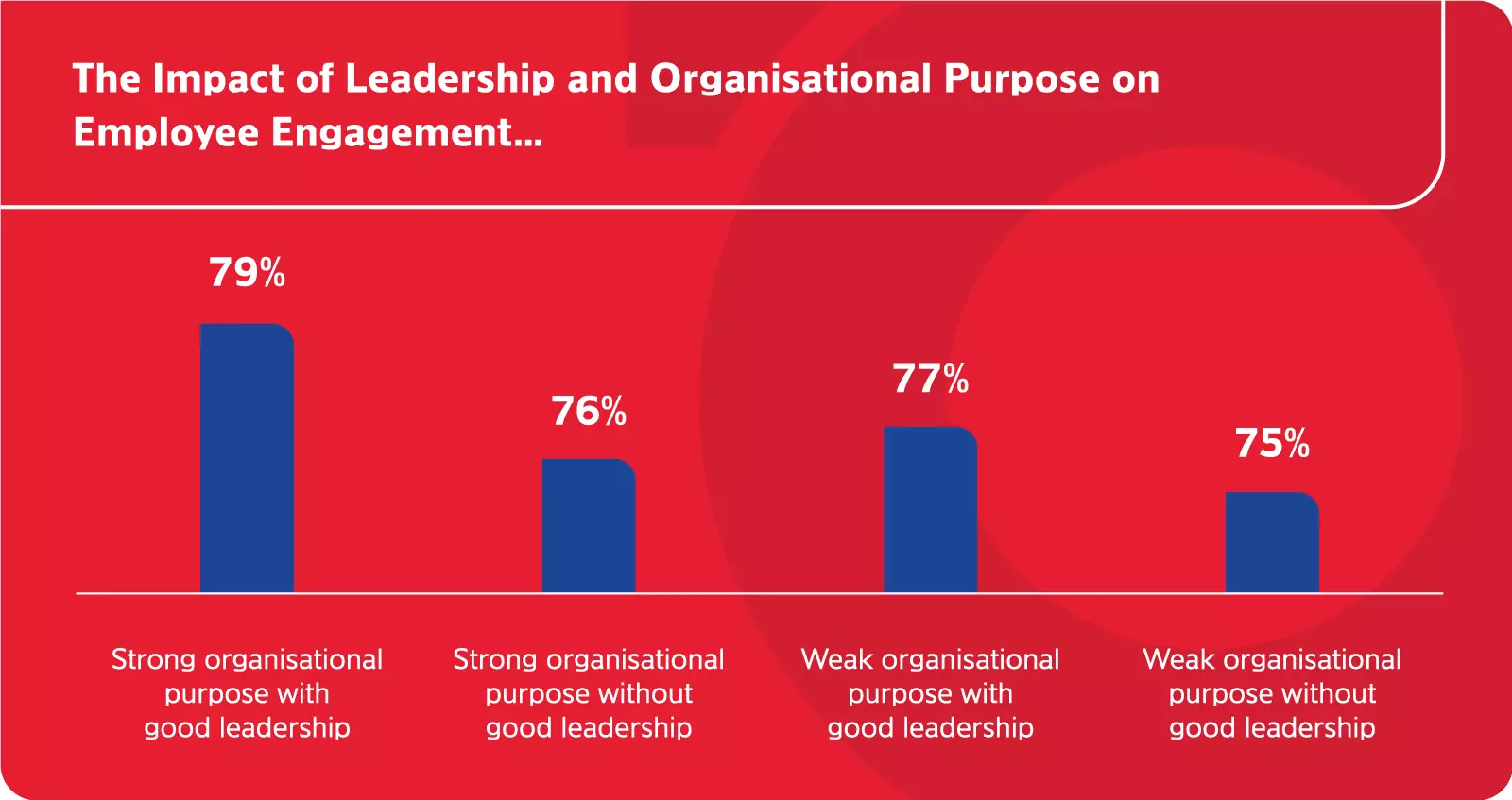
Organisational purpose is an evolving and collaborative process that demands the commitment of every employee. That leads us to our third trend. You can find all the details about this trend and more in the complete report. Download it now!
Trend 3: Dialogue for Transformation
Employees who feel genuinely listened to by the organisation are more likely to be engaged, and organisations orchestrating meaningful employee dialogues are reaping the benefits. Our latest Top Employers data shows that almost every HR practice encouraging employee involvement in strategic decisions helps to drive business success metrics.
A Dialogue for Transformation has two elements:
- On an individual level, employees need to see their input applied practically in business decisions – those who feel empowered to influence how their work gets done experience far higher performance levels and job satisfaction.
- Beyond the individual, collective intelligence describes the alchemy that happens when diverse perspectives meet collaboratively. It represents the sum of individual intelligence and the additional innovation sparked through their combination.
Empowerment plus collective intelligence has helped to drive new ideas for organisations, often above and beyond the scope of regular day-to-day business.
Moving the needle on what matters will demand ever closer and more constant conversation with employees. Transformational dialogue will be foundational for the last two trends. Download the full report to find out more.
Trend 4: Evolution of Wellbeing Effectiveness
Many organisations struggle to balance their HR budgets while still trying to enhance employee wellbeing. In 2024, therefore, wellbeing will be about getting the most suitable offerings, not the most. Research carried out by Top Employers Institute last year demonstrated that additional wellbeing programmes provided little or no additional benefit to employees beyond a saturation point.
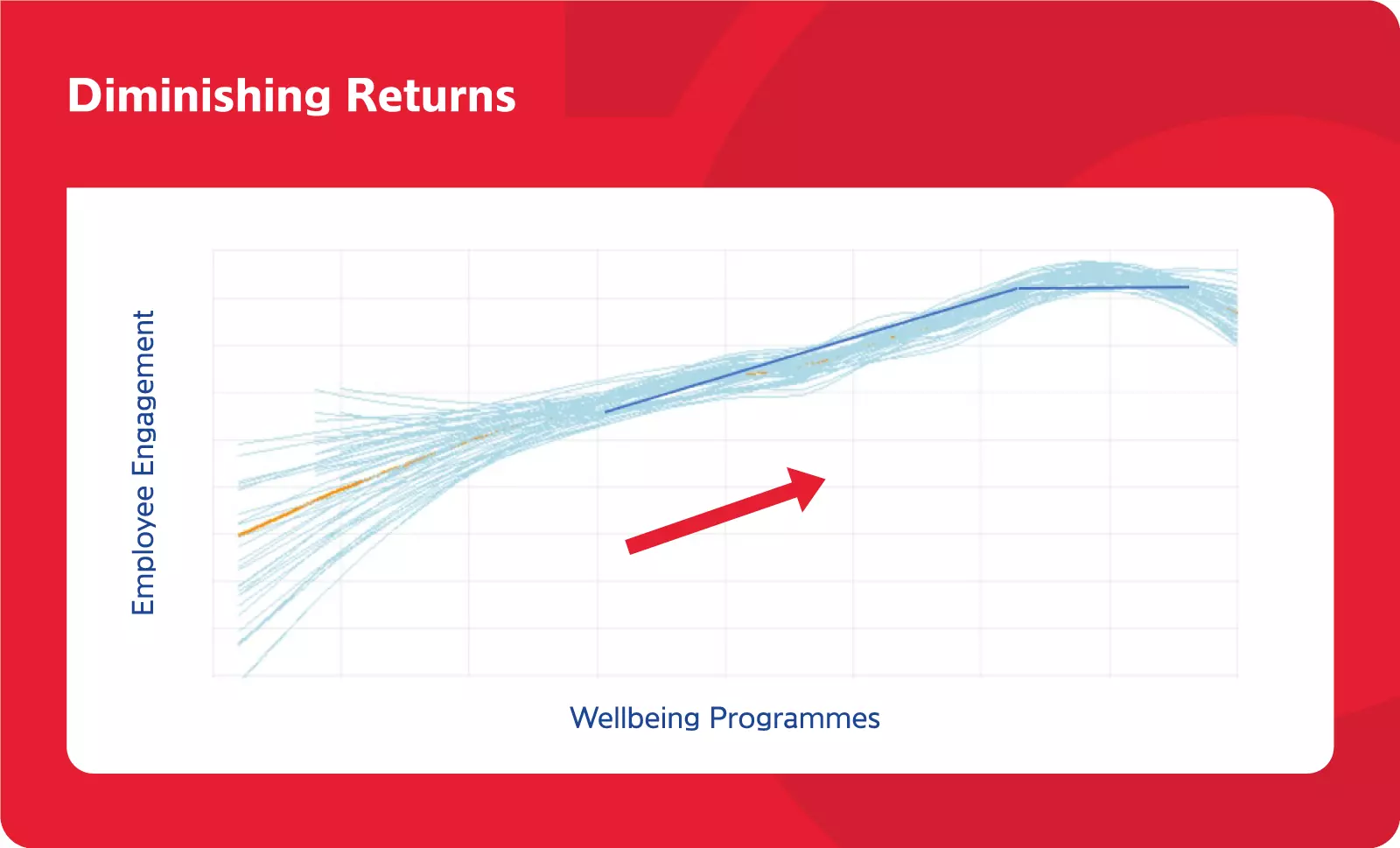
Most Top Employers actively promote their wellbeing programmes through organisation-wide strategy, assessment and metrics.
- Organisation-wide total wellbeing strategy. Nearly four in five (79%) organisations have a coherent overarching approach to all dimensions of wellbeing (up four percentage points since our last survey).
- Wellbeing programme assessment. Nearly three in four (72%) organisations regularly conduct an ’employee wellbeing needs assessment’ to identify employee needs, interests, likes and dislikes and adjust their offerings where appropriate (up five percentage points).
- Wellbeing metrics. We have also seen a significant increase in the use of metrics, with over two-thirds of our Top Employers consistently using them (68%, up eight percentage points), along with the accountability of over half (54%) of leaders to meet wellbeing targets (up seven percentage points).
With this, there may be specific wellbeing challenges for new demographics, which takes us to our final trend.
Trend 5: Broaden the Horizon of DEI
In the last year, diversity, equity, and inclusion (DEI) have also come under budgetary pressure, so organisations are looking for these initiatives to impact their workforce positively. In 2024, the tight talent market will grow as employers become more open to “non-traditional” candidates.
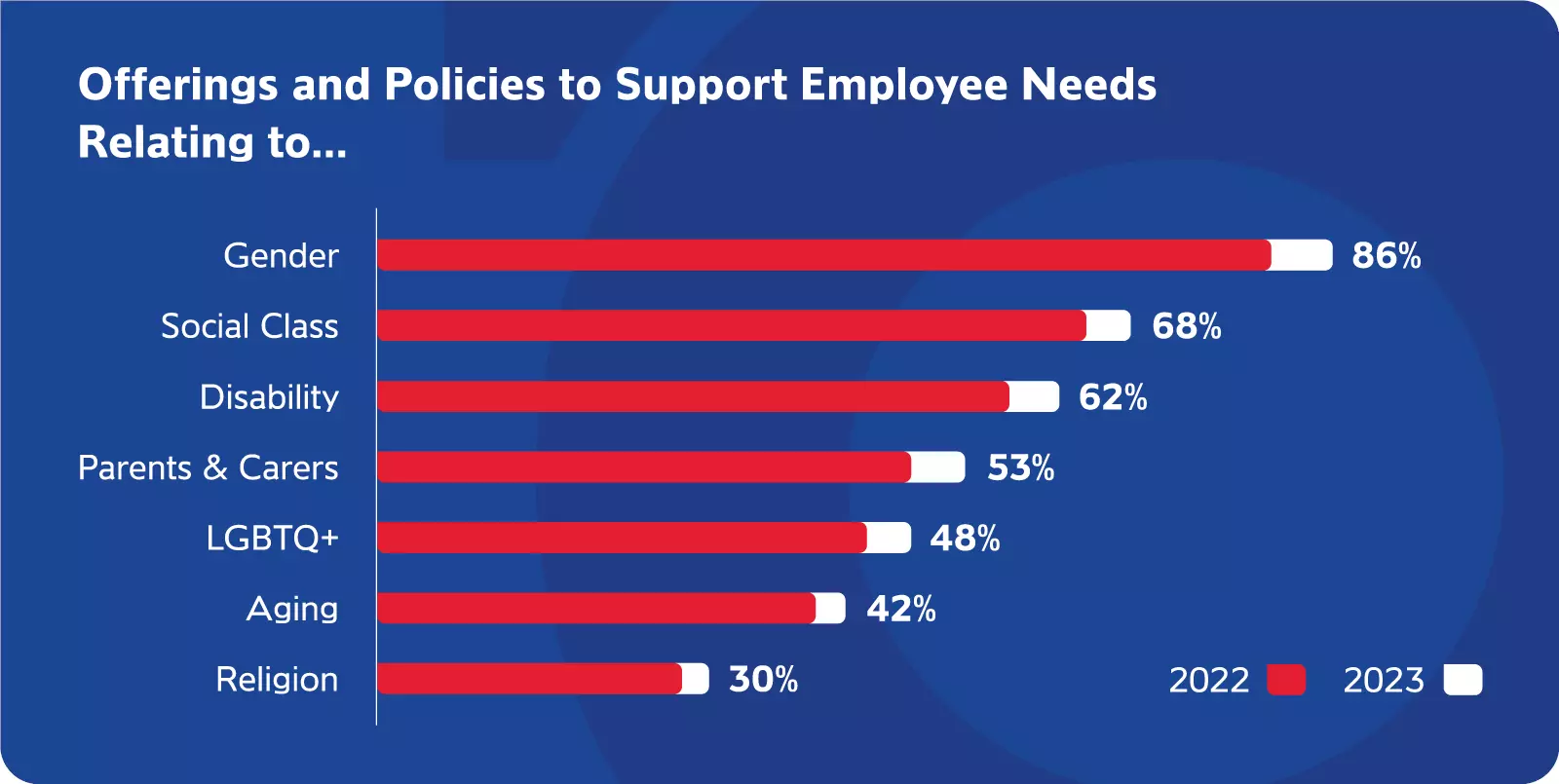
We think DEI approaches will change in three ways:
- The consideration of diversity will expand far beyond demographic segmentation. Whilst groupings, such as gender and race, will continue to be areas of focus, 2024 will see a shift towards a more nuanced approach to DEI. For example, expect the importance of neurodivergent talent (and its link to higher levels of creativity and innovation) to grow.
- DEI analytics and the metrics used will become more sophisticated. Not all demographics are straightforward to capture. However, we have learned from progress in gender representation that data is critical to improvement.
- The “majority” will be actively included in DEI strategies at some point in their career journey, with different experiences increasingly acknowledged. A more holistic inclusion strategy will likely be adopted to complement the ongoing targeted initiatives for under-represented groups.
Download a copy of The World of Work 2024 by filling out the form now.