Best Practice | Accenture Accentuates the Employee Experience
The programme “Change @ Work, Poland edition” started in 2019 as the first One Accenture initiative to promote a sense of belonging within the organisation. The programme aims to improve employee satisfaction by helping them feel more valued and connected to the organisation.
Using a dedicated AI tool, Accenture Poland engaged approximately 250 employees in real time to shape their culture of belonging. Based on extensive research, they have determined four main areas that most influence employees’ sense of belonging. Under this programme, Accenture Poland is running 15 amazing projects to shape a better world for more than 9 000 employees.
This is just a snapshot of Accenture’s innovative best practice. You can find the entire practice in our HR Best Practices database, which is exclusively available to Top Employers. Get inspiration and insight into the approach, challenges and learnings experienced by certified Top Employers. Access it now via the Top Employers Programme if you are certified or learn more about it here!
Why the practice was needed
During difficult and unpredictable times, Accenture Poland believes that leaders must act alongside younger colleagues to co-create the best solutions. Involving employees at all levels of an organisation can also help them feel engaged with the organisation in a meaningful way and could, therefore, help retain talent.
How the practice was implemented
Accenture’s Change @ Work, Poland edition consisted of three main steps:
- Accenture Poland conducted research using individual in-depth interviews with approximately 50 employees to understand the main factors that determine a feeling of belonging within Accenture.
- The analysed dataset included:
- The anonymised personal data of respondents was obtained from internal human resource management systems.
- Qualitative data – statements of respondents obtained based on the interview discussion guide.
- Quantitative data – responses to questions asked using a five-point Likert scale.
- Based on the research, the organisation designed four main activities that were most important for employees in terms of belonging.
- Using an AI tool, Remesh, Accenture Poland involved approximately 250 employees in shaping final solutions that best met employees’ expectations.
The co-creation method was used, and the initiative was run by employees for employees as a way to understand and focus on their real needs.
Results of the practice
- More than 300 employees gave feedback to shape the final solutions.
- 15 initiatives are being implemented to increase employee satisfaction.
- Accenture Poland is moving from talent consumption toward talent creation, with Gen Z pushing for this change.
Meet the New Top Employers
Earlier this year, Top Employers Institute proudly announced that over 2 300 Top Employers had received the Top Employers Certification in 2024. Those Top Employers were recognised across 121 countries and regions.
In June, we are excited to share that 58 new Regional Top Employers and one European Top Employer joined our global community of organisations committed to excellence in people practices. This recognition underscores these organisations’ commitment to fostering outstanding HR strategies and people practices globally.
As the global authority in recognising excellence in people practices, the Top Employers Institute Certification Programme is an extensive process involving an independently audited and fact-based HR Best Practices Survey and validation to ensure truthful answers. The survey covers six domains and 20 subtopics:
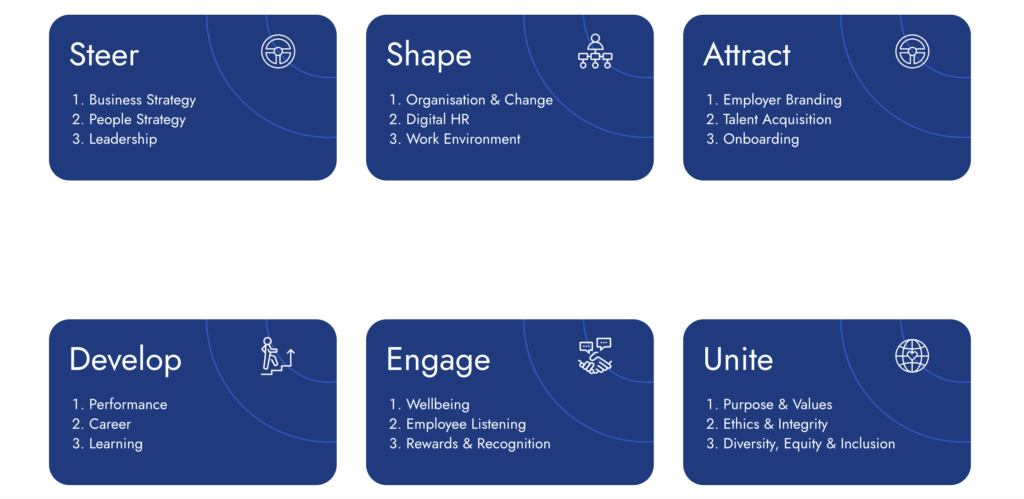
In 2023 and 2024, organisations and leaders had much to consider, with many things in flux. David Plink, CEO of Top Employers Institute, observed: “In a world where geopolitical, societal, and macro-economic developments follow each other in rapid succession, the Top Employers 2024 are showing once again that they are a beacon of stability and reliability. Top Employers have shown that despite turbulent times, their focus remains on creating the best workplace possible for their people to thrive.”
When asked what makes a Top Employer, David Plink shared: “In my 16 years with the company, there are two characteristics that I have observed consistently within the members of the Top Employers community. First, certified Top Employers go above and beyond for their people. They are the embodiment of people focus. Secondly, not a single Top Employer got certified without always striving for more. To learn, to become better and to stay curious at all times. People-focused and a growth mindset. It sounds so simple in summary, but it takes a lot to consistently live up to these principles.”
See the full list of the newly Certified Top Employers, below:
Australia
Azerbaijan
- The International Bank of Azerbaijan OJSC
Brazil
China
Colombia
Czech Republic
Denmark
Egypt
France
Germany
- Atlas Dienstleistung für Vermögensberatung GmbH
- Bayerische Beamten Lebensversicherung a.G.
Greece
- Athenian Brewery SA (Heineken)
Hungary
Italy
South Korea
Mexico
The Netherlands
Nigeria
Portugal
Saudi Arabia
Serbia
Sierra Leone
Slovakia
South Africa
- Mondi South Africa (Pty) Ltd
- Shoprite Checkers PTY LTD
Spain
Switzerland
Turkey
United Kingdom
United States
See the full list of Certified Top Employers
3 Trends Changing the Diversity Equity and Inclusion Landscape
In today’s rapidly evolving business landscape, Diversity, Equity, and Inclusion (DEI) principles are more critical than ever. In our World of Work Trend 2024, we discovered a significant shift in the prioritisation of DEI for Top Employers. Despite the challenges of 2023, there was an 18 percentage point increase in the prioritisation of DEI. This means that two in five Top Employers were continuing to prioritise DEI, a trend that underscores the growing importance of DEI in the business landscape.
As HR teams and leaders, you hold a significant role in fostering an environment that embraces these values. Understanding DEI and its benefits can transform your organisation, driving innovation, employee satisfaction, and overall success. Your actions are key to making a difference.
What is DEI?
- Diversity refers to the variety of differences among people in an organisation. These differences include race, ethnicity, gender, age, sexual orientation, disability, and education. Diversity is about recognising, respecting, and valuing the unique attributes that each individual brings to the table.
- Equity is the principle of fairness in processes and outcomes. While equality implies treating everyone equally, equity involves recognising that people have different needs, experiences, and opportunities and adjusting policies and practices accordingly. It ensures that everyone has access to the same opportunities and is not disadvantaged due to systemic barriers.
- Inclusion creates an environment where all individuals feel welcomed, respected, supported, and valued. It goes beyond simply having diverse representation to ensuring that diverse individuals are actively included in all aspects of organisational life and decision-making.
Put in simpler terms, DEI is a set of closely held values by organisations that aim to support and include different groups of individuals, including people of different races, ethnicities, disabilities, gender identification and more. It’s about creating a workplace where everyone feels valued and included.
Benefits of DEI
- Enhanced Innovation and Creativity: A diverse workforce combines many perspectives, experiences, and problem-solving approaches. This diversity of thought fosters creativity and innovation. Studies have shown that diverse teams are likelier to introduce new ideas and solutions than homogenous teams. By embracing DEI, organisations can unlock the full creative potential of their employees.
- Improved Employee Performance and Engagement: When employees feel valued and included, their job satisfaction and engagement levels rise. Inclusive workplaces are characterised by higher morale and a sense of belonging, which translate into increased productivity and performance. Employees who believe their organisation is committed to DEI are more likely to be motivated, loyal, and willing to go the extra mile.
- Greater Talent Attraction and Retention: In an increasingly competitive job market, organisations prioritising DEI have a significant advantage in attracting top talent. Job seekers today, particularly younger generations, place a high value on diversity and inclusion. A commitment to DEI signals that an organisation is forward-thinking and socially responsible, making it an attractive workplace. Additionally, inclusive workplaces tend to have lower turnover rates, saving costs for recruiting and training new employees.
- Better Decision Making: Diverse teams bring diverse perspectives and experiences, leading to more well-rounded and informed decision-making. When considering various viewpoints, organisations can identify potential pitfalls and opportunities that may have been overlooked.
- Increased Employee Innovation: An inclusive environment encourages employees to share their ideas and take risks without fear of being marginalised or dismissed. This culture of open communication and respect can lead to a higher rate of innovation and continuous improvement within the organisation.
Trends in DEI
The consideration of diversity will become intersectional and will expand far beyond single demographic segmentations
DEI initially focused on a handful of single demographic segments, such as interventions related to gender or race. While these groupings will remain focus areas, 2024 will see a shift towards a more nuanced approach to DEI. The aspects of employee identities acknowledged and welcomed in the workplace will expand.
Top employers increased their offerings and policies to better support employee needs related to disability, parents and carers, social class, educational background, LGBTQ+, and ageing in 2023. Neurodiversity was measured for the first time in our HR Best Practices Survey. While only 22% currently have specific practices or policies regarding Neurodiversity, 72% expect the importance of Neurodiversity in people’s practices to increase by 2026.
Analytics and metrics will increase in sophistication
One reason why many organisations have focused on race and gender in DEI initiatives is that it is relatively easy to measure. Not all demographics are straightforward to capture. However, we have learned from progress in gender representation that data is critical to improvement.
This information is typically gathered by encouraging respondents to voluntarily and anonymously self-identify regarding belonging to underrepresented groups. Each demographic comes with distinct challenges. For example, in specific geographies, asking employees to share LGBTQ+ identities could result in legal and physical danger.
For others, inconsistency in definitions could muddy the waters. Social class includes considering a person’s social and economic future, shaped by where they start. The parent’s educational and occupational history is sometimes used as a proxy but can also be deceptive. Resolving these obstacles will depend on an organisation’s unique context, with priority always given to employee safety, respect, and the right to define their identities rather than data clarity.
The impact of artificial intelligence on DEI
Artificial Intelligence (AI) development is poised to impact DEI initiatives within organisations profoundly. AI technologies offer numerous opportunities to enhance DEI efforts, from improving recruitment processes to ensuring fairer workplace practices. However, the integration of AI also presents challenges that must be navigated carefully to avoid reinforcing existing biases and inequalities.
AI can play a crucial role in fostering an inclusive workplace culture. AI-powered analytics can monitor and analyse employee interactions and engagement, identifying patterns that may indicate issues of exclusion or discrimination. By providing real-time insights, AI can help HR leaders address potential problems proactively and develop targeted interventions to promote inclusivity. Furthermore, AI-driven training programs can educate employees about unconscious biases and inclusive behaviours, fostering a more equitable and respectful work environment.
The deployment of AI in DEI initiatives is not without risks. If AI systems are trained on biased data or if their development lacks diverse perspectives, they can perpetuate and even exacerbate existing biases. For example, an AI tool trained on historical hiring data from a homogenous workforce may inadvertently favour candidates who resemble past hires, thus reinforcing a lack of diversity. To prevent this, organisations must implement rigorous checks and balances, including diverse teams of developers and ongoing audits of AI systems to ensure fairness and accountability.
Final Thoughts
Diversity, Equity, and Inclusion are not just buzzwords or trends but essential components of a thriving, modern organisation. Organisations can drive meaningful change by embedding DEI into the core of their organisational culture. By doing so, they can unlock many benefits, from enhanced innovation and employee engagement to improved decision-making. Embracing DEI is not just the right thing to do—it’s the smart thing to do for the future success of your organisation.
How to Build a Strong Company Culture in a Global Organisation with NTT Data
Every organisation has a culture, whether it was intentionally or passively created. A healthy workplace culture is one of the fundamental elements of a successful company. In today’s global landscape, businesses extend their operations across borders and cultivate diverse workforces. Developing and maintaining a strong culture in this context presents some unique challenges. A positive work environment benefits a company in numerous ways, which is why it is essential to build that culture rather than leave it to chance.
During our insightful conversation filled with personal anecdotes at the 2023 Top Employers Inspire event, Kim Curley, VP of People & Organisation at NTT DATA, shared valuable perspectives and actionable strategies on the art of crafting and nurturing a strong corporate culture. Kim’s role is unique in that she’s responsible for NTT DATA’s internal change management process and for the organisation’s consultancy services in that space, which she called “the personal side of business where all the wonderful messy, human things happen.” Experiencing change from the inside and managing it as a third party for other organisations has given her great insight into how to successfully build a strong culture.
Crafting a Culture
Like many companies, NTT DATA re-evaluated its priorities and values during the massive societal and workplace changes brought on by the pandemic. Kim explained, “We had been through a tremendous amount of change in the past three years and we wanted to assess what aspects of our culture had weakened that we needed to strengthen.” Trust, community, and success were the three values identified through their discussions.
The next step was deciding how to strengthen those values in their workplace culture. Kim shared that the discussion began with a guiding question: “How do we define these values that make us special and make us a place where people want to come work and a place that clients want to hire?” Three strategies emerged as important aspects of crafting their culture.
- Involve employees in developing initiatives around the three core values. If culture is not built from the ground up, it will be very difficult to enforce it from the top down.
- Create a social accountability contract. Foster a sense of responsibility among employees to embody and uphold the core values.
- Anchor to a career coach model. Resources extend beyond hierarchical, mentor-like relationships to help employees develop across the different roles they hold as consultants and over the arc of their careers.
Download Now: Navigating a Dynamic Workforce
Overcoming Common Challenges
Mindset
Changing people’s mindsets is one of organisations’ most significant challenges when implementing new initiatives. “It takes a tremendous amount of energy not only from the people trying to encourage the change but also from the brave souls trying to make the change. That’s always the hardest part, to be a supporter and to step into that new space,” said Kim. This process was an excellent opportunity to lean on the social accountability contract and encourage employees to support one another as they adapted.
Silos
Silos are another familiar challenge companies face, and this challenge becomes even more pronounced when a company operates on a global scale. One of the significant problems posed by silos is their potential to impede the growth of a company-wide culture. To confront this issue head-on, Kim’s team developed a proactive strategy. She described their process, “We look at what our company values mean for each team. What can be done to make these values come to life in our individual geographies, business units, and ways of working?” For example, the community looks very different for a team co-located in the same geographic area with an office space than for a remote team working from different countries. Community is equally essential in both scenarios, though initiatives to cultivate a sense of community will look very different.
Organisational Hurdles
Aligning policies and procedures with company culture is essential to NTT DATA’s success. “When you’re trying to change culture, one of the things that will trip you up the fastest is if the organisational elements of your business do not support the cultural change,” Kim said to elaborate on this point. Changes to a company’s infrastructure have far-reaching effects and can either support or hinder how the culture evolves. Therefore, it is critical to be intentional about company policies and structure them in a way that supports the culture.
Read More: Virtusa’s Talent Digital Transformation
A Continuous Process
Kim compared their approach to caring for a garden to summarise how her team fosters a strong company culture. “You have to constantly nurture it to help it grow and be very aware of what you add to it,” she explained. Ultimately, a positive company culture is a constant work in progress. Although building it requires time and effort, the long-lasting benefits are immense. Low turnover rates, boosted productivity, and high morale are all results that help a company achieve success.
One of the things I enjoyed most about our discussion was hearing about Kim’s personal experience with NTT DATA’s cultural changes and how those changes impacted her daily workflow and her relationships with colleagues. I encourage readers to check out our full conversation for even more insights and a personal perspective on what a strong culture can mean to employees.
Watch the video on our YouTube channel now!
Haier Europe: Elevating its People Practices with the Top Employers Programme
About Haier Europe
Haier Europe is a global leader in home appliances and consumer electronics, recognised for 15 consecutive years as the world’s No.1 brand globally in major appliances, selling under the Candy, Hoover and Haier brands. The organisation comprises of 750 colleagues in the UK&I and 100,000 globally.
Haier Europe’s Top Employers Journey
Haier Europe had been on an improvement journey, investing heavily in people systems, processes and benefits and whilst colleagues inside the business would have seen the transformation, they wanted to receive external recognition in order to attract great talent, and give candidates the confidence to know that they had been certified by an external, independent validation process. They therefore joined the Top Employers Certification Programme, and following completion of the HR Best Practices Survey and Validation Process, were certified as a UK Top Employer 2023.
Elevating its People Practices
“We have definitely seen the profile of our employer brand increase, we see our candidate numbers are very strong and our retention figures are improving in key areas, but the most important outcome from joining the Top Employers Programme is that it has really made Haier Europe a better workplace for our colleagues because it has given us the impetus and direction to keep improving.” Matthew Given, Group HR Director UK & Ireland, Haier Europe
Having achieved Top Employer Certification in year one, the Haier Europe team immediately started work on its action plan to further improve its HR, using the Top Employers Results Dashboard. They did this by:
- Having a dedicated team of specialists within the HR team working on the Top Employers Certification project.
- Aligning the Top Employers HR Best Practices Survey topics and results with the action plans and choosing focus areas which would add most value to the business.
- Regularly reviewing with the team each quarter to ensure that improvements were being made within these focus areas.
Impressive results
In year two, following on from the action planning, Haier Europe increased their score on the Top Employers Best Practices Survey by 20% points.
They had prioritised Employee Listening, wellbeing and DEI, with the new colleague listening strategy bringing great insights and making sure that they really understood how colleagues felt about the business and its programmes. They also mapped, explored and improved many more colleague and candidate journeys.
The leadership team has also taken notice of the tremendous progress and are now championing many new initiatives across engagement, wellbeing and DEI.
Best Practice | Virtusa’s Talent Digital Transformation
Certified Top Employer, Virtusa, committed to an 18-month-long HR digital transformation to dramatically change the digital experience for their employees, covering everything from recruiting and onboarding to learning and development, inclusion, and rewards. The organisation did not simply make small incremental changes; they reimagined all their processes and radically transformed them into a single, fully integrated, hyper-personalised employee platform.
This is just a snapshot of Virtusa’s innovative best practice. You can find the entire practice in our HR Best Practices database, which is exclusively available to Top Employers. Get inspiration and insight into the approach, challenges and learnings experienced by certified Top Employers. Access it now via the Top Employers Programme if you are certified or learn more about it here!
Why the practice was needed:
Although technology is at the core of their business, Virtusa struggled to make technology work correctly for their employees. They had too many disjointed systems that were not creating a seamless employee experience. The systems were not driving engagement or speaking to one another. Eranga Pathirage, VP & Head of HR for the UK, Europe, and the Middle East + the Global Head of HR Tech Transformation, helped the organisation dramatically improve its talent understanding and engagement through a digital HR transformation.
Pathirage recalls that they already had all this valuable data about their 35 000 employees across 25 countries. As a provider of technical services, they respected and knew the power of technology. They saw a solution in centring the relationship between technology and their employees to drive adoption and employee loyalty.
Read More: Best Practice | Momentum Metropolitan’s Offboarding Practice
How they implemented the practice:
Pathirage recalls that the most challenging part of their HR digital transformation was the beginning, as he and his team wanted to be bold and did not know exactly how to start; they wanted to involve everyone in the business and obtain their buy-ins as well. Pathirage and his team took on the enormous task of reviewing all their processes to truly reimagine a digital solution offering their people an optimal employee experience. As he explained, they were not making incremental changes to some of their HR systems but instead re-hauling the entire process. In thinking through the right solution then, they followed some important grounding principles:
- There would be one single source of truth.
- Their HR digital solution would be fully integrated within Virtusa’s IT system.
- The technology they picked would also give the company the ability to evolve. The technology selected and implemented should allow Virtusa to stay agile and guide the business accordingly.
- As a technology services organisation, Virtusa also wanted to put technology first.
With these grounding principles, the organisation set out to pick a Software as a Service (SaaS) solution for each element of the employee experience. The solution as a whole was born in the cloud.
Download Now: World of Work Trends 2024
The results of implementing the practice
The results of this HR digital transformation can already be seen. The company now has an AI chatbot to assist in a personalised candidate experience, providing a consistent company story for prospective employees. SkillPrism, powered by AI, can create an employee profile from multiple data points to fully understand competencies within the business. The company can now also offer a personalised learning journey for their employees and, through Edge, can offer their own internal “LinkedIn,” giving each employee one to three personalised job openings across customers, domains, and countries.
Once this digital solution was offered, Virtusa employees adopted it quickly, with an 85% adoption rate in the first two weeks.
Learn more about the Top Employers Certification here.