Best Practice | UST’s Step IT Up Programme
Step IT Up, a UST proprietary programme, helps organisations hire more diverse employees by directly addressing the global IT skills gap. The programme offers underrepresented candidates a customised four- to seven-month curriculum focusing on technology careers. Graduates can enter a new job market with a higher salary promise. UST client companies benefit from the programme by creating a more diverse and inclusive workforce.
Why the practice was needed
Computer Science graduates have surpassed engineering graduates as the highest-paid undergraduates right out of university, but in the United States in 2021, only about 21% of Computer Science majors are women. In another study, they found that when you look at Computer Science majors by ethnicity, 64.2% are White, 18.8% are Asian, 6.9% are Latino, and 4.2% are Black
Additionally, about 10 years ago, UST also noticed that even Computer Science majors weren’t necessarily receiving the same number of focused learning hours needed to be effective in entry-level IT positions; typical (American) undergraduate education offers classes more generally, covering several topics. New IT hires must go through months of on-the-job training to be more effective in their work.
UST realised they needed to change the landscape and focus on a talent pool outside of Computer Science. They started looking at graduates with more general academic backgrounds and have created a new talent pool from which to hire.
This is just a snapshot of UST’s innovative best practice. You can find the entire practice in our HR Best Practices database, which is exclusively available to Top Employers. Get inspiration and insight into the approach, challenges and learnings experienced by certified Top Employers.
How the practice was implemented
The Step IT Up training programme was created about 10 years ago and has been successful ever since. UST’s idea is to find, recruit, pay, and train candidates who have graduated from four-year degree programmes and help place them within their client companies.
Details on Recruiting
Candidates for the programme are recruited within the geographical area in which the client companies would like them to work. The client company usually specifies what types of candidates they’d like to consider and the requirements for the role. UST then sets out to find applicants for a new programme. Candidates are usually recruited through UST’s Alumni network, partner organisations, military bases and other outside referrals. Each applicant passes an assessment test that measures reading, math and analytics. If candidates do well on the assessment, they move on to the interview phase with both UST and the client company, and together, they select who will join the programme.
Details on Programme Participation
The UST programme is different from some others in the market in that they try to eliminate any financial obstacles candidates may face to enter the programme; candidates are guaranteed a job if they start the programme and are paid from the start of their training. Wages vary depending on geographic area, but the goal is to give them space to focus and study for the programme when enrolled. Once they’ve completed the training, candidates are given a salary increase. When they are hired into the client company, they receive a higher salary upon conversion.
This programme and the skill set earned will also set a candidate up for the potential of a six-figure salary in the future as they have entered into an industry that they may not have otherwise considered. All participants finish as technologists with the equivalent of a Computer Science degree.
Details on the Programme
- The Step IT Up programmes are given onsite and virtually.
- UST has executed the programme across the US, Europe, Asia, Australia and Central America.
- Each training programme has an instructor with collegiate and industry experience and a Coach/Mentor.
- Training can run from four to seven months, depending on the skill set requested from the client company.
- The training programme is customised; UST uses a curriculum the client company has looked at and approved for an entry-level job.
- The client company adds their software tools to the curriculum.
- The programme usually runs with homework assignments from 8:00 to 17:00 from Monday to Friday.
- To pass, candidates need at least a 70% overall and to successfully complete a final capstone project.
Results of the practice
- Many women and other minority groups have been able to work in a field they did not otherwise think was for them, either due to a lack of positive role models in IT or advice/guidance to the contrary. These programme graduates help break stereotypes and break down barriers in the industry by offering a new and different voice.
- 90% of the individuals who start training graduate from the programme.
- 87% of those who start to work onsite at a client company get converted/hired directly after 12 months.
You can also learn more about UST’s social and DEI efforts in the video below.
Best Practice | Accenture Accentuates the Employee Experience
The programme « Change @ Work, Poland edition » started in 2019 as the first One Accenture initiative to promote a sense of belonging within the organisation. The programme aims to improve employee satisfaction by helping them feel more valued and connected to the organisation.
Using a dedicated AI tool, Accenture Poland engaged approximately 250 employees in real time to shape their culture of belonging. Based on extensive research, they have determined four main areas that most influence employees’ sense of belonging. Under this programme, Accenture Poland is running 15 amazing projects to shape a better world for more than 9 000 employees.
Why the practice was needed
During difficult and unpredictable times, Accenture Poland believes that leaders must act alongside younger colleagues to co-create the best solutions. Involving employees at all levels of an organisation can also help them feel engaged with the organisation in a meaningful way and could, therefore, help retain talent.
How the practice was implemented
Accenture’s Change @ Work, Poland edition consisted of three main steps:
- Accenture Poland conducted research using individual in-depth interviews with approximately 50 employees to understand the main factors that determine a feeling of belonging within Accenture.
- The analysed dataset included:
- The anonymised personal data of respondents was obtained from internal human resource management systems.
- Qualitative data – statements of respondents obtained based on the interview discussion guide.
- Quantitative data – responses to questions asked using a five-point Likert scale.
- Based on the research, the organisation designed four main activities that were most important for employees in terms of belonging.
- Using an AI tool, Remesh, Accenture Poland involved approximately 250 employees in shaping final solutions that best met employees’ expectations.
The co-creation method was used, and the initiative was run by employees for employees as a way to understand and focus on their real needs.
Results of the practice
- More than 300 employees gave feedback to shape the final solutions.
- 15 initiatives are being implemented to increase employee satisfaction.
- Accenture Poland is moving from talent consumption toward talent creation, with Gen Z pushing for this change.
HR Practices to Elevate Your Workforce: Insights from Asia-Pacific’s Top Employers 2024
This year, we’ve certified 369 organisations in Asia-Pacific as Top Employers, and we have curated a selection of best practices from these esteemed organisations to inspire you. In this comprehensive resource, you’ll find insights and exemplary practices that have not only raised the global standard of HR excellence but also set the benchmark for others to follow.
Download the ebook now to uncover invaluable insights. Here are some highlights you’ll find inside:
- Learning and Development – Discover how AstraZeneca fosters a culture of lifelong learning to support its 2030 Bold Ambition. Learn how their 3Es Learning Framework (Experience, Exposure, and Education) empowers employees to embrace a ‘learning mindset,’ focusing on real-time application and long-term development through coaching and feedforward. Explore how initiatives like Degreed, P100, LEAP 50, and the Accelerate program enhance skills, broaden perspectives, and accelerate leadership development. Discover how AstraZeneca’s commitment to everyday development experiences drives innovation and delivers life-changing medicines to patients, reflected in high engagement scores and strong business performance.
- Onboarding – Discover how NN Life Insurance Japan has transformed its onboarding process by integrating digital tools with personal communication. Learn how new hires benefit from instant access to essential information and e-learning resources, coupled with personal interactions such as welcome sessions with senior management. Explore how these efforts enhance talent retention and engagement by fostering strong connections within the organization.
- Performance – Discover how Lyreco Thailand’s Performance Development Review (PDR) promotes ongoing learning and development. Learn how this holistic procedure integrates self-assessments, open communication, constructive feedback, and personalized development plans to align individual goals with company objectives. Explore how Lyreco’s PDR process, implemented through the Workday platform, has enhanced employee growth, reduced turnover, and increased engagement and satisfaction.
- Sustainability – Discover how CHEP Australia fosters a culture of sustainability throughout the employee lifecycle. Learn how their sustainable practices are embedded from recruitment to onboarding and beyond, promoting a nature-positive economy through their pooling model. Explore initiatives like their annual Sustainability Week and Helping Hands program, which support employee engagement and community involvement, contributing to their ambitious sustainability goals.
- Leadership – Discover how Servier Philippines anchors its leadership on the company value of CARE, fostering a highly inclusive and psychologically safe working environment. Learn how their transformation journey prioritizes acting on feedback, with initiatives like « You spoke, we listened » promoting open communication and continuous improvement. Explore how their psych safety training programs and workshops have built trust and collaboration, leading to high engagement and recognition as a Top Employer.
- Talent Acquisition – Discover how GSK Indonesia’s Talent Pipeline strategy shifts from reactive to proactive recruiting, building relationships with passive external talent for future opportunities. Learn how this approach has streamlined the hiring process, reduced costs, and improved the quality of hires. Explore the steps of identifying, assessing, and engaging potential candidates, ensuring a ready pool of talent for critical roles.
- Career Development – Discover how DLMI Malaysia supports employee career development through initiatives like Personal Development Plans, continuous dialogue, and career coaching programs. Learn how their internal digital career marketplace facilitates mobility and advancement, enhancing employee engagement and satisfaction. Explore how their annual Talent Reviews and Succession Planning process ensure the development of talents for critical leadership roles.
- Offboarding – Discover how GEP India’s Alumni Network on LinkedIn keeps ex-employees connected to the organization. Learn how this professional network facilitates brand advocacy, rehiring of boomerang employees, and networking opportunities. Explore how GEP maintains relationships with former employees through engaging content and periodic alumni events.
Meet the New Top Employers
Earlier this year, Top Employers Institute proudly announced that over 2 300 Top Employers had received the Top Employers Certification in 2024. Those Top Employers were recognised across 121 countries and regions.
In June, we are excited to share that 58 new Regional Top Employers and one European Top Employer joined our global community of organisations committed to excellence in people practices. This recognition underscores these organisations’ commitment to fostering outstanding HR strategies and people practices globally.
As the global authority in recognising excellence in people practices, the Top Employers Institute Certification Programme is an extensive process involving an independently audited and fact-based HR Best Practices Survey and validation to ensure truthful answers. The survey covers six domains and 20 subtopics:
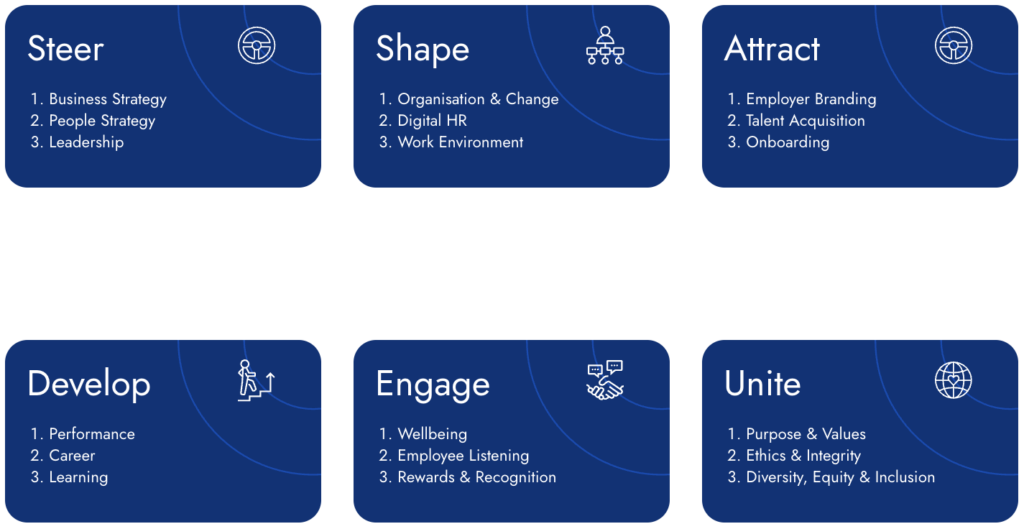
In 2023 and 2024, organisations and leaders had much to consider, with many things in flux. David Plink, CEO of Top Employers Institute, observed: “In a world where geopolitical, societal, and macro-economic developments follow each other in rapid succession, the Top Employers 2024 are showing once again that they are a beacon of stability and reliability. Top Employers have shown that despite turbulent times, their focus remains on creating the best workplace possible for their people to thrive.”
When asked what makes a Top Employer, David Plink shared: “In my 16 years with the company, there are two characteristics that I have observed consistently within the members of the Top Employers community. First, certified Top Employers go above and beyond for their people. They are the embodiment of people focus. Secondly, not a single Top Employer got certified without always striving for more. To learn, to become better and to stay curious at all times. People-focused and a growth mindset. It sounds so simple in summary, but it takes a lot to consistently live up to these principles.”
See the full list of the newly Certified Top Employers, below:
Australia
Azerbaijan
- The International Bank of Azerbaijan OJSC
Brazil
China
Colombia
Czech Republic
Denmark
Egypt
France
Germany
- Atlas Dienstleistung für Vermögensberatung GmbH
- Bayerische Beamten Lebensversicherung a.G.
Greece
- Athenian Brewery SA (Heineken)
Hungary
Italy
South Korea
Mexico
The Netherlands
Nigeria
Portugal
Saudi Arabia
Serbia
Sierra Leone
Slovakia
South Africa
- Mondi South Africa (Pty) Ltd
- Shoprite Checkers PTY LTD
Spain
Switzerland
Turkey
United Kingdom
United States
3 tendances qui modifient le paysage de la diversité, de l’équité et de l’inclusion
Dans le paysage commercial actuel, qui évolue rapidement, les principes de diversité, d’équité et d’inclusion (DEI) sont plus essentiels que jamais. Dans notre rapport World of Work Trend 2024, nous avons découvert un changement significatif dans la priorité accordée à l’IED par les principaux employeurs. Malgré les défis de 2023, la priorité accordée à l’IED a augmenté de 18 points de pourcentage. Cela signifie que deux Top Employers sur cinq continuent à donner la priorité à l’IED, une tendance qui souligne l’importance croissante de l’IED dans le paysage des entreprises.
En tant qu’équipes et responsables des ressources humaines, vous avez un rôle important à jouer dans la promotion d’un environnement qui adhère à ces valeurs. La compréhension de l’IED et de ses avantages peut transformer votre organisation, en favorisant l’innovation, la satisfaction des employés et la réussite globale. Vos actions sont essentielles pour faire la différence.
Qu’est-ce que l’IED ?
- Ladiversité fait référence à la variété des différences entre les personnes au sein d’une organisation. Ces différences comprennent la race, l’origine ethnique, le sexe, l’âge, l’orientation sexuelle, le handicap et l’éducation. La diversité consiste à reconnaître, à respecter et à valoriser les attributs uniques que chaque individu apporte.
- L’équité est le principe de justice dans les processus et les résultats. Alors que l’égalité implique de traiter tout le monde de la même manière, l’équité implique de reconnaître que les personnes ont des besoins, des expériences et des opportunités différents et d’ajuster les politiques et les pratiques en conséquence. Elle garantit que chacun a accès aux mêmes opportunités et n’est pas désavantagé par des barrières systémiques.
- L’inclusion crée un environnement dans lequel tous les individus se sentent accueillis, respectés, soutenus et valorisés. Elle va au-delà d’une simple représentation diversifiée et garantit que les individus divers sont activement inclus dans tous les aspects de la vie de l’organisation et de la prise de décision.
En termes plus simples, l’IED est un ensemble de valeurs étroitement liées aux organisations qui visent à soutenir et à inclure différents groupes d’individus, y compris des personnes de races, d’ethnies, de handicaps, d’identifications sexuelles différentes, etc. Il s’agit de créer un lieu de travail où chacun se sent valorisé et inclus.
Avantages de l’IED
- Amélioration de l’innovation et de la créativité : Une main-d’œuvre diversifiée combine de nombreuses perspectives, expériences et approches de résolution de problèmes. Cette diversité de pensée favorise la créativité et l’innovation. Des études ont montré que les équipes diversifiées sont plus susceptibles d’introduire de nouvelles idées et solutions que les équipes homogènes. En adoptant l’IED, les organisations peuvent libérer tout le potentiel créatif de leurs employés.
- Amélioration des performances et de l’engagement des employés : Lorsque les employés se sentent valorisés et intégrés, leur satisfaction au travail et leur niveau d’engagement augmentent. Les lieux de travail inclusifs se caractérisent par un moral plus élevé et un sentiment d’appartenance, qui se traduisent par une productivité et des performances accrues. Les employés qui pensent que leur organisation est engagée dans l’IED sont plus susceptibles d’être motivés, loyaux et prêts à faire des efforts supplémentaires.
- Attraction et rétention accrues des talents: Sur un marché de l’emploi de plus en plus concurrentiel, les organisations qui accordent la priorité à l’IED disposent d’un avantage significatif pour attirer les meilleurs talents. Les demandeurs d’emploi d’aujourd’hui, en particulier les jeunes générations, accordent une grande importance à la diversité et à l’inclusion. Un engagement en faveur de l’IED indique qu’une organisation est tournée vers l’avenir et socialement responsable, ce qui en fait un lieu de travail attrayant. En outre, les lieux de travail inclusifs ont tendance à avoir des taux de rotation plus faibles, ce qui permet d’économiser les coûts de recrutement et de formation des nouveaux employés.
- Une meilleure prise de décision : Des équipes diversifiées apportent des perspectives et des expériences variées, ce qui permet de prendre des décisions plus équilibrées et mieux informées. En prenant en compte différents points de vue, les organisations peuvent identifier des écueils potentiels et des opportunités qui auraient pu être négligées.
- Innovation accrue des employés : Un environnement inclusif encourage les employés à partager leurs idées et à prendre des risques sans craindre d’être marginalisés ou rejetés. Cette culture de la communication ouverte et du respect peut conduire à un taux plus élevé d’innovation et d’amélioration continue au sein de l’organisation.
Tendances en matière d’IED
La prise en compte de la diversité deviendra intersectionnelle et s’étendra bien au-delà des segmentations démographiques uniques
L’IED s’est d’abord concentrée sur une poignée de segments démographiques uniques, tels que les interventions liées au sexe ou à la race. Même si ces groupes resteront des domaines d’intérêt, 2024 verra une évolution vers une approche plus nuancée de l’IED. Les aspects de l’identité des employés reconnus et accueillis sur le lieu de travail s’élargiront.
En 2023, les meilleurs employeurs ont augmenté leurs offres et leurs politiques pour mieux soutenir les besoins des employés liés au handicap, aux parents et aux soignants, à la classe sociale, au niveau d’éducation, aux LGBTQ et au vieillissement. La neurodiversité a été mesurée pour la première fois dans notre enquête sur les meilleures pratiques RH. Alors que seulement 22 % des personnes interrogées ont actuellement des pratiques ou des politiques spécifiques concernant la neurodiversité, 72 % s’attendent à ce que l’importance de la neurodiversité dans les pratiques des personnes augmente d’ici à 2026.
Les analyses et les mesures seront de plus en plus sophistiquées
L’une des raisons pour lesquelles de nombreuses organisations se sont concentrées sur la race et le sexe dans les initiatives d’IED est qu’ils sont relativement faciles à mesurer. Toutes les données démographiques ne sont pas faciles à saisir. Toutefois, les progrès réalisés en matière de représentation des sexes nous ont appris que les données sont essentielles à l’amélioration.
Ces informations sont généralement recueillies en encourageant les personnes interrogées à s’identifier volontairement et anonymement comme appartenant à des groupes sous-représentés. Chaque groupe démographique présente des défis distincts. Par exemple, dans certaines régions, le fait de demander aux employés de partager leur identité LGBTQ peut entraîner des risques juridiques et physiques.
Pour d’autres, l’incohérence des définitions peut brouiller les pistes. La classe sociale comprend la prise en compte de l’avenir social et économique d’une personne, déterminé par ses origines. Les antécédents scolaires et professionnels des parents sont parfois utilisés comme indicateur, mais ils peuvent aussi être trompeurs. La résolution de ces obstacles dépendra du contexte propre à chaque organisation, la priorité étant toujours donnée à la sécurité, au respect et au droit des employés à définir leur identité plutôt qu’à la clarté des données.
L’impact de l’intelligence artificielle sur l’IED
Le développement de l’intelligence artificielle (IA) est sur le point d’avoir un impact profond sur les initiatives d’IED au sein des organisations. Les technologies de l’IA offrent de nombreuses possibilités de renforcer les efforts d’IED, qu’il s’agisse d’améliorer les processus de recrutement ou de garantir des pratiques plus équitables sur le lieu de travail. Toutefois, l’intégration de l’IA présente également des défis qu’il convient de relever avec prudence afin d’éviter de renforcer les préjugés et les inégalités existants.
L’IA peut jouer un rôle crucial dans la promotion d’une culture d’entreprise inclusive. Les analyses alimentées par l’IA peuvent surveiller et analyser les interactions et l’engagement des employés, en identifiant des modèles qui peuvent indiquer des problèmes d’exclusion ou de discrimination. En fournissant des informations en temps réel, l’IA peut aider les responsables des ressources humaines à aborder les problèmes potentiels de manière proactive et à élaborer des interventions ciblées pour promouvoir l’inclusivité. En outre, les programmes de formation pilotés par l’IA peuvent sensibiliser les employés aux préjugés inconscients et aux comportements inclusifs, favorisant ainsi un environnement de travail plus équitable et plus respectueux.
Le déploiement de l’IA dans les initiatives d’IED n’est pas sans risque. Si les systèmes d’IA sont formés sur des données biaisées ou si leur développement manque de perspectives diverses, ils peuvent perpétuer et même exacerber les préjugés existants. Par exemple, un outil d’IA formé sur des données historiques d’embauche d’une main-d’œuvre homogène peut, par inadvertance, favoriser les candidats qui ressemblent aux anciens employés, renforçant ainsi le manque de diversité. Pour éviter cela, les organisations doivent mettre en place des contrôles rigoureux, y compris des équipes de développeurs diversifiées et des audits continus des systèmes d’IA pour garantir l’équité et la responsabilité.
Réflexions finales
La diversité, l’équité et l’inclusion ne sont pas seulement des mots à la mode ou des tendances, mais des composantes essentielles d’une organisation prospère et moderne. Les organisations peuvent conduire des changements significatifs en intégrant l’IED au cœur de leur culture organisationnelle. Ce faisant, elles peuvent dégager de nombreux avantages, allant de l’amélioration de l’innovation et de l’engagement des employés à l’amélioration de la prise de décision. Adopter l’IED n’est pas seulement la bonne chose à faire, c’est la chose intelligente à faire pour le succès futur de votre organisation.
The Impact of Leadership and Organisational Purpose on Employee Engagement
The recognition of the growing impact of organisational purpose on employee engagement has not just risen significantly over the last few years but has become a key trend shaping the future of work. It is no longer new for Top Employers to have clear commitments to a ‘positive impact’ on the world. In our World of Work Trends Report 2023, we identified that the importance of a ‘lived’ purpose—one that comes straight from the heart of those within the organisation—would become a constant in everyday business decisions.
In our latest research, in our World of Work Trends 2024, we dived deeper into this trend as we recognised that organisations that provide opportunities for employees to reflect on their sense of purpose and connect this to that of the organisation enjoy higher engagement, revenue growth, and profitability. It’s not surprising that 2023 saw an eight-percentage point increase in adopting this practice among Top Employers.
The importance of organisational purpose and leadership
Looking at this year, we saw that this trend continues to evolve, especially as the world becomes increasingly unpredictable and trust in traditional institutions is declining. For example, trust in government and journalists is low (41%, 47%), while trust in CEOs currently sits at 64%.
This context is of interest to us in this article. The link between employee and organisational purpose is becoming more important and equally challenging as further disruption in the world affects the workplace and workplace values become increasingly diverse. In this changing environment, it will be the leaders within organisations who will be tasked with navigating this complex world and transforming company values into action.
We identified that organisations will only see employee engagement and financial benefits from a strong organisational purpose if they have the right leaders in place to bring it to life. Purpose-driven leadership will be critical to success in 2024 and beyond.
The impact of leadership and organisational purpose on employee engagement in numbers
We analysed the relationship between organisational strength and organisational purpose and collected information about employee engagement in 1 860 Top Employers. We found the following:
- Companies with strong organisational purpose and good leadership had employee engagement rates of 79%.
- Companies with strong organisational purpose without good leadership had employee engagement rates of 76%.
- Companies with weak organisational purpose and good leadership had employee engagement rates of 79%.
- Companies with weak organisational purpose without good leadership had employee engagement rates of 75%.
It is clear that leadership has a clear impact on how organisational purpose is felt and how that affects employee engagement rates. Therefore, we need to investigate what employees really want from their leaders. What makes employees trust their leaders?
What makes a great leader?
People are different, and what they want from their leaders reflects this difference, but there are still similarities in what people now expect from them. On big-picture issues, they want leaders to have a perspective beyond immediate business concerns. 60% of employees are interested in hearing their CEO speak about controversial social and political issues that they care about. It is now common for employees to closely review the actions and opinions of their leaders to see how they align with organisational values.
But empathy is really at the heart of purpose-driven leadership. When employees were asked about the criteria they used to decide who to trust, 79% cited empathy as a deciding factor.
Empathy as the Key Factor
It is clear that empathy stands out as a critical leadership skill. Empathy is the ability to understand and share the feelings of another. For people wanting to become empathetic leaders, here are key strategies to aid in this transformation:
- Active Listening: Empathy starts with listening, and leaders who want to develop this skill need to take the time to proactively listen to their employees. That involves being fully present, understanding, responding, and remembering what employees say and share.
- Open Communication Channels: Leaders must create an environment where open communication is encouraged and valued. This work can be done with regular check-ins and multiple feedback channels.
- Recognition and Validation: Recognising employees’ hard efforts is a powerful tool for leaders to show empathy. Leaders should be trained to acknowledge both their team members’ achievements and emotional states. This validation helps employees feel seen and appreciated, boosting morale and engagement.
- Conflict Resolution Skills: Empathetic leaders are skilled at resolving conflicts in a way that respects all parties involved. Training leaders in conflict resolution techniques can help them navigate disputes with sensitivity and fairness, ensuring that all voices are heard and considered.
- Feedback with Compassion: Providing constructive feedback is essential, but doing so with empathy makes a significant difference. Leaders should be trained to deliver feedback in a supportive way that focuses on growth rather than criticism. This involves balancing honesty with kindness and offering actionable suggestions for improvement.
- Leading by Example: Finally, leaders must lead by example. Demonstrating empathy in their interactions sets a standard for the entire organization. When leaders consistently act with empathy, it becomes a core part of the company culture, influencing the behaviour of employees at all levels.
Final Thoughts
Empathy in leadership is the cornerstone of an inclusive and effective workplace. Organisational purpose is an evolving, collaborative process that demands the lived commitment of every employee. Without authentic buy-in, neither the employee nor the organisation truly benefits. Once seen as a top-down process owned by the C-suite, strategy is facing a similar revolution. By prioritising this essential skill, HR professionals can help build a thriving, resilient organisation equipped to meet the challenges of the modern work environment.