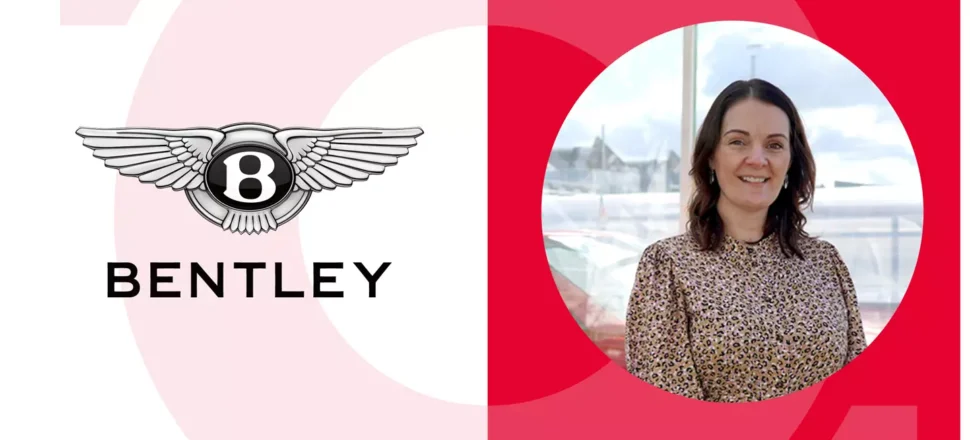
Mental Health Q&A: Bentley
In advance of #WorldMentalHealthDay, we caught up with Emma Humphries from certified UK Top Employer Bentley. Emma is co-chair of its wellbeing network BeAccessible – in this interview she reveals more about the network, how it contributes to positive change within the organisation, and how mental health has moved up the organisation’s priority list.
Tell us about yourself and your organisation?
I’m Emma and I work as a Technical Analyst here at Bentley Motors. Bentley has a proud 103-year history of building the most sought-after luxury cars, and we’re also on the most ambitious journey with our Beyond100 plans to become exclusively electric and end-to-end carbon neutral by 2030.
At the heart of Bentley are our 4,000 colleagues. Whilst those numbers might sound big, we’re a tight team with generations of families working here, which makes Bentley a very special place to be. I am proud to follow the footsteps of my late Grandfather who joined the business the day it opened its gates, followed shortly after by my Nan. Since then, there has always been members of my family throughout Bentley’s history; my father, working mainly in Security, and my three brothers working in Purchasing, Maintenance and Finance. When I finished college, I knew I wanted to be a part of the Bentley brand and family. I’m proud to have just completed my 25 years of service, working predominantly in Logistics – a department and family that is full of drive and passion.
It’s our people that bring our vision for Diversity and Inclusion to life with our colleague led networks. I co-chair one of those networks, known as BeAccessible. It was launched following World Mental Health Day in 2021 and our ambition is simple; we support colleagues in all aspects of health and wellbeing to ensure our workplace is inclusive, and aim to create an equal environment for colleagues with disabilities. Other colleague networks include BeProud, who advocate for our LGBTQ+ community, our BeUnited network who represent colleagues of ethnic minority, our BeReady network, who support colleagues with a background in the army or other recognised force and our BeInspired network which brings together those with an interest in increasing the proportion of female colleagues across all of our business areas to accelerate our progress towards Bentley’s Beyond 100 goals of 30% women in management by 2030.
How has Bentley’s mental health strategy evolved over the past year, in what we all hope is a post-pandemic world?
The Covid-19 pandemic has impacted us all in different ways, and we quickly realised that we could not deliver a one-size fits all approach to mental health. With the support of our Head of Diversity & Inclusion, the BeAccesible network established a Positive Mental Health Workstream, and evolved our strategy to have a range of touchpoints for colleagues in a way that works for them, whether that be at work or in new home office.
So, our multi-tactic approach means colleagues can get access to face-to-face peer group support through our regular Time to Talk sessions or get more tailored and personalised support through a trained Mental Health First Aider. But we have also evolved our strategy to focus on day-to-day mental health through BeFit walking programmes, BeFit fruit giveaways etc, as well as the opportunity for colleagues to join our allotment community to enjoy the outdoors because we know helping colleagues with positive habits can help mitigate the impact of mental health stressors.
Has mental health moved up your organisational priority list?
Absolutely, in fact it is being actively championed, from board level to factory floor. It makes me feel proud to work here and excited about what the future holds for Bentley.
Bentley offers an array of resources for colleagues. This month, along with the network’s regular monthly Time to Talk sessions, we are promoting our Mental Health Traffic Light guide, which contains several useful resources – for example, a list of our Mental Health First Aiders and information on our BeFit programs, designed to get colleagues moving and exercising. We are also sharing colleague’s experience of Ben, the Automotive Charity, and the great support that they offer to colleagues from our automotive industry. The network chairs and members have regular opportunities to meet or ask questions with the Board where we receive full support, answers and guidance, ensuring that we are all striving for the same goal of improving colleagues’ experiences.
How have conversations around mental health changed?
I’m a firm believer that the more we talk about mental health, the more we can demystify. We’ve got a supportive communications team who help make health and wellbeing a priority across our messaging, and we’ve been empowered to host monthly MS Teams sessions to reach our remote colleagues, or those working at home. We also use national events to bring awareness, for example May’s Time to Talk was about Loneliness.
This constant conversation has seen the network reach 170 members, as well as engaging with many more thousands of our colleagues in some way.
Mental health is definitely becoming something that more and more people want to talk about and support and I am really proud that our BeAccessible network has been an enabler for this.
What will be your priorities in Mental Health in the year ahead?
The network has just advertised a companywide Movember campaign, we will be focusing on mental health during International Men’s Day with our Men’s Forum Workstream to ensure we continue our mission to remove taboo and stigma and encourage colleagues to start conversations and signpost. BeAccessible also promotes Bookboon, which is a digital learning service provider for corporate learning & development. In particular, we will be promoting titles linked to mental health and stress as a priority on awareness days and throughout the year generally.
Ganar las batallas por el talento
Propongo dejar de decir que estamos en la guerra por el talento. Y no porque se haya suavizado, sino más bien, al contrario, porque se está recrudeciendo. Es por cambiar nuestra perspectiva sobre el concepto en sí, ya que su forma real no es la de una guerra, si no de continuas batallas por el talento. Nuestra capacidad para atraer, para implicar y mantener comprometido e ilusionado al talento que necesitamos no es algo que ganamos o perdemos una vez, sino que es un proceso –apasionante– de mejora continua en el que las áreas de gestión de personas tenemos un papel determinante.
El 88% de las compañías certificadas como Top Employers en el mundo disponen de una estrategia de marca empleadora que incluye, como elemento central, su propuesta de valor al empleado. Naturalmente, cualquier organización ofrece algún tipo de propuesta de valor a sus empleados –si no ofreciera algo, difícil sería poder atraer a nadie y menos mantenerlo en la compañía – pero aquí estamos hablando de abordar eficazmente el reto de identificar, desarrollar y comunicar qué es lo que ofrece al talento que necesita, tanto en el momento de la atracción como durante toda su vida en la compañía. Qué es lo que hace única a una organización y la convierte en una compañía a la que los profesionales quieren pertenecer, donde quieren trabajar y vivir. Eso, indudablemente, es una ventaja competitiva que barre a la competencia.
Las mejores compañías quieren asegurarse de que cumplen lo que prometen y lo logran embarcándose en un proceso de escucha y de mejora continua. Por eso, el 89% de las Top Employers diseñan y revisan los momentos clave de su proceso de adquisición de talento para que estén alineados con los pilares o características clave de su marca empleadora. Y el 70% mide sistemáticamente su reputación como empleador entre sus posibles candidatos, su mercado diana de talento. Y el 70% de las Top Employers mapean, para optimizarlo, el viaje del candidato. Dibujan cómo será su experiencia subjetiva, la vivencia desde el punto de vista del candidato, y trabajan con la información que recogen de las encuestas para activar un proceso de mejora continua en cada uno de los puntos de contacto. Lo que consiguen es mejorar la experiencia del candidato para que sea ágil, atractiva y refleje los pilares de su marca empleadora.
Y no se limitan a los candidatos, sino que también se dirigen a los empleados, los existentes y los nuevos. El 79% de las Top Employers miden la experiencia de los nuevos empleados, pero es muy interesante comprobar como el 40% se centran también en saber si la percepción sobre la marca empleadora que tenían antes de incorporarse se ha visto cumplida en su experiencia real en las primeras semanas de vida en la empresa. Una información muy interesante, reflejo de que son compañías con actitud valiente, muy comprometidas con las personas, y con talante de mejora continua, porque los resultados que captan llevan indefectiblemente a la acción, y, o bien se cambia la experiencia… o se tiene que cambiar la marca empleadora.
Las mejores compañías trabajan para generar confianza en su marca empleadora, para mantener el compromiso adquirido con su promesa de valor, durante todo el ciclo de vida del talento en la organización. El 85% de las compañías certificadas como Top Employers se aseguran de que haya un alineamiento claro entre la marca empleadora y la percepción y la experiencia que viven los empleados. Son marcas consistentes y coherentes, que trabajan para que no haya disonancia entre lo que dicen que son y lo que realmente son en el día a día de la compañía.
Una estrategia de marca empleadora tiene en su centro la propuesta de valor al empleado. Es, al fin y al cabo, lo que le da consistencia, porque recoge los beneficios, tangibles e intangibles, que se ofrecen a los empleados, y está alineada con los pilares de la marca empleadora, vinculados muy especialmente con los valores actuales y aspiracionales de la compañía.
El 80% de las Top Employers tienen claro que una buena propuesta de valor al empleado debe incluir un proceso eficaz de escucha, por lo que implican activamente a representantes de los diferentes grupos de empleados en la definición de su propuesta de valor, evaluando sus necesidades, aspiraciones y sus experiencias laborales actuales. Las mejores prácticas al respecto nos muestran la relevancia de segmentar las muestras de empleados y analizar si existe brecha entre la visión de la empresa – habitualmente del trabajo conjunto de la dirección y recursos humanos– y la del empleado.
Y, desde luego, la EVP, corazón de la estrategia de marca empleadora, no es el resultado de un ejercicio aislado, sino que las mejores empresas –el 72% de las compañías Top Employers– multiplican su valor evaluándolo periódicamente, continúan con el ejercicio sistemático de escucha a los empleados y el 46% de ellas utilizan herramientas tan eficaces como el mapeo de la experiencia del empleado, que detalla la percepción del empleado en cada punto de contacto de su viaje en su relación con la compañía.
Las batallas por el talento se libran de forma continua. Sócrates, con muy buen criterio, nos dejó esta reflexión: “El modo de obtener una buena reputación es procurar ser lo que se desea parecer”. La consonancia entre lo que decimos que somos y lo que realmente somos es lo que genera confianza en la marca empleadora. Las mejores compañías invierten tiempo, recursos e ilusión y se embarcan en un proceso de mejora continua para cumplir lo que prometen.
Supporting your talent strategy with Big Data
How can HR analytics and specifically big data be used for talent management?
That is what exactly Certified Top Employer Saint-Gobain discussed in a recent Top Employers Connect webinar. In the latest of our ‘For a Better World of Work’ series, we were joined by Jan Billekens, Manager Group HR Efficiency at Saint-Gobain and Alissa Hankache, Ph.D., Global HR Auditor at Top Employers Institute.
Read ahead to get a snapshot at some of the highlights from the webinar and fill in the form (on the right-hand side of the page) to get the recording to watch whenever you have a moment.
Companies use AI in people-related decisions for many reasons, including consistency, reduced bias, casting a broader net, and efficiency.
Data scientist Cathy O’Neil explains in her book “Weapons of Math Destruction” that algorithms and AI are easy to create using historical data and can improve the efficiency of decision making.
Data from TEI shows that among certified companies:
- In 87% of cases, HR supports business with people analytics.
- And in 88% of cases, business leaders are committed to using HR data analytics for fact-based decision-making about the workforce.
Approaching HR with analytics
With more than 166,000 employees, located in 75 countries, and a shared purpose of “MAKING THE WORLD A BETTER HOME”, Saint-Gobain is certified as a Global Top Employer since 2016. After internal reflection and deliberation, Saint-Gobain was left with one big question:
“How can we use big data for talent management in a global and highly decentralized industrial matrix organization like Saint-Gobain?
Based on this, the following objectives were established:
- Identify Talents
- Targeted development and career support
- Developing leadership capabilities
Ensure retention and commitment
An approach with three steps was then developed for the HR analytics project at Saint-Gobain:
- Assess Bronze Talent management
- Identify Talents at risk of leaving
- Identify undiscovered Saint-Gobain talents
Assess Bronze Talent Management
The first phase was to look at emerging trends from the algorithm, which came through as follows:
- Career progression – The algorithm has identified that talents within the five years at Saint-Gobain climb two-thirds bands more than non-talents.
- Career follow-ups – In annual succession planning and [erformance reviews, talents were mentioned more often in people reviews than non-talents.
- Development and training opportunities, – Talents have more training opportunities than non-talents.
- Base salary management – Salary increases are higher for talents than-non talents.
- Increasing gender balance – The % of female hired talents is 6% higher than male talents hired – based on strategic objectives.
The conclusion of this first part is that it confirmed that “what we want to do with our talent management is being achieved”.
Identify talents at risk of leaving
The second algorithm – looked into the past and analysed what were the elements of talents who left Saint-Gobain voluntarily in the past. The most impactful parameters were salary increase percentage and the date of last increase. The lower the salary increase, the higher the risk of leaving – no surprise, but it is also confirmed by the algorithm.
An interesting trend emerged when looking at tenure – when the last increase for a salary was between 6 months and 1.5 years, there is a lower risk of leaving. But after 1.5 years of a lower salary increase, there is a higher risk of leaving. The algorithm provided a percentage of the risk of leaving talent – about 150 names. These were then sent to country HRDs with all the parameters of risks included. They were asked to provide feedback on whether there was a risk of leaving or not (and at various levels of risk). Based on a combination of input from the algorithm, and feedback from HRDs – 100 of the 150 employees were able to be retained. Managers were able to take proactive actions to prevent employees from leaving.
Identifying undiscovered Saint-Gobain Talents
One of the interesting components of the webinar was to note how Saint-Gobain uses an algorithm to identify undiscovered talents. Part of the diagram, was important to understand:
- Precision – % of true SG Talents among the Talents identified by the algorithm
- Recall – % of Talents identified by the algorithm among the SG Talents
After consultation with and feedback from country HRDs on the 250 names proposed by the machine, 115 Bronzes talents were detected!
The webinar also discussed various other aspects of HR analytics including:
- Data visualization
- Semantic Analysis
- Data integrity
- Data confidentiality
The key message echoed throughout the session is that HR Analytics is a means besides all other HR tools. HR should take advantage of these digital tools in order to spend more time meeting people face to face
The Lasting Impact of Burnout
UK organisations may be adjusting to a post-pandemic world, says Marlene Mey from Top Employers Institute, but for their employees, the battle against burnout is far from over.
Mental Health Awareness Week has transformed our understanding around mental health issues, particularly over the last few years. The Covid-19 pandemic is (hopefully) behind us, but in its wake it has left a trail of challenges that we continue to battle against. Amongst those, burnout remains one of the biggest.
Research from Ceridian at the end of last year showed us that burnout remains a big problem. More than three-quarters (79%) of UK workers had experienced burnout, it revealed, with 35% reporting high or extreme levels. And although employers have been making rapid adjustments towards a new normality of hybrid working arrangements in the first half of 2022, many of their employees are not feeling remotely “normal” about their new working lives.
Burnout: Quick to arrive, Slow to heal
In the UK, the first wave of COVID-19 had an immediate impact on mental health, with psychological distress at work increasing to 28% in April 2020, from 18% in 2019, according to the Institute of Labour Economics. While the impact of the pandemic was instantaneous for mental health, the scarring it caused is unlikely to recede any time soon.
In addition, with new hybrid working arrangements emerging, employers are treading a narrow tightrope. Some risk coercing reluctant employees back into office-based working patterns that no longer fit with their lives. Other businesses have opted for a largely remote workforce, with employees left at home – and very much alone. According to the Mental Health Foundation, one in four of us feel lonely some or all of the time. For the great majority of us, social connection and belonging are central to our well-being. In its absence, burnout can quickly take root.
Three Steps Forward
All of this comes at a time of disconnect between many employers and their employees. Too many of the former know they need to adapt to survive but take little account of the psychological readiness of their employees for further change. And some employees already feel burnt out, with a lack of recognition for discretionary effort put in through the pandemic. So, what can be done to tackle the lasting impact of burnout.
- Formalise and enshrine processes. Our observation is that many businesses are either lacking the necessary formality in their mental health processes, or simply letting them wither as the post-pandemic world emerges. This is a big mistake – the pandemic could be over, but the pain for many is not. The answer has to lie in long-term formalised mental health programmes. Only then will employees have the confidence that they are being looked after properly, whatever their working arrangements. For example, UK Top Employer, Ageas UK, has employee wellbeing programmes with a strong formalised structure, including initiatives such as an online wellbeing community, an employee assistance programme, and access to Mental Health First Aiders and training sessions for managers, delivered by the mental health charity Mind.
- Create a sense of psychological safety. Organisations also need to create a “psychologically safe” working environment, in which employees feel able to talk about mental health, without fear of judgement or a negative impact on their career. For example, Top Employer Equiniti (EQ), the UK’s leading share registrar has a strong Mental Health network in place with 200 members. This raises awareness of mental health and feeds back to the business on colleague experiences. To have spaces in this way brings multiple benefits; including helping to avoid burnout in the first place, to recognise the issue and give support wherever possible.
- Give practical burnout support immediately. When the worst does happen, data from Certified Top Employer organisations here in the UK provides us with some hope around what is possible. Nearly two thirds of UK Top Employers (63%) provide burnout recovery support, up from less than half (49%) a year earlier. And almost three in five (58%) guarantee time to “unplug” and/or take stress-relief breaks (up from 44%). Knowing practical support is available is essential. The best businesses understand that burnout support is an ongoing commitment to employees, not a one-off reaction to exceptional circumstances.
Without action, the impact of burnout could get much worse before it gets better. So now that the pandemic is (hopefully) behind us, it is vital for businesses to understand that tackling mental health, and burnout in particular, must remain a formalised commitment that can be shared and discussed safely, and where support and practical help is always on hand when it is most needed.
Case Study: App Gente Consum
Descargad el Case Study
Os presentamos el Top Employers España Insights 2024. Poniendo a las Personas en el Corazón de la Organización, un completo informe en el que adaptamos las 5 grandes tendencias globales de gestión de personas a la realidad de nuestro país y las complementamos con las iniciativas e insights de referencia de 9 de las compañías certificadas en España.
Descargad de forma gratuita el Top Employers España Insights 2024 cumplimentando el formulario mostrado a la derecha para recibir el enlace de descarga por correo electrónico.
¿Es vuestra organización una compañía Top Employer?
Si vuestra organización no es todavía una compañía Top Employer, podéis pedir información para conocer los requisitos para formar parte del Programa de Certificación y posicionaros entre los empleadores líderes a nivel global y local, además de beneficiarios de las principales ventajas del programa (Brand, Alignment, Benchmark y Connect). Clicad aquí para descubrirlo todo sobre la Certificación Top Employers.
Case Study: La Escuela Vertical de Cofares
Descargad el Case Study
Os presentamos el Top Employers España Insights 2024. Poniendo a las Personas en el Corazón de la Organización, un completo informe en el que adaptamos las 5 grandes tendencias globales de gestión de personas a la realidad de nuestro país y las complementamos con las iniciativas e insights de referencia de 9 de las compañías certificadas en España.
Descargad de forma gratuita el Top Employers España Insights 2024 cumplimentando el formulario mostrado a la derecha para recibir el enlace de descarga por correo electrónico.
¿Es vuestra organización una compañía Top Employer?
Si vuestra organización no es todavía una compañía Top Employer, podéis pedir información para conocer los requisitos para formar parte del Programa de Certificación y posicionaros entre los empleadores líderes a nivel global y local, además de beneficiarios de las principales ventajas del programa (Brand, Alignment, Benchmark y Connect). Clicad aquí para descubrirlo todo sobre la Certificación Top Employers.