The era of AI-powered change is well underway, redrawing the architecture of organisations faster than leaders can adapt. This is already testing their readiness to guide their people and businesses through a period of accelerated transformation.
In parallel, market volatility, uneven economic growth, and the redeployment of talent into AI-focused, revenue-generating roles are intensifying this pressure on leaders. All of this is redefining not only what leaders need to do to respond, but also how they need to lead in 2026.
Although the impact of AI is clear, three-quarters (74%) of employers still find it difficult to translate AI’s potential into scaled value. For those organisations that can achieve this, the benefits are clear: our own research, based on more than 2,300 Top Employers across 125 countries, shows that high-profitability companies are 7% more likely to use AI to enhance the employee experience than their lower-performing peers.
Leaders face complex, competing pressures: to drive innovation while maintaining trust, a central challenge in developing responsible AI in HR. They also need to ensure that AI serves as a catalyst for human potential, rather than a substitute for it. This requires a radically different approach – a new leadership mindset which we call “AI-powered leadership”.
Those HR leaders failing to redesign leadership for the AI era risk building faster systems on faltering foundations, hampering commercial potential. The challenge is to offer the organisation practical ways to turn AI into more human-centred, high-performing leadership.
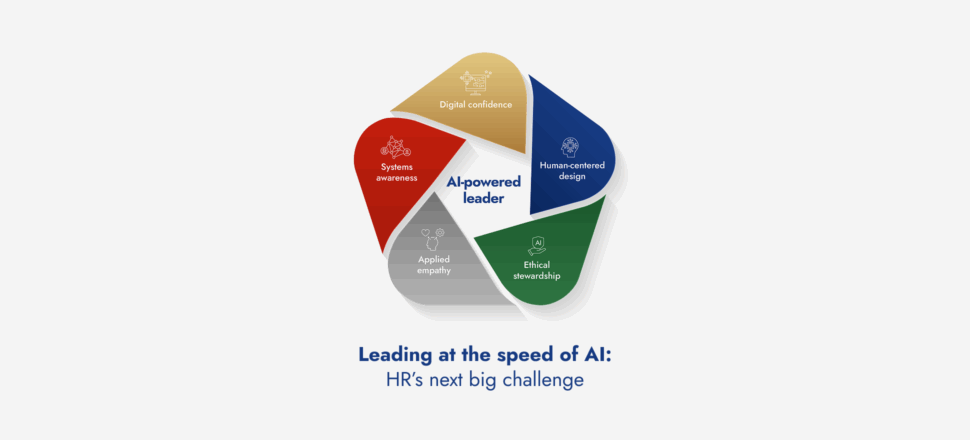
Our five-pillar blueprint for AI-powered leadership
AI-powered leadership redefines how leaders think and act, using technology to strengthen human values and drive resilient, high-performing organisations. Based on our global research at Top Employers Institute, our AI-powered leadership blueprint defines five interconnected pillars that all organisations can base their leadership on to thrive in the AI era. When combined, they offer a model for uniting human insight with intelligent technology to drive organisational performance with purpose.
1. Digital confidence
Digital confidence is foundational to build AI skills for leaders. An AI-powered leader needs the ability to question, evaluate and integrate AI responsibly, even though they are not technology experts. The most effective leaders understand when to use AI’s analytical strength to amplify human judgment. For example, in simulated market experiments within the automotive industry, AI models outperformed humans in predictable conditions but struggled during unexpected disruptions. Human knowledge and experience provided the context that algorithms lacked.
2. Human-centred design
AI should enhance the human experience of work. Organisations that use AI to elevate employee experience as well as efficiency, are already outperforming their peers. Evidence around organisations implementing AI highlights a trade-off: quick wins may boost efficiency, but without deliberate design where humans take the lead, it can erode long-term engagement. This shows that when technology is designed around people’s needs, engagement and innovation can grow together.
3. Ethical stewardship
As AI reshapes and speeds up decisions and workflows, ethics become a defining measure of leadership quality and the backbone of responsible AI in HR. Ethical stewardship means embedding fairness, transparency, and accountability into every process, at a time when concerns around trust are widespread. For example, when leaders take responsibility for how AI is used and clearly explain the principles guiding their choices, they turn technology into a source of trust rather than the source of uncertainty.
4. Applied empathy
AI can analyse data and respond with great efficiency, though it cannot replicate emotional connection. Leaders who combine AI insights with emotional intelligence create workplaces where communication is open and trust is strong. Some organisations, for example, use AI-powered coaching tools such as custom GPTs to help leaders improve the quality of the difficult conversations they sometimes need to have. Our own research shows that 85% of Top Employers now encourage self-reflection in leadership development, a seven-point increase from the previous year.
5. Systems awareness
AI-powered leaders view their organisations as dynamic systems. They anticipate how AI will reshape not only tasks but relationships, structures, and culture. Systems awareness allows leaders to guide teams through complexity. For example, it helps them recognise that a single technological decision can have ripple effects across the entire organisation. The most effective leaders balance innovation with this system-wide context, ensuring that AI enhances both collaboration and adaptability.
HR’s big opportunity – and responsibility
For HR leaders, AI-powered leadership represents both an opportunity and a responsibility. There is an unprecedented opportunity to embed AI in HR strategy to help organisations reimagine what leadership looks like in the AI era, by embedding the five-pillar blueprint into learning, performance, and culture.
HR leaders have an incredible opportunity to act as the catalysts of this change, empowering senior executives and boards to harness AI in ways that truly augment human potential. Those that can seize this opportunity and embrace the responsibility of AI-powered leadership will ensure that technology strengthens, rather than replaces, human insight and judgment in their organisation.
Download our AI-powered leadership report now to see the five pillars in action – and learn how HR can lead the transformation.