Use this dropdown to select your preferred language.
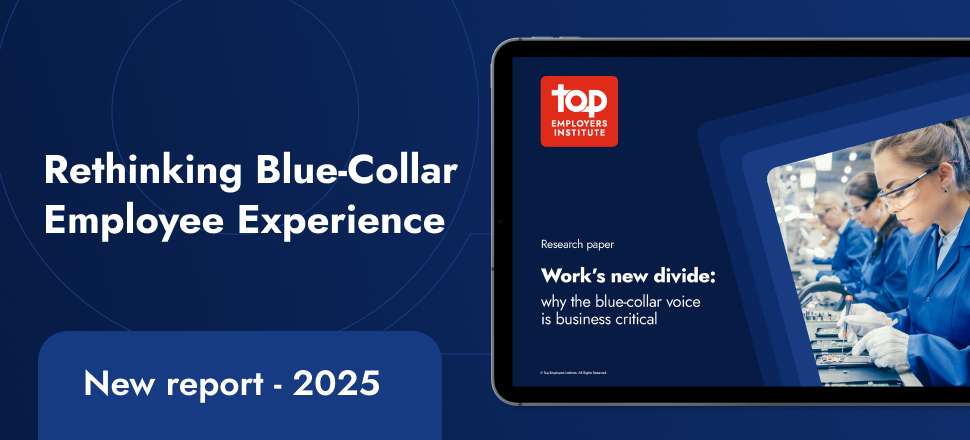
Rethinking Blue-Collar Employee Experience
Work’s new divide: why the blue-collar voice is now business critical
Rethinking Blue-Collar Employee Experience
Blue-collar employees are the backbone of the global economy, and their output is critical for the success of many organisations. However, their needs and expectations have, too often, been overlooked in HR strategies.
But that is changing
Across industries, blue-collar employees are stepping forward to make their voices heard, demanding fairness, recognition, and a meaningful workplace experience. Organisations that fail to listen risk losing talent and competitive ground in an era defined by skills shortages, retention pressures, and operational risk.
We’re proud to introduce our latest report, Rethinking Blue-Collar Employee Experience. The report draws on data from 2,200 employees across 11 countries and provides an in-depth examination of the needs, challenges, and realities faced by blue-collar workers, offering a roadmap for enhancing the employee experience for this critical workforce.
Download the report to discover:
🔹 Actionable, evidence-based actions HR teams can take to drive belonging, retention, and engagement.
🔹 First-hand insights from blue-collar workers from different generations, industries and regions to understand the real-world challenges and needs of employees.
Key findings:
✅ Connection drives engagement: Blue-collar employees with strong workplace relationships are 51% more likely to be engaged, yet many lack structured opportunities to connect.
✅ Pay matters, but meaning matters too: While only 55% believe their pay reflects their value, employees who feel their work makes a positive impact are 74% more likely to be engaged.
✅ Communication impacts safety: 26% say their workplace safety measures are inadequate, underscoring the link between clear communication and operational resilience.
✅ AI brings anxiety and opportunity: While 73% agree AI is improving their industry, only 61% have received sufficient training, and just 25% say their current job aligns with their long-term goals.
✅ Flexibility is a silent dealbreaker: 64% value flexibility more than financial rewards, yet nearly a third report they have no control over their schedules.
Why it matters:
Blue-collar workers shape more than just operational outcomes. They play a prominent role in influencing your culture, productivity, and organisational success. Investing in their experience is not only the right thing to do. It is critical for your organisation’s success.
Download your copy now:
Unlock actionable insights to build a future-ready blue-collar employee experience that drives productivity, profitability, and sustainable growth.
Neuroinclusion in practice: From awareness to action
Our recent webinar, Neuroinclusion in the workplace: From awareness to action, showed HR leaders how to take a giant leap forward from understanding the importance of neuroinclusivity to embedding it across leadership and teams at every level of an organisation.
Sarah Andresen, Chief Product and Technology Officer at Top Employers Institute discussed best practice neuroinclusivity with Eline Jammaers, Assistant Professor at Hasselt University and Tristan Lavender, Founder & Chair of Philips Neurodiversity Network.
The case is made, so let’s move to action.
HR leaders should already know that neuroinclusion helps organisations widen their talent pool, unlock latent potential and create stronger, more connected teams. There is no shortage of research showing that inclusive organisations have a better chance of meeting the expectations of socially-conscious consumers, while employees working there are more likely to feel engaged – and stick around.
Top Employers Institute’s new paper Neuroinclusive by design: Creative and thriving team environment for all echoes these findings and goes much further. It identifies three features of thriving, inclusive teams: harnessing individual talents, co-creating clarity and embracing empathy to drive better business performance.
Below are just some of the practices that the webinar looked at to show best practice inclusivity in action.
1. Start with leadership: Role models set the tone.
Senior leaders play a pivotal role in introducing neuroinclusive practices. When leaders are open about their own neurodivergence, it sends a powerful and positive message. It normalises differences and encourages psychological safety, especially among younger employees and others unsure about disclosing their neurodivergence.
Line managers are also vital role models. Their ability to sit and to listen, respond with flexibility and ask the normal day-to-day questions, such as ‘What support would help you do your best work?’ can be transformative.
One enduring myth that the webinar also explored is when neurodiversity is billed as bringing ‘superpowers’ to the workplace. While neurodivergent employees do bring unique strengths, these must be wholeheartedly supported. The true value of neurodivergence is only unlocked with the active encouragement of leaders and managers; a passive acceptance that we are all different is simply not enough.
2. Continue with teams: Embed psychological safety as an everyday instinct.
To move inclusion beyond good intentions means teams must also play their full part. Psychological safety needs to be a daily given, built through small, consistent behaviours. Both leaders and their teams should, for example, ask new hires about communication preferences, environmental needs or work styles as an instinct, without the need for a formal diagnosis. Simple common-sense actions like these have a wider purpose – they reduce barriers and improve collaboration among not only neurodivergent employees but everyone.
Inclusion happens in these ‘micro-moments’ of work: how to run meetings, give feedback, and handle discussions. Leaders and teams need to model empathy and openness, not just in policy but in day-to-day behaviour, until it becomes deeply embedded.
This needs to be visible externally, to attract future talent. Personal stories of neuroinclusion attract the job candidates of the future, as well strengthening internal alignment.
3. Reinforce through ERGs and metrics: A key role for HR.
Our Neuroinclusive by Design research describes a necessary mindset shift from ‘accommodation’ to ‘intentional inclusion’, building flexibility, clarity and empathy proactively into team culture from the outset. And HR has a key role to play in driving this forward in several ways.
For example, Employee Resource Groups (ERGs) are a powerful tool for accelerating inclusion. They provide safe spaces for connection, education and advocacy. For them to flourish, HR leaders must support them in a similarly active way, with funding, time and clear links to organisational strategy.
The webinar showed how companies like Philips have introduced formal neuroinclusion policies at a national level to make sure that ERG insights translate into organisation-wide support. And this is the kind of structural reinforcement that Top Employers’ new platform, HREdge | NeuroInclusion, has been designed to support. It provides the necessary tools, insights and expert guidance for embedding inclusion across the employee lifecycle.
Measuring neuroinclusivity also remains a challenge for many employers. One practical way for HR to play a role is to embed questions within existing wellbeing or engagement surveys, to align with key desired outcomes like job satisfaction or a sense of belonging. This requires trust, with participants needing to believe that their responses will not only be anonymous but used constructively. ERGs can play a unique role here too, for example through running pulse surveys or providing qualitative insights from neurodivergent communities.
Final word…
Neuroinclusion by design in 2025 is no longer only for the neurodivergent. It is a journey from awareness to action for all, a framework for designing better work for everyone, at every level of an organisation.
To explore how to start or scale your neuroinclusive practices, download our research paper or for tailored business recommendations and benchmarking solutions, find out more about our new platform, HREdge | NeuroInclusion.
Neuroinclusion by design: Progressive HR strategies to drive team success
Organisations today face growing pressure to create environments that embrace all forms of human diversity – including the need to accommodate diverse ways of thinking. In a recent LinkedIn Live webinar, Dr Emily Cook, Senior Researcher and Paola Bottaro, People Director, both from Top Employers Institute, explored the insights behind our new paper, Neuroinclusive by Design: Creating a Thriving Team Environment for All.
The session offered a compelling blueprint for HR leaders seeking to embed neuroinclusion into the way work gets done – not just as a reactive set of accommodations, but as a proactive principle of workplace design.
Drawing on in-depth interviews with neurodivergent professionals and the experiences of certified Top Employers such as Tata Consultancy Services and Bentley, the research identifies three essential traits of high-performing neurodiverse teams: harnessing individual talents, co-creating clarity, and embracing empathy.
The concept of intentional neuroinclusion is gaining traction, shifting focus from making adjustments for individuals to proactively structuring work environments to both expect and support a wide range of cognitive and behavioural styles. This not only benefits neurodivergent employees, but also enhances the working experience for all.
Rather than responding to challenges as they arise, this proactive approach integrates flexibility, clarity and empathy from the outset. This in turn enables a more inclusive and productive culture that supports differing ways of thinking, communicating and working.
Unlock collective success by harnessing individual talents
Many neurodivergent employees bring distinctive strengths, such as pattern recognition, that employers are in danger of overlooking when using traditional role definitions and job descriptions.
Our research encourages HR teams to look out for new skills. Techniques like skills profiling, using internal marketplaces for talent and more intentional performance conversations can help uncover and leverage these often-hidden strengths.
Neurodivergent professionals also frequently contribute beyond their formal roles, engaging in innovation projects and employee resource groups (ERGs). Supporting and celebrating this kind of engagement is one way that organisations can help fully unlock individual potential and elevate team performance.
Define and commit to consistent ways of working
The research found that inconsistent or mismatched expectations around how work gets done – whether in meetings, communication styles or collaborative processes – can become significant barriers for neurodivergent individuals.
Flexible and inclusive ways of working can be achieved by co-creating team norms, rather than imposing top-down rules. For example, teams might need to agree on meeting cadences, notification boundaries, or which tasks are best tackled together versus independently.
This shared clarity creates an environment where all team members, regardless of their cognitive profile, understand what’s expected and feel able to contribute effectively.
Embrace empathy to build trust
Our research showed that trust and psychological safety emerged as foundational to neuroinclusive teams. Neurodivergent employees often feel pressure to conform to behavioural expectations, such as direct eye contact or small talk, that may not align with how they naturally interact. This “masking” can take a toll on mental health over time.
Empathy, in this context, involves understanding and accepting diverse forms of communication and engagement. Employers can reinforce this through formal systems like manager training and inclusive policies, and through everyday signals – such as how to deliver feedback or how to understand alternative working styles.
Regular check-ins that focus on employee experience, not just outputs, can play a vital role in normalising support-seeking and creating space for authenticity.
Adapt neuroinclusion for differing cultures and contexts
In response to a question from the webinar audience, it was acknowledged that while in this instance our research interviews did not cover all geographic regions, the broader research we do at Top Employers Institute draws on data and insights from organisations across multiple continents. The principles highlighted in the paper – flexibility, clarity, and empathy – are designed to be adaptable to local context and nuance.
Neuroinclusion strategies should never follow a “one-size-fits-all” model. Different regions, industries, and cultures bring varying approaches, vocabularies and challenges to the topic. The key lies in building environments that are fundamentally inclusive by design, yet flexible enough to reflect local norms and realities.
A strategic blueprint for a better world of work
The overarching takeaway from our webinar was that neuroinclusion should not be seen as an adjustment to existing systems, but rather as a framework for the design of modern work. Through intentional design, organisations can build environments that both expect and celebrate diversity.
Along with this research paper, we’ve introduced a new platform, HREdge | NeuroInclusion, as a practical support tool for organisations at any stage of their neuroinclusion journey, providing access to tailored insights, expert guidance and a global network of HR leaders. And as the research makes clear, organisations that commit to neuroinclusion are not just improving workplace culture – they are positioning themselves for greater adaptability, innovation and long-term success.
How Top Employer, CME, transformed its People Strategy and gained business influence
In a media landscape defined by fierce competition and rapid transformation, Central European Media Enterprises (CME) did something bold: it made people strategy a business priority.
A few years ago, the HR team at CME operated with limited visibility, minimal influence, with no consistent processes across its regional markets. Employee engagement wasn’t measured, employer branding was uncharted territory, and HR did not have a seat at the table when the organisation discussed its business agenda.
That was the landscape Soňa Schwarzová stepped into as she took on the role of Chief People and Sustainability Officer, but fast forward to today, and the company is being recognised for its excellent people practices as a Certified Top Employer. That milestone reflects how the organisation.
From marginal to mission-critical
Fast forward to today, and CME stands tall as the first media company in Central and Eastern Europe to be Certified as a Top Employer. But as Soňa is quick to emphasise, the Certification itself wasn’t the final goal. It was the catalyst for continuous change and improvement.
The process of going through the audit is more important than the Certification. That’s more the cherry on top. — Soňa Schwarzová
The Top Employers Certification Programme acted as a powerful framework for CME as it gave the team data-led insights that allowed them to prioritise creating alignment, unlocking collaboration across markets, and transforming the HR function from reactive to strategic.
What changed for CME?
The case study reveals a roadmap for HR transformation:
Structured audits became CME’s annual People strategy blueprint
Cross-country collaboration flourished, empowering smaller HR teams
HR gained credibility, influence, and internal legitimacy
Employer branding accelerated, enhancing CME’s appeal across talent markets
HR now informs business strategy, not just supports it
As Soňa notes, Every country CEO included the Top Employers [insights] in their top-to-top presentations. That’s a major shift. We’re on the agenda.
The key takeaway
This isn’t just a success story. It’s a strategic playbook for HR leaders navigating complex environments, limited resources, and growing expectations.
Whether you’re rethinking your HR operating model, seeking to elevate your employer brand, or striving for business alignment, CME’s journey offers concrete, replicable insights.
Discover how our globally recognised Certification Programme, along with our data-led insights and advisory expertise, enables you to advance your talent attraction, development, engagement and retention strategies.
Engage, upskill and reskill for a future-ready workforce
The workforce is changing more rapidly now than ever, and companies are being challenged to redesign. Technological changes, generational changes and the changing demands of the market have all meant that it has never been more critical for companies to work towards developing an effective talent development strategy.
We will explore why upskilling and reskilling are core to the future of workforce planning, which is the key component of a future-ready talent strategy that focuses on upskilling employees and boosting employee engagement.
Why talent development needs a strategic reset
The pace of disruption, driven by Artificial Intelligence (AI), automation, and hybrid work models, has exposed a growing gap between existing capabilities, existing technology gaps and emerging business needs. Organisations that want to survive and succeed are being pushed to upskill and reskill their employees to address the places where traditional approaches to training are falling short in this changing landscape. Just last year, in 2024, companies in the UnitedStates spent $101,8 billion on employee training, with organisations spending, on average, 13% of their budget on upgrading their learning tools and technologies.
Agility and adaptability are essential for organisations, and they are achieved by developing a new way of working that prioritises a holistic talent strategy. These talent strategies integrate:
Upskilling and reskilling the workforce
Employee engagement as a growth enabler
Future-focused workforce planning
When HR leaders view talent development as a strategic lever, they unlock workforce agility and create a sustainable competitive advantage that positively impacts the broader business strategy.
Why upskilling and reskilling are essential
The demand for effective learning and development strategies is essential in the changing business landscape. Companies that invest in skill development create a more agile and capable workforce that allows these organisations to be ready for future changes. Here are four reasons why reskilling and upskilling is essential:
Supports career growth
Keeps employees up to date with technological advances
Contributes to a flexible workforce
Improves career growth
The benefits of upskilling and reskilling your workforce
Investing in learning and development is one of the most cost-effective ways to retain talent, reduce turnover, and boost business performance. Organisations that focus on upskilling and reskilling have found:
Improved employee engagement and retention: Employee satisfaction is crucial for high productivity and output quality. Employee satisfaction is also vital in ensuring that turnover rates remain low. HR Magazine UK has found that 32% of employees in the United Kingdom changed their jobs because their previous employer did not offer sufficient training opportunities. That is linked to job satisfaction being closely related to retention – employees with high engagement levels are unlikely to seek new opportunities outside of their organisation. Upskilling employees also shows that a company is committed to their people, fostering a sense of loyalty among the team.
Faster internal mobility and leadership pipeline growth: Prioritising learning and development programmes is key in streamlining succession planning. That is because training programmes can be used not only as a way for organisations to identify high-performing employees who have the potential to excel in leadership positions but also as the possibility of developing these individuals while addressing any skills gaps within the company.
Improved financial results: While many benefits of upskilling and reskilling are related to employees’ experience, it is critical to recognise the financial benefits of these enhanced learning and development strategies. Forbes has estimated that companies that emphasise and prioritise employee development will yield a 218% increase in income per employee. Additionally, reskilling initiatives have been found to save money by reducing reliance on recruitment. Research by The HR Director has found an average cost saving of between 70-92% when employers concentrate on improving the skills of their current employees rather than hiring new employees.
Higher productivityand innovation capacity: Innovation is key to improved business performance. It helps no one to remain static and reliant on old working methods. A recent LinkedIn Learning Report found that 94% of employees would stay longer at an organisation that empowers them through increased investment in their career development. A Gallup report has also found that companies experience a 17% increase in productivity when employees receive the training they need.
Reskilling and upskilling for a future-ready workforce
To close skill gaps and future-proof capabilities, leading organisations are prioritising three things:
Skills audits and workforce mapping
Curated learning paths aligned to business needs
Real-world application through projects and stretch assignments
Creating effective learning and development initiatives should go beyond compliance training. They should empower all employees to transition into new roles as business needs evolve.
Key components of a future-focused talent development strategy
To ensure relevance and impact, a strategic talent development programme should include:
Leadership alignment: No talent strategy can succeed without executive leadership’s visible, vocal support. Senior leaders must not only approve budgets and resources but also model learning behaviours, champion internal mobility, and hold teams accountable for capability-building outcomes.
Skills-based frameworks: A skills-based framework maps out the competencies your business needs to thrive. This enables skills visibility, agile workforce planning, and better alignment between employee development and strategic priorities. It also supports fairer, more inclusive talent mobility by reducing reliance on traditional job titles.
Technology-enabled learning: Leverage AI-powered platforms like Learning Experience Platforms (LXPs) to provide personalised, adaptive learning journeys that reflect individual goals and business needs. Technology enables you to scale development across geographies, roles, and learning styles—while capturing valuable data for insights and optimisation.
Cross-functional opportunities: Today’s top performers grow by moving across teams, functions, and geographies. Create pathways for rotational assignments, stretch projects, and internal gigs that allow employees to apply their skills in new contexts. This boosts engagement and drives knowledge sharing, innovation, and leadership readiness.
Impact measurement: Track development outcomes using leading indicators, including:
Employee engagement and satisfaction
Retention and internal mobility
Skills acquisition and application
Leadership pipeline strength
Business performance outcomes
How HR teams can lead the way in developing a reskilling plan from strategy to implementation
It is crucial for the success of any reskilling strategy to take careful, well-researched steps to ensure that their strategy creates a real impact in the organisation. For HR teams to ensure that this happens, they can take the following steps:
Audit current capabilities against future requirements: Use skills diagnostics and workforce analytics to understand what you have, what you need, and where the gaps are. Consider technical and soft skills and factor in upcoming business priorities, such as digital transformation, ESG goals, or market expansion.
Prioritise critical roles and high-impact skills: While creating a strategy that includes everyone in the organisation is essential, it doesn’t have to happen simultaneously. Focusing your resources on pivotal roles and skills that enable transformation can be more effective. This ensures your efforts are targeted and aligned with enterprise value drivers.
Engage managers as development champions: Managers are the most influential factor in enabling (or blocking) growth. Equipping them with tools and training to have meaningful development conversations, allocate stretch assignments, and mentor purposefully ensures that employees can develop their skills best.
Launch pilot programmes to test and learn: Start small, think big. Use pilot initiatives to experiment with new learning models, technologies, or career mobility frameworks. Measure impact, gather feedback, and iterate. This agile approach builds momentum and uncovers what works in your unique context before scaling.
Final thoughts
Building a talent development strategy is not just about ticking a box. It is about creating a culture of learning that continuously adapts to workforce expectations, market realities, and organisational ambitions. It is integral to driving performance, innovation and long-term competitive advantage.
Find more strategies and trends to improve your workplace for all of your employees in our World of Work Trends 2025.
Neuroinclusive by design: A future blueprint for a thriving team environment
With an estimated 10-20% of the population identifying as neurodivergent, many organisations are seeking ways to harness their untapped potential. However, there is a paradox at the heart of the current debate around neurodiversity in the workplace. Research shows that teams with neurodivergent members experience up to a 30% increase in overall success, and individuals with ADHD score 41% higher in creativity tests. Yet many neurodivergent employees still face barriers, with over 50% fearing workplace stigma or discrimination.
Why is this – and what can be done about it for the benefit of businesses and employees alike?
Building inclusive workplaces
At Top Employers Institute we’ve been delving deep into what makes neurodiverse teams thrive. Our latest research paper, Neuroinclusive by design: Creating a thriving team environment for all, explores the steps organisations can take to build truly inclusive workplaces. It provides key statistics, and practical recommendations that HR can implement to create a more neuroinclusive workplace.
Traditional workplace structures are changing, and neuroinclusive practices are forming the blueprint for the future of work. For a true neuroinclusive workplace, however, HR leaders must shift from providing piecemeal adjustments to embedding systemic inclusivity into their hiring, team collaboration, and leadership development practices. Organisations that embrace neurodiversity in this way will not only enhance employee wellbeing but also gain a vital competitive edge.
Through extensive research and interviews with neurodivergent employees, we have identified three critical traits shared by successful neurodiverse teams:
Harnessing individual talents for collective success. Neurodivergent employees excel when given flexibility and autonomy, allowing them to leverage their unique strengths in a way that benefits the entire organisation.
Defining and committing to consistent ways of working. High-performing teams find the right balance between structure and flexibility, co-creating communication methods that work for everyone.
Embracing empathy and nurturing interpersonal trust. A culture of psychological safety, where employees feel understood and valued, fosters collaboration and engagement.
Being ‘neuroinclusive by design’ is about reshaping the workplace so that diverse ways of thinking, processing information and collaborating are naturally supported. This approach benefits everyone, leading to more innovative, adaptable, and high-performing teams.
Can your business afford to ignore the benefits of creating a thriving team environment for all? By championing neurodiversity within teams, companies are not just creating better workplaces—they are shaping the future of work itself.
Fill in the form below to access the full research paper and explore how leading organisations are putting neuroinclusion into action.
Access the full research paper
Subscribe
Keep up to date with trends, best practices and news in the world of HR
We use cookies to improve your experience.
Learn more >