Why now? The urgent need
for AI-powered leadership
The era of AI-powered change is well underway, redrawing the architecture of organisations faster than leaders can adapt. This is already testing their readiness to guide their people and businesses through a period of accelerated transformation.
In parallel, market volatility, uneven economic growth, and the redeployment of talent into AI-focused, revenue-generating roles are intensifying this pressure on leaders. All of this is redefining not only what leaders need to do to respond, but also how they need to lead in 2026.
Although the impact of AI is clear, three-quarters (74%) of employers still find it difficult to translate AI’s potential into scaled value. For those organisations that can achieve this, the benefits are clear: our own research, based on more than 2,300 Top Employers across 125 countries, shows that high-profitability companies are 7% more likely to use AI to enhance the employee experience than their lower-performing peers.
Leaders face complex, competing pressures: to drive innovation while maintaining trust, a central challenge in developing responsible AI in HR. They also need to ensure that AI serves as a catalyst for human potential, rather than a substitute for it. This requires a radically different approach – a new leadership mindset which we call “AI-powered leadership”.
Those HR leaders failing to redesign leadership for the AI era risk building faster systems on faltering foundations, hampering commercial potential. The challenge is to offer the organisation practical ways to turn AI into more human-centred, high-performing leadership.
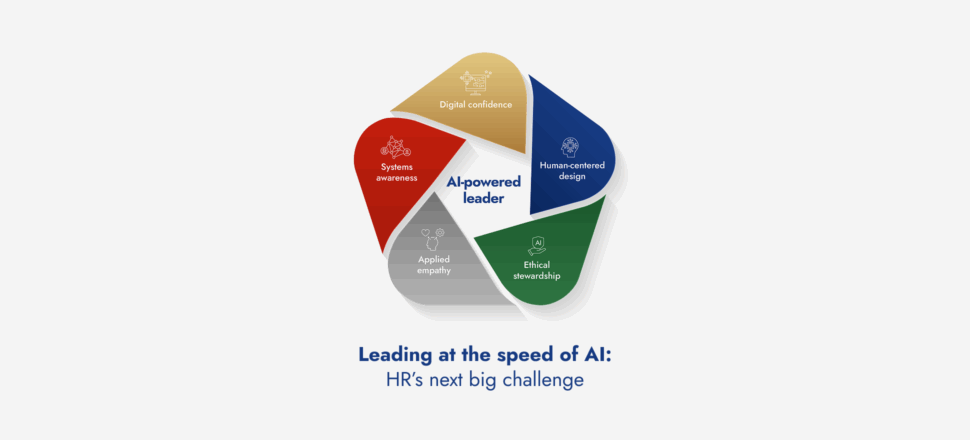
Our five-pillar blueprint for AI-powered leadership
AI-powered leadership redefines how leaders think and act, using technology to strengthen human values and drive resilient, high-performing organisations. Based on our global research at Top Employers Institute, our AI-powered leadership blueprint defines five interconnected pillars that all organisations can base their leadership on to thrive in the AI era. When combined, they offer a model for uniting human insight with intelligent technology to drive organisational performance with purpose.
1. Digital confidence
Digital confidence is foundational to build AI skills for leaders. An AI-powered leader needs the ability to question, evaluate and integrate AI responsibly, even though they are not technology experts. The most effective leaders understand when to use AI’s analytical strength to amplify human judgment. For example, in simulated market experiments within the automotive industry, AI models outperformed humans in predictable conditions but struggled during unexpected disruptions. Human knowledge and experience provided the context that algorithms lacked.
2. Human-centred design
AI should enhance the human experience of work. Organisations that use AI to elevate employee experience as well as efficiency, are already outperforming their peers. Evidence around organisations implementing AI highlights a trade-off: quick wins may boost efficiency, but without deliberate design where humans take the lead, it can erode long-term engagement. This shows that when technology is designed around people’s needs, engagement and innovation can grow together.
3. Ethical stewardship
As AI reshapes and speeds up decisions and workflows, ethics become a defining measure of leadership quality and the backbone of responsible AI in HR. Ethical stewardship means embedding fairness, transparency, and accountability into every process, at a time when concerns around trust are widespread. For example, when leaders take responsibility for how AI is used and clearly explain the principles guiding their choices, they turn technology into a source of trust rather than the source of uncertainty.
4. Applied empathy
AI can analyse data and respond with great efficiency, though it cannot replicate emotional connection. Leaders who combine AI insights with emotional intelligence create workplaces where communication is open and trust is strong. Some organisations, for example, use AI-powered coaching tools such as custom GPTs to help leaders improve the quality of the difficult conversations they sometimes need to have. Our own research shows that 85% of Top Employers now encourage self-reflection in leadership development, a seven-point increase from the previous year.
5. Systems awareness
AI-powered leaders view their organisations as dynamic systems. They anticipate how AI will reshape not only tasks but relationships, structures, and culture. Systems awareness allows leaders to guide teams through complexity. For example, it helps them recognise that a single technological decision can have ripple effects across the entire organisation. The most effective leaders balance innovation with this system-wide context, ensuring that AI enhances both collaboration and adaptability.
HR’s big opportunity – and responsibility
For HR leaders, AI-powered leadership represents both an opportunity and a responsibility. There is an unprecedented opportunity to embed AI in HR strategy to help organisations reimagine what leadership looks like in the AI era, by embedding the five-pillar blueprint into learning, performance, and culture.
HR leaders have an incredible opportunity to act as the catalysts of this change, empowering senior executives and boards to harness AI in ways that truly augment human potential. Those that can seize this opportunity and embrace the responsibility of AI-powered leadership will ensure that technology strengthens, rather than replaces, human insight and judgment in their organisation.
Download our AI-powered leadership report now to see the five pillars in action – and learn how HR can lead the transformation.
AI-powered leadership: The blueprint for uniting human insight with intelligent technology to drive organisational performance
The next era of leadership is here, and it’s powered by Artificial Intelligence (AI). It is redefining what it means to lead as it transforms decision-making, reshapes workforce structures, and accelerates at a pace that demands organisations adapt now.
The challenge for leaders is no longer whether to use AI, but how to lead with it. Leaders who step up to the challenge will find success with a mindset that reinforces human values across every decision they make.
Our latest research, AI-powered leadership: The blueprint for uniting human insight with intelligent technology to drive organisational performance, explores how HR leaders can embrace an approach that strengthens human insight by using AI.
The blueprint for AI-powered leadership
The report features five pillars that define successful leadership in the AI era:
- Digital confidence: understanding AI’s potential and limits, guiding teams with informed clarity.
- Human-centred design: using AI to elevate human capability, not replace it.
- Ethical stewardship: embedding transparency and accountability into every decision.
- Applied empathy: leveraging technology to strengthen human connection.
- Systems awareness: anticipating complexity and change to act with consistency and clarity.
These pillars form the foundation of AI-powered leadership, a model that transforms how leaders think, decide, and act in an age of intelligent technology.
A call for HR leaders
For HR leaders, there is a pivotal opportunity to bring this blueprint to life for both their leaders and themselves. They can be the catalyst that ensures this leadership approach strengthens human insight and judgment in the workplace. And in so doing, they will guide their organisation towards commercial success.
Discover how AI-powered leadership can elevate your organisation’s performance and people. Download the full report by filling out the form below.
People Summit South Africa 2025: Shaping the Future of HR Through Collaboration
On 4 September 2025, Top Employers Institute hosted its first People Summit South Africa at Vodacom Office Park in Johannesburg. In partnership with Vodacom Group and Accenture South Africa, the summit convened more than 160 HR leaders, experts, and certified Top Employers from across the region to share insights, best practices, and bold ideas shaping the future of work.
Building on the momentum of the inaugural People Summit in Egypt, the Johannesburg edition was anchored on two timely themes: AI-Powered Leadership and Skills-Based Talent Management. The day underscored the power of partnership, with Vodacom Group and Accenture South Africa demonstrating how technology, community, and human-centered strategies can transform both workplaces and society at large.
Our latest research paper, Building a skills-first workforce, reveals how a growing number of forward-thinking companies are adopting a skills-first mindset, recognising that competencies, not degrees or job titles, drive agility, innovation and business growth. The next wave of workforce performance will be defined by how organisations embed skills-first practices into strategy and culture. Leaders who invest now in skills transparency, career mobility and integrated workforce planning will be better able to meet the needs of their business while planning for the future of talent management. Download the research paper for free today and start building a skills-first workforce: Download it here.
Setting the Stage: A Vision for HR in Africa
In his opening remarks, Nathier Jappie, Regional Manager for Africa at Top Employers Institute, emphasised the summit’s purpose: creating a platform for HR leaders to learn, collaborate, and collectively drive a better world of work. Sandra Botha, Global HR Auditor at Top Employers Institute, followed with an opening keynote exploring how organisations can align HR practices to global benchmarks while adapting to Africa’s unique market realities.
From the outset, the summit positioned itself not just as a conference, but as a catalyst for action – highlighting how certified Top Employers across the continent are leading the charge in employee experience, leadership development, and transformation.
Vodacom: Harnessing AI for People-Centric Impact
As Africa and South Africa’s #1 Top Employer for two consecutive years, Vodacom set the tone with a series of powerful contributions.
- Welcome Address: Matimba Mbungela, CHRO of Vodacom Group, highlighted how Vodacom’s HR strategy is rooted in people-first leadership, continuous learning, and technological innovation. His message framed Vodacom not only as a telecoms leader, but as a people leader driving progress across Africa.
- Case Study – Churn Prediction Model: Tando Mkosi, Managing Executive of Talent, Capabilities and Organisational Development, demonstrated how Vodacom leverages AI to predict and prevent employee churn. By combining predictive analytics with real-time insights, Vodacom is strengthening its ability to retain talent, boost engagement, and maintain its competitive edge as a certified Top Employer.
- Case Study – Human-Centered IoT: Njabulo Mashigo, HR Director at Vodacom South Africa, presented a forward-looking case study on how intelligent connectivity is enabling organisations to design human-centered IoT solutions. These tools empower employees with smarter, more personalised experiences – reinforcing Vodacom’s belief that technology must serve people, not replace them.
Together, Vodacom’s contributions highlighted how AI can be ethically and effectively applied to HR, creating systems that are predictive, inclusive, and anchored in trust.
Accenture: Community, Creativity, and Social Impact
Accenture South Africa brought a unique perspective to the summit, showcasing how HR and corporate purpose can intersect to drive both business and societal impact.
- Case Study – The Philipstown Wire Car Grand Prix: Presented by Vanessa Goonahsylin and Leandi van den Berg, this case study told the inspiring story of how a small-town pastime – children racing handmade wire cars – was transformed into a global platform for creativity and resilience.
By elevating the race to an international stage, Accenture demonstrated how storytelling, technology, and social investment can reframe community traditions into powerful symbols of inclusion and innovation. Beyond showcasing corporate creativity, the initiative supports the Philipstown Wire Car Foundation, proving that HR strategies can extend far beyond office walls into real-world impact. Accenture’s session reinforced the summit’s central message: leadership in HR requires both technological advancement and deep human connection.
The Power of Dialogue: Panel on AI-Powered Leadership
The highlight of the day was the panel discussion, “Leading with Intelligence: How HR Leaders Are Using AI to Unlock Human Potential”. Moderated by Karen Muller from Top Employers Institute, the panel convened executives from Vodacom, Accenture, Schneider Electric, Tsebo Solutions Group, Coca-Cola Beverages Africa, and others.
Across four themes—Strategy & Integration, Ethics & Human-Centric Leadership, Impact & Results, and The Future of AI in HR; the discussion explored pressing questions:
- How can AI enhance decision-making without replacing human judgment?
- What ethical safeguards are needed to ensure fairness and trust in AI-driven HR?
- How do organisations measure ROI on AI in talent management?
- What lessons can global HR leaders learn from African organisations pioneering AI adoption?
The panellists agreed that while AI offers immense promise, from predictive analytics to skills-based workforce planning—it must be guided by ethical frameworks, cultural values, and an unwavering focus on human dignity. This dialogue reflected a broader truth: Africa is not simply adopting global trends but shaping them with locally grounded, globally relevant insights.
A Platform for Connection and Recognition
Beyond its formal sessions, the People Summit South Africa created an environment for meaningful networking. Over 160 attendees engaged in peer-to-peer learning, sharing case studies, and exploring opportunities for collaboration. The event closed with a prize draw to an exclusive HR Ignite session with our Client Success team and a call to action: for HR leaders to continue the conversations sparked during the summit and take practical steps toward embedding AI-powered, skills-based leadership within their organisations.
Why Collaboration Matters
The success of the Johannesburg summit underscores the power of strategic partnerships. Top Employers Institute, Vodacom, and Accenture together showcased what’s possible when global standards, corporate innovation, and local community insights converge.
- For Top Employers Institute, the summit reinforced its role as the global authority on HR certification, benchmarking, and best practice sharing.
- For Vodacom, it was an opportunity to demonstrate leadership not just in telecommunications, but in building inclusive, people-driven workplaces.
- For Accenture, it highlighted how HR strategies can extend impact into communities, fostering resilience and creativity at scale.
Together, these collaborations illustrate how African HR leaders are at the forefront of building smarter, more inclusive, and more sustainable workplaces.
Looking Ahead
The 2025 People Summit South Africa marked a milestone: the first of its kind in the country, powered by collaboration with Vodacom and Accenture. As we look forward, the summit’s themes—AI-powered leadership, skills-based talent management, and human-centered innovation—will continue to shape HR conversations across Africa and beyond.
For Top Employers Institute, the summit reaffirmed its mission: to support organisations in creating better workplaces, to spotlight those achieving certification excellence, and to convene leaders who are transforming the world of work.
Relive the moments and discover the energy of the People Summit South Africa through our official photo gallery here. If you would like more information, or wish to collaborate on any future initiatives, please contact our Regional Marketing Manager, Nazia Osman on Nazia.osman@top-employers.com
Rethinking the Blue-Collar Employee Experience: Lessons from South Africa’s Leading Employers
The world of work is changing at an unprecedented pace. Across industries, HR leaders are rethinking how to engage and support employees in a way that goes beyond pay and job security. Nowhere is this more evident than in the experiences of blue-collar employees – often the backbone of operations, yet historically overlooked in organisational transformation strategies.
At Top Employers Institute, our Blue Collar Employee Experience Report highlights the urgent need to create more meaningful, connected, and future-ready workplaces for frontline employees. To bring these findings to life, we recently sat down with HR leaders from Sanlam and Tsebo Solutions Group in a podcast series that explores practical strategies for building purpose, engagement, and growth opportunities across the workforce.
You can watch the full podcast episodes on our YouTube channel and dive deeper into the research by downloading the Blue Collar Employee Experience Report here.
Why the Blue-Collar Experience Matters
Blue-collar employees represent a critical portion of the workforce. From frontline service staff to operational teams in manufacturing, logistics, and facilities management, they directly impact customer experience, business resilience, and brand reputation.
Our research shows that:
- Only 55% of blue-collar employees feel that their pay reflects their value.
- Yet engagement and retention rise dramatically when work feels meaningful and connected.
- Employees increasingly look for flexibility, growth opportunities, and recognition, alongside fair compensation.
The implications are clear: organisations that fail to address the unique needs of blue-collar employees risk losing talent, productivity, and competitiveness. Those that get it right, however, can unlock higher engagement, stronger loyalty, and future-ready capabilities.
First episode with Sanlam – Bridging Blue and White Collar Workforces
In our conversation with Ayesha Davids-Bassadien, Organisational Effectiveness Manager at Sanlam, the focus was on creating a unified employee experience across diverse workforce segments.
Key Takeaways from Sanlam:
- Connection & Engagement: Sanlam is actively creating structured opportunities for employees at all levels to build meaningful workplace relationships. These initiatives go beyond formal meetings and foster authentic collaboration across blue- and white-collar teams.
- Purpose at Work: Employees are motivated not only by pay but also by the sense that their work contributes to something greater. Sanlam ensures that staff at every level understand how their roles impact both the organisation and wider society.
- Safety & Communication: Operational resilience depends on clear, consistent communication. Sanlam invests in communication structures that promote both employee wellbeing and business continuity.
- Preparing for the Future: As AI and digital transformation reshape industries, Sanlam is investing in skills training and career pathways that equip employees for long-term success.
Ayesha emphasised that flexibility is emerging as a powerful driver of engagement, often rivalling financial incentives. By balancing operational demands with employee needs, Sanlam is building a more resilient and motivated workforce.
Episode 2 with Tsebo Solutions Group – Empowering the Frontline
Our discussion with Elanie Kruger, Group CHRO at Tsebo Solutions Group, highlighted how blue-collar employees can thrive when given purpose, community, and growth opportunities.
Key Takeaways from Tsebo:
- Purpose Beyond Pay: While compensation remains important, Tsebo recognises that engagement increases dramatically when employees feel their work is meaningful. Initiatives that highlight impact and contribution play a crucial role.
- Community & Belonging: For many blue-collar employees, the workplace is their primary social environment. Tsebo fosters connection through team-building, recognition, and initiatives that build community on the frontline.
- Flexibility & Retention: Providing greater control over schedules and work-life balance, while meeting operational needs, has proven to be a critical retention tool.
- Future Skills: As frontline roles evolve, Tsebo is redesigning the employee experience to ensure staff remain motivated, skilled, and ready for the future of work.
Elanie also underscored the importance of sharing practical HR lessons. By focusing on connection, purpose, and development, HR leaders can unlock higher engagement and reduce turnover in blue-collar segments.
The Bigger Picture: Building a Better World of Work
The stories from Sanlam and Tsebo align strongly with the findings of our Blue Collar Employee Experience Report. Together, they paint a clear picture:
- Engagement is no longer about pay alone—it’s about connection, flexibility, and growth.
- Organisations that empower frontline employees with skills, purpose, and community will be best positioned to thrive in the future of work.
- HR leaders must actively design experiences that are inclusive of all employee groups, recognising that blue-collar employees are critical drivers of business performance and resilience.
At Top Employers Institute, we believe that certification, benchmarking, and shared best practices provide organisations with the insights they need to continuously improve the employee experience. Through our global community of certified Top Employers, we see how forward-thinking HR strategies can drive both organisational success and employee fulfilment.
The challenge for HR leaders today is not just to retain talent but to create environments where employees—blue-collar and white-collar alike—feel connected, valued, and prepared for the future. As Sanlam and Tsebo Solutions Group demonstrate, organisations that prioritise purpose, engagement, and development can transform the blue-collar experience into a powerful source of resilience and growth.
👉 Watch the full podcast series on our YouTube channel
👉 Download the full Blue Collar Employee Experience Report here: Rethinking Blue-Collar Employee Experience At Top Employers Institute, our mission is to help organisations grow as recognised employers of choice -because when people thrive at work, businesses thrive too.
Building a skills-first workforce
Skills are the new currency of work. In the current climate of talent scarcity, technological disruption and shifting workforce expectations, HR teams are finding that traditional, credential-based approaches are not enough.
Our latest research paper, Building a skills-first workforce, reveals how a growing number of forward-thinking companies are adopting a skills-first mindset, recognising that competencies, not degrees or job titles, drive agility, innovation and business growth.
The report offers you:
- Insight into how Top Employers are embedding skills-first practices across the talent lifecycle.
- A practical roadmap for building an agile and resilient future-ready workforce.
Our research shows that organisations embracing skills-first practices are already seeing tangible results: improved internal mobility, reduced turnover, and stronger diversity outcomes.
Why it matters
The next wave of workforce performance will be defined by how organisations embed skills-first practices into strategy and culture. Leaders who invest now in skills transparency, career mobility and integrated workforce planning will be better able to meet the needs of their business while planning for the future of talent management.
Sign up to download the research paper for free today and start building a skills-first workforce.
The flexibility gap: The silent dealbreaker for blue-collar talent
The conversation about the changing world of work is often dominated by white-collar headlines – hybrid policies, AI adoption, and office redesigns. But there’s another, quieter shift happening: the balance of power between white- and blue-collar workforces. And it’s reshaping what employers must do to attract and keep their most essential people.
In our World of Work Trends Report 2025, we found that 35% of the fastest-growing roles fall outside traditional white-collar categories, while demand for white-collar professionals is declining in many regions. Roles in manufacturing, logistics, and other frontline sectors continue to be in high demand. According to Revelio Labs, job postings for white-collar positions fell by 12.7% between Q1 2024 and Q1 2025 – slightly more than the 11.9% decline in blue-collar postings. And the sharpest drop? Entry-level business and tech roles.
Pay is also telling a new story. While white-collar wage growth has flattened, pay for blue-collar jobs is on the rise. This is a clear signal for leaders: the value of frontline talent is increasing, and old assumptions about what matters to them are out of date.
Why flexibility is the new currency
Blue-collar workers want to feel valued – but many don’t. In our latest research, Top Employers Institute has spoken to 2,200 blue-collar workers to understand what really matters to these employees. We’ve found that only 68% of blue-collar workers say they feel appreciated for their contributions. Historically, pay has been the main bargaining chip. But now, flexibility is emerging as a silent dealbreaker.
For many blue-collar employees, flexibility doesn’t mean working from home – it means more control over schedules, predictable hours, shift-swapping options, or even compressed work weeks. These are the factors that determine whether a role fits into their lives – and whether they stay or go.
As Top Employers’ Organisational Psychologist Emily Cook puts it:
Blue-collar employee experience has long been treated as a second-tier issue. But in a labour market defined by skills scarcity and operational risk, it must now be on the executive agenda.
One strategy won’t fit all
HR strategies designed for office workers rarely land well on the shop floor. In a labour market where more than a third of the fastest-growing jobs are blue-collar, leaders need people strategies that reflect how different groups define a “good job.” That means listening to employees, adapting benefits, and above all, embedding flexibility into workforce design.
The competitive edge
Pay alone won’t secure the talent companies need amongst their blue-collar workforce. Flexibility, recognition, and career opportunities are now part of the same equation. The employers who adapt fastest will be the ones who win in a tightening labour market.
Explore how Top Employers are responding to this shift – and the practical steps they’re taking to redesign blue-collar work for the future.