Use this dropdown to select your preferred language.
Best practice | Yettel Bulgaria’s second shift programme
Best practice | Yettel Bulgaria’s second shift programme
One of the strategic priorities of Yettel Bulgaria’s People and Culture long-term strategy is to position the organisation as an attractive employer among young people in Bulgaria. To this end, the company has school and university partnerships, specialised internships, and other initiatives that bridge the gap between its organisation and younger generations. One programme that they are particularly proud of is their Second Shift Programme, which is one-of-a-kind in the Bulgarian market.
This is just a snapshot of Yettel Bulgaria’s innovative best practice; you can find the entire practice in our HR Best Practices database, which is exclusively available to Top Employers. Get inspiration and insight into the approach, challenges and learnings experienced by certified Top Employers. Access it now via the Top Employers Programme if you are Certified or learn more about it here!
Why the practice was needed
Yettel’s ambition was to design a programme that remains relevant to the children of Yettel employees. It aimed to support their career orientation, give them a competitive advantage in the labour market, and build “Yettel Brand Ambassadors” among young talent.
Yettel Teen Academy and Second Shift programmes are designated for the children and close relatives of Yettel Bulgaria employees aged 12 to 18. The end goal is to help participants gain practical experience in a real work environment and teach them more about the place where their parents work. In participating, they also gain some basic knowledge of diverse business fields, including project management, efficient communication, and ESG work.
Yettel Bulgaria’s unique programme is situated well in the local market, addressing the gap between education and real business.
An additional benefit of the Second Shift programme is the support it provides to the business during vacation periods, such as summer months, with assistance in entry-level administrative tasks.
How the practice was implemented
The Second Shift Programme is an initiative for the children of Yettel Bulgaria’s employees. It aims to support their career orientation and position Yettel as an attractive employer among Bulgarian young people.In 2023, the organisation held its third edition of the programme, and it welcomed 64 participants between 12 and 18 years of age—all of them children or close relatives of Yettel employees who gained real-world work experience in a chosen field.During their four-week paid assignment, the youngsters had the opportunity to work with professionals from different units on real small-scale projects. Each participant had a mentor who supported the students during the programme. In 2023, Yettel expanded the Second Shift Programme by introducing Yettel Teen Academy, which covers a wider age group: 11 to 14-year-olds who, in the span of one week, have the opportunity to learn more about the different units in the company and the needed skills for their future careers.Participants are split into two groups, depending on their age. During the first week, the children between fifth and sixth grade had the opportunity to spend half a day with colleagues from different units, gaining knowledge about the company and the needed skills for their future careers, such as presentation skills, communication skills, Project Management skills, etc.The same content was adjusted slightly for the older age group – seventh to twelfth grade – and presented during the programme’s second week.All the sessions are part of the different modules of the programme and were delivered by company volunteers and fellow Yettel employees. In this programme and other initiatives, Yettel Bulgaria strives to put employees in the centre when designing and implementing HR projects; their needs are prioritised in both professional and personal life.
Results of the practice
During the programme’s first year, 15 participants were registered between fifth and sixth grade and 49 young people between seventh and twelfth grade. Since then, the programme has expanded further.Based on the positive feedback and the increased engagement that this initiative provides, the programme acts as a statement that is part of their HR projects portfolio and has been a proud winner in various national employer branding awards.
Insights from the People Summit 2024
Today, 84% of the organisations are defining a vision for how technology contributes to the overall employee experience. That was the focus of the People Summit 2024, hosted by SAP and the Top Employers Institute, which took place on June 12, 2024, at the SAP Labs Campus in Bengaluru, Whitfield in India.
And we’re delighted to share some of the resources shared during the People Summit:
World of Work Trends 2024
Top Employers Institute’s World of Work Trends 2024 analyses the latest trends in people strategies and practices from leading organisations globally. In the report, our analysis showed five significant trends affecting workplaces in 2024. Those trends are:
Empower through AI
The Future Defined with Purpose
Dialogue for Transformation
Evolution of Wellbeing Effectiveness
Broaden the Horizon of DEI
These trends were unpacked by Adrian Seligman, Executive Board Member at the Top Employers Institue. You can download the report here, and watch Adrian’s Keynote here:
Throughout the People Summit, insights were shared by SAP which also featured many insights from the research they’re doing into the future of work. SAP have identified future of work trends three strategic dimensions. You can access an array of resources shared by SAP during the conference here:
Future-Proofing HR: Trends and Transformations in India
The People Summit also featured a wonderful panel discussion on future-proofing HR and discussing trends and transformations in the Indian Landscape. On the panel was Kavita Kurup, Global Head HR and Corporate Communications at UST, Shilpy Sharma, Regional HR Head at Empower, Kiran Sn, Vice President – HR, HCLTech, Shweta Mohanty, Head of Human Resources: India at SAP and Billy Elliott, Regional Director Asia-Pacific, Top Employers Institute.
They addressed the integration of technology, the distinction and enhancement of employee experience vs. engagement, the importance of diversity, equity, and inclusivity (DE&I), and strategies for skills development and talent management.
Key points included:
Technological Integration: Shilpy Sharma highlighted the evolving role of technology in HR, emphasizing advancements that boost organizational efficiency while considering potential drawbacks like job displacement and privacy concerns.
Employee Experience vs. Engagement: Kavita Kurup differentiated between the two concepts, sharing successful UST initiatives to enhance both through personalized approaches and flexible work arrangements.
Skills Development and Talent Management: Kiran SN discussed HCLTech’s approach to upskilling and reskilling, aligning talent initiatives with strategic goals, and addressing challenges like budget and time constraints.
Diversity, Equity & Inclusivity: Shweta Mohanty shared effective strategies and impactful programs at SAP to promote DE&I, acknowledging challenges like unconscious bias and tokenism.
Earlier this year, Top Employers Institute proudly announced that over 2 300 Top Employers had received the Top Employers Certification in 2024. Those Top Employers were recognised across 121 countries and regions.
In June, we are excited to share that 58 new Regional Top Employers and one European Top Employer joined our global community of organisations committed to excellence in people practices. This recognition underscores these organisations’ commitment to fostering outstanding HR strategies and people practices globally.
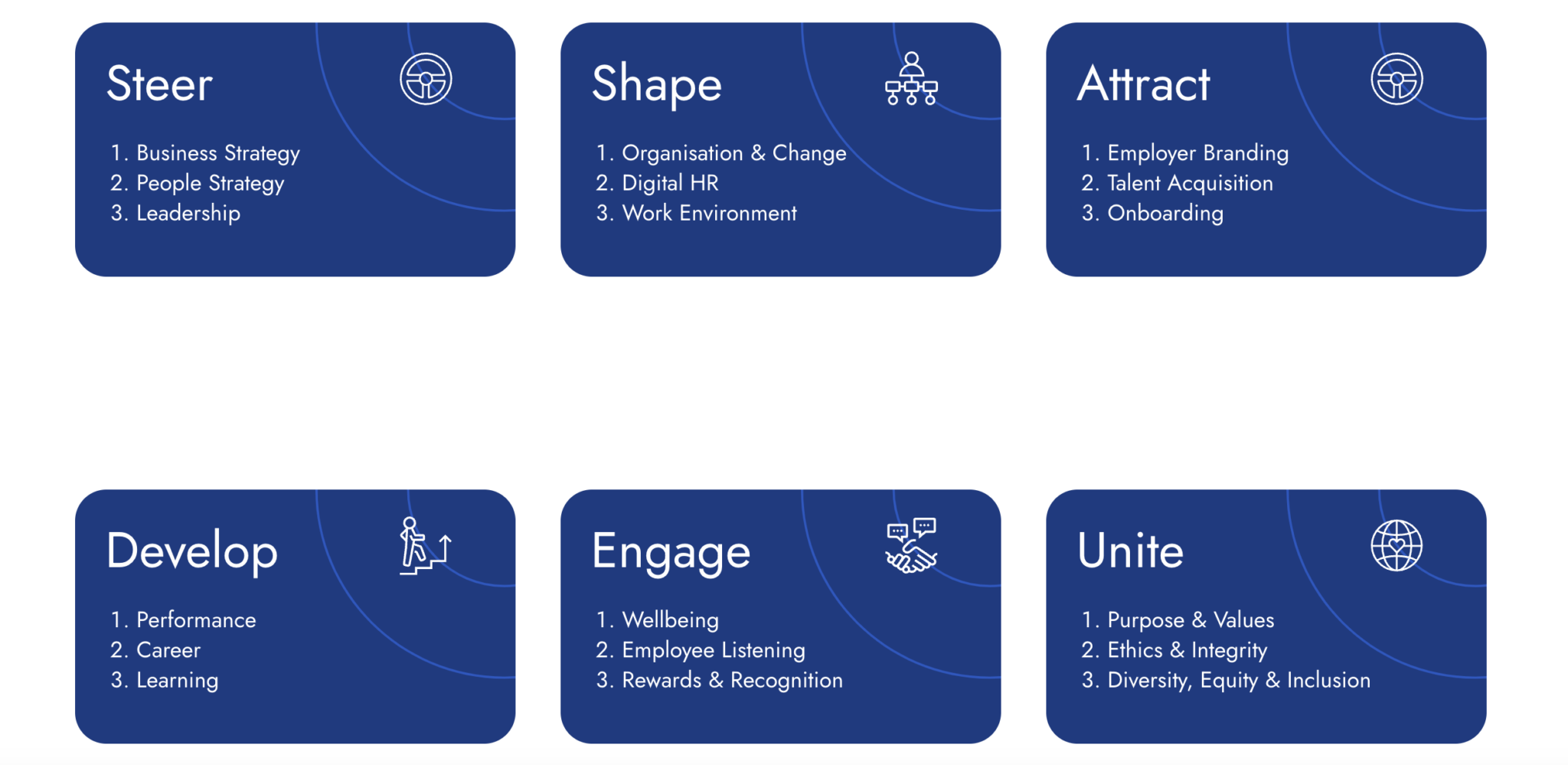
As the global authority in recognising excellence in people practices, the Top Employers Institute Certification Programme is an extensive process involving an independently audited and fact-based HR Best Practices Survey and validation to ensure truthful answers. The survey covers six domains and 20 subtopics:
In 2023 and 2024, organisations and leaders had much to consider, with many things in flux. David Plink, CEO of Top Employers Institute, observed: “In a world where geopolitical, societal, and macro-economic developments follow each other in rapid succession, the Top Employers 2024 are showing once again that they are a beacon of stability and reliability. Top Employers have shown that despite turbulent times, their focus remains on creating the best workplace possible for their people to thrive.”
When asked what makes a Top Employer, David Plink shared: “In my 16 years with the company, there are two characteristics that I have observed consistently within the members of the Top Employers community. First, certified Top Employers go above and beyond for their people. They are the embodiment of people focus. Secondly, not a single Top Employer got certified without always striving for more. To learn, to become better and to stay curious at all times. People-focused and a growth mindset. It sounds so simple in summary, but it takes a lot to consistently live up to these principles.”
See the full list of the newly Certified Top Employers, below:
We caught up with Gabi Sanchez, Managing Director at certified Top Employer Verisure UK who reveals how they retain talent in a competitive market, the fantastic wellbeing initiatives in place, and how the organisation utilises AI to enhance DEI within its recruitment processes and to boost efficiency and productivity across the board.
Introduce yourself and tell us about your organisation
My name is Gabi Sanchez, I am the Managing Director of Verisure UK. We are the leading European provider of professionally monitored security systems. We are proud to protect over 5 million customers in 17 countries in Europe and Latin America. Our mission is to bring peace of mind to families and small business owners by providing them with the best security solutions and services.
What makes Verisure UK a Top Employer?
We recognise the importance of continuous career development and wellbeing. Our initiatives are constantly evolving to allow our colleagues to grow both professionally and personally. We are delighted to offer a range of training and development courses, weekly check-ins, and annual career discussions to empower colleagues to reach their full potential.
We believe that personal wellbeing is critical to the overall growth of our colleagues, we offer a comprehensive employee benefits package to improve our colleague’s well-being, including private medical insurance, pension, flexible working, health and wellbeing programmes, away days, financial advisors, a day off for birthdays and many more.
Additionally, we have created spaces that foster a collaborative and innovative work environment. Our offices are designed to enhance productivity and satisfaction, with amenities such as subsidised canteen, games room and break out spaces in our Newcastle Centre of Excellence.
What is the biggest people challenge your business faces in 2024? And what will you do to meet this challenge?
One of our challenges revolves around talent retention and development in a competitive market. As one of the UK’s leading monitored alarm companies, we recognise the critical role our employees play in delivering exceptional service and driving innovation. As a result, we are continuously investing in tailored training, competitive benefits packages, providing clear career paths, and addressing feedback to retain top talent and remain competitive.
Tell us about a recent HR initiative you have instigated within your organisation that you are most proud of?
We are immensely proud of the initiatives we have implemented. One standout initiative is our Mental Health First Aiders program, a vital support system for colleagues navigating mental health challenges. This program cultivates an environment where individuals feel supported and empowered to seek assistance, resulting in improved mental health and overall wellbeing throughout our workplace. Furthermore, we extend a 24-hour counselling service through Aviva, ensuring that our team members have access to professional support whenever they need it.
How is AI affecting your business?
AI has become a transformative force in our business, impacting our people practices in different ways. One notable aspect is our utilisation of AI tools to enhance diversity and inclusion within our recruitment processes. We employ an AI tool to ensure gender-neutral language in our job ads, mitigating unconscious biases and promoting equal opportunities for all candidates. In addition, we’ve implemented an AI tool called Co-Pilot, which streamlines our work processes and workflows, allowing our teams to focus on strategic initiatives rather than repetitive administrative tasks. By automating routine processes, we’ve been able to boost efficiency and productivity across the board.
Which wellbeing offerings in your business are proving the most popular with employees? And which are proving the most effective in terms of their impact?
Our flexible working opportunities and private healthcare are two of the most popular and impactful wellbeing offerings among our employees.
Our colleagues are given the flexibility to work remotely from home or abroad or simply adjust their hours to suit their schedule depending on their role. This plays a huge role improving work-life balance and maintaining high satisfaction levels. Additionally, our private healthcare offering has been incredibly popular. It has had a significant positive effect on our employees’ well-being. Our private healthcare option contributes to better overall health and morale within the team, and we continue to receive positive feedback on both fronts.
Have you any new DEI initiatives you can tell us about that help you tap into fresh sources of talent?
We have several DEI initiatives that help us tap into fresh sources of talent both internally and externally. This year, one of the exciting outcomes from our DEI roundtable is the launch of an internal job fair. This allows us to tap into fresh sources of talent within our existing workforce and promote internal mobility. It also provides an opportunity for our colleagues to meet colleagues from different departments and discover different opportunities that they didn’t know is available to them.
What’s next? Tell us about a new initiative/project for 2024 that you’re most excited about?
This year brings a wave of exciting new initiatives and roles. We are on the lookout for talented individuals, who would like to grow with our company. The roles currently available include customer service representatives, sales executives to Alarm Receiving Centre Ambassadors and many more. We offer extensive on the job training and a supportive work environment that empowers individuals to thrive and advance their careers. We’re also launching thrilling new initiatives, such as new television campaigns, so people can expect to see a lot more of our branding throughout the year!
Best Practice | Conscious Leadership Builds an Inclusive and Effective Culture at Boehringer Ingelheim
At Boehringer Ingelheim Mexico, leaders are crucial for shaping a culture where all employees can feel a sense of belonging within the organisation. As role models, they help to set the scene and show that diversity and inclusion are priorities. For the organisation, the meaning of diversity refers to diversity of thought, while inclusion is how they bring different perspectives and ideas together for innovation.
This best practice focuses on developing a new generation of inclusive leaders through a series of targeted training modules to enable them to foster psychological safety at all organisational levels and identify issues arising from micro-aggressions, harassment, discrimination, and unconscious biases. The basis for this transformation was a “Conscious Business Leadership Programme,” an Unconscious Bias e-learning course, and Psychological Safety & Speak Up workshops.
This is just a snapshot of Boehringer Ingelheim’s innovative best practice. You can find the entire practice in our HR Best Practices database, which is exclusively available to Top Employers. Get inspiration and insight into the approach, challenges and learnings experienced by certified Top Employers. Access it now via the Top Employers Programme if you are certified or learn more about it here!
Why the practice was needed
Culture and leadership are inextricably linked: consciously or unconsciously, leaders foster the values and beliefs that underpin an organisation’s culture and imprint values and assumptions that persist for decades. An organisation’s leaders can also shape culture over time through their conscious and unconscious behaviours.
Boehringer Ingelheim Mexico recognises that being able to promote their organisation as one where different genders, identities, races, ages, and backgrounds are celebrated is directly linked to increased employee engagement, innovation, and productivity. Prioritising diversity and inclusion training at all levels, but especially for the role models who lead organisational culture, is key to facilitating true inclusivity. Without engaged leadership, such activities can become nothing more than corporate speak.
How the practice was implemented
Boehringer Ingelheim Mexico has implemented a Leadership Journey that includes comprehensive D&I training. Traditionally, in business, leaders are often selected based on their individual success. At Boehringer Ingelheim Mexico, developing leadership skills goes beyond technical skills; the ethical aspect of leadership has become imperative. Leaders are asked to grow in their roles in a human sense.
These programmes aim to evoke the internal commitment of the team members to accomplish the organisation’s mission with effectiveness and integrity. It means doing so with the understanding that their team members are human beings who will only do their best if they are inspired, feel safe, and believe they are truly included and have a sense of belonging in the organisation.
All leaders in the company are required to participate in training programmes to ensure that they all operate from the same basis for managing talent within the organisation. For D&I, their Leadership Journey includes four programmes:
Unconscious Bias e-Learning accessible through an online D&I channel
Psychological Safety & Speak Up leadership workshops
People Growth + Diversity & Inclusion + Belonging: D&I topics as part of management are addressed during the mandatory training for Boehringer Ingelheim leaders. The training includes skills and tools for communication, feedback, and feedforward.
Conscious Business Leadership Programme: developed and presented in conjunction with Fred Kofman, a renowned Executive Coach and Advisor on leadership and culture and Founder of the Conscious Business Center. Over the course of 32 weeks, leaders engage in learning about the following topics: leadership, culture, communication, responsibility, humility, collaboration, resolution (honesty), coordination (commitments), essentialism, co-evaluation (feedback), emotions, meditation, perspectives (empathy), stoicism (flourishing), teamwork, coaching, capitalism (ethics), anti-capitalism (justice), and the West (economy and citizenship).
The web platform, for leaders and direct reports, was created on the company’s intranet. This space is available to ensure that employees are able to find all the information they need and more to reinforce an open, just and equitable culture. In this way, leaders have access to information from anywhere, at any time, to be able to effectively address issues such as micro-aggressions, bullying, discrimination, etc.
The Conscious Business Leadership Programme was designed and aligned with the company’s corporate competencies, behaviours and code of ethics, allowing Boehringer Ingelheim Mexico’s leaders (Directors, Senior Management and Middle Management) to put the organisation’s philosophy and values into practice on a daily basis within their teams. Their leaders learn to manage by improving effectiveness, caring for collaborative relationships with their team and peers, as well as promoting the welfare of all involved.
Leadership is divided into three cohorts, and the programme is tailored accordingly. Thereafter, the training is cascaded throughout the organisation. Those three cohorts are:
Cohort 1: Senior Leadership
Cohort 2 and 3: Leaders across the business functions
The results of the practice:
To measure the effectiveness of this best practice, a global survey is undertaken annually across Boehringer Ingelheim countries, totalling 54 000 employees. Each country has its own results and a comparison with the global results. Below are a selection of the results Boehringer Ingelheim Mexico has obtained that are directly related to the leadership development trainings and coaching discussed in this best practice:
86% agree that leaders work effectively with people who are different from themselves.
93% agree that people are treated with respect in Boehringer Ingelheim, regardless of their job, level, etc.
98% agree that the values of Boehringer Ingelheim and the principles of the Code of Conduct support employees in their work on a day-to-day basis.
Notable Quotes:
“No matter what position you hold in the company, you can make a huge impact with what you say and how you say it.” Luis Carlos Pérez, Director of Communication
“Regardless of position or rank, lets demand that we work with the principles of Conscious Business. It is the most efficient and fastest way to establish a conscious business culture.” Augusto Muench, CEO
How to Build a Strong Company Culture in a Global Organisation with NTT Data
Every organisation has a culture, whether it was intentionally or passively created. A healthy workplace culture is one of the fundamental elements of a successful company. In today’s global landscape, businesses extend their operations across borders and cultivate diverse workforces. Developing and maintaining a strong culture in this context presents some unique challenges. A positive work environment benefits a company in numerous ways, which is why it is essential to build that culture rather than leave it to chance.
During our insightful conversation filled with personal anecdotes at the 2023 Top Employers Inspire event, Kim Curley, VP of People & Organisation at NTT DATA, shared valuable perspectives and actionable strategies on the art of crafting and nurturing a strong corporate culture. Kim’s role is unique in that she’s responsible for NTT DATA’s internal change management process and for the organisation’s consultancy services in that space, which she called “the personal side of business where all the wonderful messy, human things happen.” Experiencing change from the inside and managing it as a third party for other organisations has given her great insight into how to successfully build a strong culture.
Crafting a Culture
Like many companies, NTT DATA re-evaluated its priorities and values during the massive societal and workplace changes brought on by the pandemic. Kim explained, “We had been through a tremendous amount of change in the past three years and we wanted to assess what aspects of our culture had weakened that we needed to strengthen.” Trust, community, and success were the three values identified through their discussions.
The next step was deciding how to strengthen those values in their workplace culture. Kim shared that the discussion began with a guiding question: “How do we define these values that make us special and make us a place where people want to come work and a place that clients want to hire?” Three strategies emerged as important aspects of crafting their culture.
Involve employees in developing initiatives around the three core values. If culture is not built from the ground up, it will be very difficult to enforce it from the top down.
Create a social accountability contract. Foster a sense of responsibility among employees to embody and uphold the core values.
Anchor to a career coach model. Resources extend beyond hierarchical, mentor-like relationships to help employees develop across the different roles they hold as consultants and over the arc of their careers.
Changing people’s mindsets is one of organisations’ most significant challenges when implementing new initiatives. “It takes a tremendous amount of energy not only from the people trying to encourage the change but also from the brave souls trying to make the change. That’s always the hardest part, to be a supporter and to step into that new space,” said Kim. This process was an excellent opportunity to lean on the social accountability contract and encourage employees to support one another as they adapted.
Silos
Silos are another familiar challenge companies face, and this challenge becomes even more pronounced when a company operates on a global scale. One of the significant problems posed by silos is their potential to impede the growth of a company-wide culture. To confront this issue head-on, Kim’s team developed a proactive strategy. She described their process, “We look at what our company values mean for each team. What can be done to make these values come to life in our individual geographies, business units, and ways of working?” For example, the community looks very different for a team co-located in the same geographic area with an office space than for a remote team working from different countries. Community is equally essential in both scenarios, though initiatives to cultivate a sense of community will look very different.
Organisational Hurdles
Aligning policies and procedures with company culture is essential to NTT DATA’s success. “When you’re trying to change culture, one of the things that will trip you up the fastest is if the organisational elements of your business do not support the cultural change,” Kim said to elaborate on this point. Changes to a company’s infrastructure have far-reaching effects and can either support or hinder how the culture evolves. Therefore, it is critical to be intentional about company policies and structure them in a way that supports the culture.
Kim compared their approach to caring for a garden to summarise how her team fosters a strong company culture. “You have to constantly nurture it to help it grow and be very aware of what you add to it,” she explained. Ultimately, a positive company culture is a constant work in progress. Although building it requires time and effort, the long-lasting benefits are immense. Low turnover rates, boosted productivity, and high morale are all results that help a company achieve success.
One of the things I enjoyed most about our discussion was hearing about Kim’s personal experience with NTT DATA’s cultural changes and how those changes impacted her daily workflow and her relationships with colleagues. I encourage readers to check out our full conversation for even more insights and a personal perspective on what a strong culture can mean to employees.