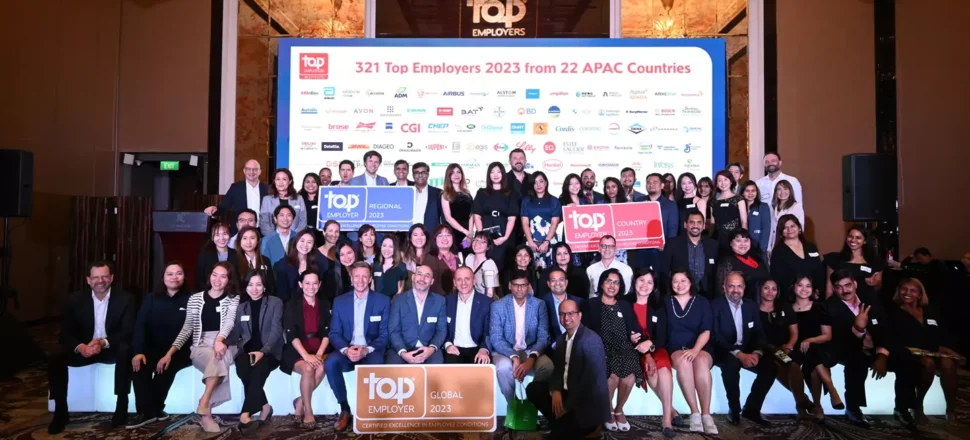
Purpose and Employee Experience Take Center Stage at the APAC Top Employers 2023 Certification Celebration in Singapore
Top Employers from 22 Asia Pacific countries gathered at the ST Regis in Singapore on February 9 to celebrate their Top Employer 2023 Certification. This annual event recognises the commitment of these companies’ HR teams to create a world-class HR environment.
In his keynote talk, Billy Elliott, Regional Director for Asia-Pacific Top Employers Institute, shared that 22 Asia Pacific countries were honoured as Top Employers. These countries, including China, India, South Korea, Australia, Singapore, Japan, Malaysia, Thailand, Hong Kong, New Zealand, Philippines, Azerbaijan, Bangladesh, Indonesia, Kazakhstan, Pakistan, Sri Lanka, Taiwan, Uzbekistan, Vietnam, Cambodia, and Myanmar, have companies that have created and implemented best in class HR strategies and practices. This has resulted in a positive impact on the lives of approximately 2,574,089 employees.
The companies recognised as Regional APAC Top Employers (for having been certified in a minimum of five countries in region) were UST, Sanofi, SABIC, Novartis, Airbus, Worldline, and Ingredion. The companies recognised as Global and Regional Top Employers were Alstom, BAT, Boehringer Ingelheim, CHEP, DHL Express, HCLTech, DHL Global Forwarding, Infosys, JTI, Pepsico, Phillip Morris International, Puma, Saint-Gobain, Takeda, and TCS.
With both regional and global companies recognised as Top Employers, it is evident that creating a positive employee experience is a top priority for many organizations, which was the focus of the first panel discussion held:
*Fill in the form to get access to the panel discussion.
Employee Experience becomes Super-Personalised
The importance of personalising employee experience has become a critical focus area for organizations. To better understand this topic, a panel discussion was held with three leading HR executives – Sanjiv Agarwal, Head of Human Resources at Swiss Re, Satish Kannan, Vice President & Head HR of Global Markets, Europe & MEA at Infosys, and Patricia Lam, HR Director and APAC HR Performance & Integration at Alstom and moderated by Ammara Naeem, Head of Client Success at Top Employers Institute. Here are some key takeaways from the discussion.
- Employee experience covers the entire employee journey – During the panel discussion on employee experience, Sanjiv of Swiss RE emphasised that the concept of employee experience and morale is not new, but rather something that has always existed in the workplace. Employee experience encompasses all aspects of the employee’s journey, from the moment they apply to the company to their experience during the interview process and throughout their time with the organization. Employee experience should not be solely driven by HR but should be considered a part of the organization’s culture.
- Three drivers for an employee experience framework – Satish of Infosys discussed three key drivers for their employee experience framework, which include adapting to a hybrid work model, leveraging technology for a unified experience, and creating an inclusive culture. To measure digital maturity of talent, they introduced the “Digital Quotient,” which involves building competency, gaining exposure, and delivering value, with scores for each component. This approach allows employees to customize their digital career journey by identifying learning and product opportunities to improve their scores.
- The importance of consistency in employee experience – In the discussion, Patricia of Alstom emphasized the importance of consistency in employee experience and how to achieve it through digitalization. They have established a global learning organization and a digital platform that provides various learning opportunities for employees to drive their career development. Patricia also highlights a digital career path portal that allows employees to assess their competencies and match them with available jobs in the organization.
Purpose, Straight from the Heart
The second panel, “Purpose, Straight from the Heart,” brought together three HR leaders from major multinational corporations to discuss the importance of purpose-driven organizations in today’s business landscape. Kelly Tay, Head of Talent Leadership Organization for Southeast Asia and South Korea at Boehringer Ingelheim, Meng Hwee Teoh, Asia Talent Head at Sanofi, and Fred Barou, Senior Vice President of Customer Success Management at Amadeus. Here are the key takeaways.
During the opening statement of the Purpose, Straight from the Heart panel, the audience was presented with a provocative statement – “Purpose is fluff not much action” – and asked to agree or disagree. The results were unexpected, with 37% of the audience agreeing and the rest disagreeing. The panellists went on to discuss the implications of this divide and how organizations can move beyond seeing purpose as a mere buzzword and translate it into concrete actions. Here are key takeaways of that panel discussion:
- Connecting Individual and Organizational Purpose for Employee Engagement – Meng Hwee Teoh from Sanofi discussed how the company’s purpose statement, “to chase the miracles of science, to improve the lives of our people, the communities and our own employees,” is not just a plaque on the wall, but a rally call for employees to live out in their everyday lives. Before launching the purpose statement, the company identified behaviours that are important to gear towards the purpose and set up a set of “play to win” behaviours. Additionally, the company redefined performance to help employees focus on areas where they could create an impact and linked it closely to the employee’s everyday life.
- Communicating Purpose to Customers and Employees – Fred, a commercial leader from Amadeus, a B2B travel and tourism company, spoke about the challenge of effectively communicating the company’s purpose to customers and ensuring that employees can connect with it daily. The company’s original purpose was to “shape the future of travel,” which has since been updated to “create better journeys for everyone,” reflecting the company’s commitment to opening travel to everyone and improving the travel experience. The purpose serves as a guiding principle for employees and creates a sense of connection to the company’s mission, particularly during the pandemic when the travel industry was severely impacted.
- Purpose is not just a one-time event or training – Kelly from Boehringer Ingelheim believes that purpose is about actions from the past, present, and future, and that it’s important to create events and opportunities for reflection in order to connect employees with the company’s purpose. As an example, during their “Valued Through Innovation Day,” they invited an artist to speak about how she uses her purpose to create art, and employees were given the opportunity to reflect on their own purpose and create artwork representing it as a team. This exercise helped employees connect emotionally with the company’s purpose and led to meaningful stories being shared.
The Top Employer Certification is an important recognition for companies that care about their employees and are dedicated to and are dedicated to creating a better world of work for their people. The celebration of this achievement is a time to reflect on the hard work and dedication that went into achieving the certification, as well as a time to recognise the accomplishments of the HR teams. If you are interested in becoming a Top Employer and and participating in this year’s Certification Programme, get in touch with the APAC Top Employers Institute team at apac@top-employers.com.
Case Study: Deutsche Post DHL
Certified Top Employer, Deutsche Post DHL Group (DPDHL), is the world’s leading logistics company employing nearly 600,000 colleagues and operating in over 220 countries and territories worldwide.To increase collaboration and interaction between their large number of employees within the company, DPDHL has implemented Smart Workplace, a mobile application designed to improve the daily employee experience. Developing the Smart Workplace was a challenge not only because it was a huge undertaking in scale, but it was also a challenge given the diversity of employees, roles, languages and places of work.
- The organisation customised this intranet as a mobile application using tools such as the Office 365 suite.
- The Covid-19 pandemic impacted the launch and need of the Smart Workplace platform for DPDHL.
- Smart Workplace has become one of the leading internal information sources within DPDHL, engaging more than 300,000 employees worldwide just 6 months after its launch.
Boosting Morale by Giving Back with CPFL Energy
CPFL Energy Fosters Goodwill by Creating a Sustainability Plan
Giving back is an important part of a company’s presence in a local community and, for larger companies, the world at-large. Charity work improves a company’s image, creates a better place to live and work for employees and local residents alike, and fosters a sense of goodwill. With so many worthy causes, companies often focus their philanthropic efforts on an issue that resonates with their services, mission, and values. For CPFL Energy, a Certified Top Employer, that cause is climate change.
CPFL Energy is the largest energy company in South America. Headquartered in Campinas, Brazil the company was founded in 1912 and operations are supported by 13 000 employees. Their focus is on the distribution, generation, and commercialization of energy services to over 10 million addresses, which represents more than 22 million people.
The company recently implemented a Strategic Sustainability Plan with 15 commitments and an investment of R$1.8 billion from 2020 – 2024. CPFL’s plan is fully aligned with the United Nations’ Sustainability Goals. Some of their goals include maintaining at least 95% renewable energy sources in their generation portfolio, reducing greenhouse gas emissions – which they did by 24% in 2020, and generating carbon credits by assisting consumers’ energy transition with decarbonization and energy efficient solutions.
Three value pillars are the basis for CPFL’s sustainability plan: sustainable energies, smart solutions, and shared value. These values succinctly summarise how the company will focus its efforts on creating a smaller environmental footprint. It’s a clear way to share with both the global business community and the local community they serve how they are taking action.
In addition to the obvious benefits of combating climate change, this initiative contributes to greater employee cohesion and job satisfaction. Working for a company that gives back improves employee regard for company leadership and fosters a positive sense of connection. Good morale is an important ingredient for successful operations and a giving back initiative is a great way to bolster it.
Rodolfo Nardez Sirol, CPFL’s Environmental and Sustainability Director, offers more detail about the company’s sustainability plan and what motivated them to devote so many company resources to it in this video. He describes how employees collaboratively developed the plan and what they are doing to keep up momentum. Check out the video to hear more about how CPFL finds fulfilment in giving back.
How the Workspace Can Improve Employees’ Experience
Learning from NN Group’s Design Innovations
The work environment has a huge impact on employees’ daily experience. It is everything that contributes to people’s experience of a physical space – the art on the walls, the floor plan, furniture, communal areas. A pleasant and comfortable office space improves productivity, helps with talent acquisition, and fosters the team’s overall sense of well being. The physical space creates an atmosphere that influences company culture and how employees interact.
With this in mind, NN Group’s Hungarian office began planning a new workspace to reflect the needs and preferences of its employees and to cultivate an agile way of working. NN Group is a financial services company with offices in 11 countries and an impressive history that spans 175 years. They provide retirement, insurance, and investment services to 18 million customers with a team of 15 000 employees. The Hungarian team spent 16 years in their previous office and welcomed the opportunity for a fresh start.
Employee feedback was one of the primary inputs guiding the design process. This feedback was gathered through workshops and questionnaires. More areas for collaboration and a more colourful, bright space were among the top requested changes. In response, the new building features large windows and numerous colourful communal areas.
The company also engaged employees with the project in creative ways throughout construction. Through a webcam, team members saw construction happening in real-time. Periodically, a member of the HR team filmed a tour of the construction site. Employees tested furniture options in the previous space, voting for their favourite ones.
Reflecting the company’s values of sustainability and community was also an important part of the project. The design team reduced water use by including a rainwater collection system to flush the toilets. Positioning the new office near public transportation decreased employees’ reliance on cars. Furniture from the old office space was donated to a local children’s hospital.
The benefits of a thoughtfully designed office space cannot be overstated. When employees like their workspace, they are more productive, energised, happy, and healthy. Many positive ripple effects result. Employees are more likely to refer new potential employees, company performance metrics improve, and employees feel valued.
In addition to these benefits, NN Group Hungary was also nationally recognized for their innovations. The office was a finalist for Hungary’s ‘Office Space of the Year’ competition. See the space and hear more of the company’s design innovations in this video hosted by Krisztina Hársfalvi-Tóth, HR Business Partner for NN Group Hungary.
Helvetia Case Study: The Impact of Internal Best Practices Sharing
Certified Top Employer Helvetia Insurance, established in 1858, is headquartered in St. Gallen Switzerland. As an organisation they currently have over 11.500 employees and more than 7 million customers across their different operating countries.
Helvetia have prioritised improving their people practices over the past few years as they joined the Top Employers programme. In recent years they have wanted to improve their practices not only through benchmarking but also through learning from the various Helvetia branches. This desire for improvement and learning lead them to create an internal best practice sharing session.
Download the Case Study to learn how:
- Helvetia have been able to create a unified best practice sharing session that has improved HR practices across their offices.
- They use the Top Employers programme to guide the improvement of their HR practices.
- Employees in Helvetia have experienced the internal best practices sharing sessions.
Mental Health Q&A: Bentley
In advance of #WorldMentalHealthDay, we caught up with Emma Humphries from certified UK Top Employer Bentley. Emma is co-chair of its wellbeing network BeAccessible – in this interview she reveals more about the network, how it contributes to positive change within the organisation, and how mental health has moved up the organisation’s priority list.
Tell us about yourself and your organisation?
I’m Emma and I work as a Technical Analyst here at Bentley Motors. Bentley has a proud 103-year history of building the most sought-after luxury cars, and we’re also on the most ambitious journey with our Beyond100 plans to become exclusively electric and end-to-end carbon neutral by 2030.
At the heart of Bentley are our 4,000 colleagues. Whilst those numbers might sound big, we’re a tight team with generations of families working here, which makes Bentley a very special place to be. I am proud to follow the footsteps of my late Grandfather who joined the business the day it opened its gates, followed shortly after by my Nan. Since then, there has always been members of my family throughout Bentley’s history; my father, working mainly in Security, and my three brothers working in Purchasing, Maintenance and Finance. When I finished college, I knew I wanted to be a part of the Bentley brand and family. I’m proud to have just completed my 25 years of service, working predominantly in Logistics – a department and family that is full of drive and passion.
It’s our people that bring our vision for Diversity and Inclusion to life with our colleague led networks. I co-chair one of those networks, known as BeAccessible. It was launched following World Mental Health Day in 2021 and our ambition is simple; we support colleagues in all aspects of health and wellbeing to ensure our workplace is inclusive, and aim to create an equal environment for colleagues with disabilities. Other colleague networks include BeProud, who advocate for our LGBTQ+ community, our BeUnited network who represent colleagues of ethnic minority, our BeReady network, who support colleagues with a background in the army or other recognised force and our BeInspired network which brings together those with an interest in increasing the proportion of female colleagues across all of our business areas to accelerate our progress towards Bentley’s Beyond 100 goals of 30% women in management by 2030.
How has Bentley’s mental health strategy evolved over the past year, in what we all hope is a post-pandemic world?
The Covid-19 pandemic has impacted us all in different ways, and we quickly realised that we could not deliver a one-size fits all approach to mental health. With the support of our Head of Diversity & Inclusion, the BeAccesible network established a Positive Mental Health Workstream, and evolved our strategy to have a range of touchpoints for colleagues in a way that works for them, whether that be at work or in new home office.
So, our multi-tactic approach means colleagues can get access to face-to-face peer group support through our regular Time to Talk sessions or get more tailored and personalised support through a trained Mental Health First Aider. But we have also evolved our strategy to focus on day-to-day mental health through BeFit walking programmes, BeFit fruit giveaways etc, as well as the opportunity for colleagues to join our allotment community to enjoy the outdoors because we know helping colleagues with positive habits can help mitigate the impact of mental health stressors.
Has mental health moved up your organisational priority list?
Absolutely, in fact it is being actively championed, from board level to factory floor. It makes me feel proud to work here and excited about what the future holds for Bentley.
Bentley offers an array of resources for colleagues. This month, along with the network’s regular monthly Time to Talk sessions, we are promoting our Mental Health Traffic Light guide, which contains several useful resources – for example, a list of our Mental Health First Aiders and information on our BeFit programs, designed to get colleagues moving and exercising. We are also sharing colleague’s experience of Ben, the Automotive Charity, and the great support that they offer to colleagues from our automotive industry. The network chairs and members have regular opportunities to meet or ask questions with the Board where we receive full support, answers and guidance, ensuring that we are all striving for the same goal of improving colleagues’ experiences.
How have conversations around mental health changed?
I’m a firm believer that the more we talk about mental health, the more we can demystify. We’ve got a supportive communications team who help make health and wellbeing a priority across our messaging, and we’ve been empowered to host monthly MS Teams sessions to reach our remote colleagues, or those working at home. We also use national events to bring awareness, for example May’s Time to Talk was about Loneliness.
This constant conversation has seen the network reach 170 members, as well as engaging with many more thousands of our colleagues in some way.
Mental health is definitely becoming something that more and more people want to talk about and support and I am really proud that our BeAccessible network has been an enabler for this.
What will be your priorities in Mental Health in the year ahead?
The network has just advertised a companywide Movember campaign, we will be focusing on mental health during International Men’s Day with our Men’s Forum Workstream to ensure we continue our mission to remove taboo and stigma and encourage colleagues to start conversations and signpost. BeAccessible also promotes Bookboon, which is a digital learning service provider for corporate learning & development. In particular, we will be promoting titles linked to mental health and stress as a priority on awareness days and throughout the year generally.