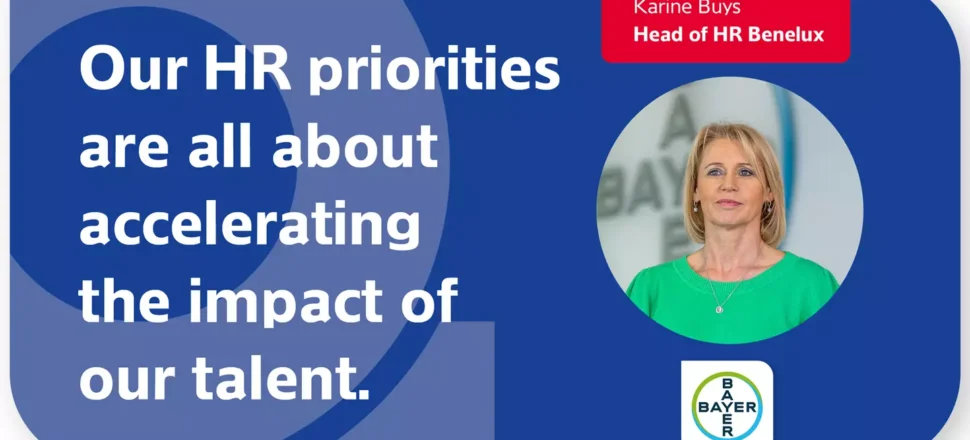
Our HR priorities are all about accelerating the impact of our talent
What are your key HR priorities for 2023 and why?
Our HR priorities revolve around maximizing the potential of our talent and fostering a culture of high performance by focusing on:
- Driving our cultural transformation through a leader development & culture program “Engage – Shape – Perform”
- Empowering and supporting all our people to take ownership of their careers, enabling them to reach their full potential
- Shaping a caring environment, in which wellbeing & employee experience at scale is key
- Implementing future ways of working (digital – data analytics – virtual assistant & automation)
- Embedding Diversity, Equity and inclusion further into everything we do
Which trends do you think will be central in the world of HR in 2023 and beyond?
Important trends in HR that we are taking into account in our strategies are the:
- Move from intuition & bias to evidence based working through data analytics
- Switch from job based to skill based working
- Hybrid working and new office concepts
- Focus on selfcare – more focus on preventive action over curative
How has being a Top Employer helped your employer brand?
The Top Employer certification helps to benchmark our company against other top employers and provides useful insights into areas we can still develop or innovate further. It is of course also an important employer branding tool, which can differentiate us from competitors. Many candidates are very well aware of it, and as the labour market is candidate driven, it is really supportive for our brand and for attracting the right candidates.
Winning the Battles for Talent
I think it’s time that we stop saying we’re in a war for talent. Not because the fight is cooling off, but rather, because it is intensifying. It is worth changing our perspective on the concept itself; its real form is not that of a war, but of continuous battles for talent. Organisation’s ability to attract, engage and stay committed to and excited about the talent they need is not something we win or lose at once. It is a process of continuous improvement – a thrilling one at that – in which the areas of people management play a decisive role.
Maximising the Employer Brand Strategy
88% of companies worldwide certified as Top Employers have an employer brand strategy that incorporates their employee value proposition as a core element. Naturally, all organisations offer some kind of value proposition to their employees.if they didn’t, it would be difficult to attract anyone, or keep them in the company for that matter – but here we are talking about effectively addressing the challenge of identifying, developing and communicating what you can offer to the talent you require, both during the hiring process and once they are in the company. A value propositon is something that makes the organisation unique, makes it a company that professionals want to belong to, where they want to work and thrive. That, undoubtedly, is a competitive advantage that sweeps away any competition.
Optimising the Candidate’s Journey
The best companies want to make sure they deliver on what they promise, and they achieve it by embarking on a process of listening and continuous improvement. That is why 89% of Top Employers design and review the key stages of their talent acquisition process so that they are aligned with the pillars or key characteristics of their employer brand. What’s more, 70% of Top Employers systematically measure their employer reputation among their potential candidates – their target market for talent – while 70% also map their candidate’s journey, allowing them to optimise it. They outline what the experience will be like, both from their perspective and that of the candidate, and work with the information they collect from surveys to implement a process of continuous improvement at each focal point. The aim of this is to improve the candidate’s experience so that the hiring process is agile and reflects the pillars of the employer’s brand, making the company more attractive.
Measuring the Experience of Newcomers
These steps are not limited to candidates; they are also aimed at employees, both existing and new. 79% of certified Top Employers measure the experience of new employees, but it is interesting to note that 40% also focus on discovering whether the perception of the employer brand the employee had before joining the organisation has matched their actual experience in their first few weeks of company life. This is very insightful information. It reflects the fact that they are companies with a daring attitude, that are very committed to people, and that thrive in the spirit of continuous improvement. The results they capture inevitably lead to action, and either they change the experience or they will have to change the employer brand.
The best companies will need to work to build trust in their employer brand with the aim of maintaining their commitment to their promise of value throughout the talent life cycle of the organisation. 85% of companies certified as Top Employers ensure that there is a clear alignment between the employer brand and the perception and experience that employees have. They are consistent and coherent brands that work to ensure that no disparity arises between how they consider themselves to be and how they really are in the day-to-day life of the company.
The EVP at the Core of the Employer Brand
An employer brand strategy should have the employee value proposition (EVP) at its core. This is, after all, what gives it consistency, because it brings together the tangible and intangible benefits offered to employees and is aligned with the pillars of the employer brand, related especially with the current and aspirational values of the company.
80% of Top Employers are clear on the fact that, for an employee, a good value proposition must include an effective listening process. For this reason, they actively involve representatives from different groups of employees in defining their value proposition, evaluating their needs, aspirations, and current work experiences. Best practices in this respect shows us the relevance of segmenting employee samples and analysing whether there is a gap between the company’s vision and that of the employee – something which is usually the joint work of management and human resources.
Mapping the Employee Experience
Of course, the EVP, the heart of the employer brand strategy, is certainly not the result of a one-off exercise; the best companies – 72% of Top Employers – increase their value by regularly assessing it, and they continue the systematic exercise of listening to employees. 46% of them use effective tools like employee experience mapping, which details the employee’s perception at every touch point of their journey in their relationship with the company.
Final Thoughts
Talent battles are continually being fought. Socrates, with very good judgment, left us with this reflection: “The way to gain a good reputation is to endeavour to be what you desire to appear”. Consistency between what we say we are and what we really are is what builds trust in the employer brand. The best companies invest time, resources, and enthusiasm, as they embark on a process of continuous improvement to achieve what they promise.
Reskilling & Upskilling Your Workforce for the Future World of Work in 2022
The last few years, with the help of the covid-19 pandemic The changing world of work seems to be moving faster than ever before, with skills that were once in demand may not be applicable to the demands of the current working landscape. Organisations that are looking to not only improve their current efficiency but their overall future as a business are aware of the necessity to reskill and upskill their workforce.
Almost all (92%) of certified Top Employers have a learning and development strategy in place in 2022, with 96% of them also continuing to have a learning and development framework. This commitment to creating an environment that is encouraging to employees reskilling and upskilling is supported by 94% of Top Employers having a defined learning and development culture.
In 2020 the World Economic Forum found that, by 2025, 85 million jobs globally will undergo a transition between human labour and machine automation across fifteen industries and 26 economies. While this change in the distribution of labour has been faster than previously expected there is still, according to the World Economic Forum, new era of work will create millions of new jobs that will require a new set of skills that will highlight the value of reskilling and, in the case of other employees, upskilling them. We will look more deeply at this trend in this article by defining and then examining what these terms mean in 2022 and beyond.
What is Reskilling and What is Upskilling?
Reskilling is simply the process of an employee learning a new set of skills and responsibilities to help them undertake a new role in their current organisation. The process of undergoing reskilling is usually lateral learning experience that allows people to make a smoother transition in their career journey.
In contrast, upskilling is the learning and development process for an employee to improve their skillset to improve their effectiveness at work. This involves giving an employee the opportunity to develop and advance a particular skill, or set of skills
Reskilling and Upskilling as Top Priorities in 2022 with an Eye for the Future
As the need for new capabilities and skills increases with the changes in the workplace continuing at a faster pace than ever, reskilling an upskilling can offer an organisation a way to develop the skills needed to ensure that they remain competitive without needing to hire for each new role. The ability for companies to retain their current workforce is not only good for their financial outlook but is also good to deal with employee’s new needs that have come as we enter the ‘new normal’ way of working.
Reskilling and upskilling are useful for employees to help employees transition within the organisation. Acknowledging that this is necessary for the future and starting to do the work to put it in place are two different actions.
The first thing an organisation should begin with is analysing where upskilling or reskilling an employee or a set of employees could help meet changing business needs. This analysis work is particular to each organisation, and as such is not something we will dive into in this article, it is work that will guide how to approach the next steps. It must be reiterated that upskilling or reskilling should be tethered to an organisation’s needs and goals.
The second step that an organisation should do is get to the organisation to structure and standardise their upskilling and reskilling efforts. This can be done by building a skills framework but if an organisation already has a learning framework it can be integrated into that structure. It can take many shapes but if an organisation wants to take reskilling and upskilling its employees seriously it needs to be understandable for the whole organisation in whatever form it takes.
Creating a culture around learning is the final step to making reskilling and upskilling a reality. It will need engagement and excitement around learning to fully benefit. Additionally, there will need to be leadership buy-in to create waves around reskilling and upskilling.
Reskilling and Upskilling Benefits
For the Organisation
- Retain your best employees
- Develop your employees’ skills
- Reduced training and hiring costs
- Increase workplace moral
- Improve the reputation of the company
For the Employee:
- Keep stable employment
- Personal growth
- Professional growth through lifelong learning
- Upward mobility through role diversity
Final Thoughts
Reskilling and upskilling are not only business prioities for now but also for the future. Organisations will need to adapt with their workforce for the changing landscape of work.
The tips are often small but have a big impact
How do you make use of the Top Employers Community?
Since being certified by Top Employers we have been building relationships, not only with the Top Employers Institute, but also with other certified Top Employers. There is a network of organisations willing to share, help one another to progress and learn from each other. I have been brought into contact, via Top Employers, with organisations with more extensive expertise on employee well-being, which has led to virtual workshops on mental health.
How do you share successful practices and processes (with other Top Employers)?
I had the opportunity to be a guest speaker twice, to share my expertise on Talent Acquisition and D&I. Whether I’m on stage or in the audience, after a Connect & Share session I am always inspired and eager to implement what I learn at PageGroup.
How has the Top Employers community contributed to your development?
Being amongst other Top Employers gives me a sense of pride in my work at PageGroup. Reflecting on the practices of other Top Employers helps me to reflect on PageGroup and act upon what we could improve. The tips are often small but have a big impact.
Case Study: Talent, Borders and Benchmarks – The Dana Way
Certified Top Employer, Dana Hungary Kft., is a global leader in the design and manufacture of highly efficient propulsion and energy-management solutions. It supports nearly all vehicle manufacturers with drive and motion systems; electrodynamic technologies, including software and controls; and thermal, sealing, and digital solutions. In 2018 they, thanks to the benchmarking benefits of the Top Employers Institute’s programme, were able to get continuous insights and visibility on their employees’ needs.
As they did, they realised that they needed to provide their employees with an international mindset/approach to the job. In response to this challenge, they launched a programme that allowed employees to take on three to six-month assignments in a different location that allowed them to develop a wider cultural and professional knowledge.
Download the Case Study to learn how:
- Dana Hungary implemented their ambitious plan and how their employees responded to the programme.
- The organisation effectively resumed the programme after it had been temporarily suspended during the covid-19 pandemic.
- The model has become a benchmark for the wider organisation as other offices look to replicate the success of the programme in their offices.
Download the Case Study to learn more.
Supporting your talent strategy with Big Data
How can HR analytics and specifically big data be used for talent management?
That is what exactly Certified Top Employer Saint-Gobain discussed in a recent Top Employers Connect webinar. In the latest of our ‘For a Better World of Work’ series, we were joined by Jan Billekens, Manager Group HR Efficiency at Saint-Gobain and Alissa Hankache, Ph.D., Global HR Auditor at Top Employers Institute.
Read ahead to get a snapshot at some of the highlights from the webinar and fill in the form (on the right-hand side of the page) to get the recording to watch whenever you have a moment.
Companies use AI in people-related decisions for many reasons, including consistency, reduced bias, casting a broader net, and efficiency.
Data scientist Cathy O’Neil explains in her book “Weapons of Math Destruction” that algorithms and AI are easy to create using historical data and can improve the efficiency of decision making.
Data from TEI shows that among certified companies:
- In 87% of cases, HR supports business with people analytics.
- And in 88% of cases, business leaders are committed to using HR data analytics for fact-based decision-making about the workforce.
Approaching HR with analytics
With more than 166,000 employees, located in 75 countries, and a shared purpose of “MAKING THE WORLD A BETTER HOME”, Saint-Gobain is certified as a Global Top Employer since 2016. After internal reflection and deliberation, Saint-Gobain was left with one big question:
“How can we use big data for talent management in a global and highly decentralized industrial matrix organization like Saint-Gobain?
Based on this, the following objectives were established:
- Identify Talents
- Targeted development and career support
- Developing leadership capabilities
Ensure retention and commitment
An approach with three steps was then developed for the HR analytics project at Saint-Gobain:
- Assess Bronze Talent management
- Identify Talents at risk of leaving
- Identify undiscovered Saint-Gobain talents
Assess Bronze Talent Management
The first phase was to look at emerging trends from the algorithm, which came through as follows:
- Career progression – The algorithm has identified that talents within the five years at Saint-Gobain climb two-thirds bands more than non-talents.
- Career follow-ups – In annual succession planning and [erformance reviews, talents were mentioned more often in people reviews than non-talents.
- Development and training opportunities, – Talents have more training opportunities than non-talents.
- Base salary management – Salary increases are higher for talents than-non talents.
- Increasing gender balance – The % of female hired talents is 6% higher than male talents hired – based on strategic objectives.
The conclusion of this first part is that it confirmed that “what we want to do with our talent management is being achieved”.
Identify talents at risk of leaving
The second algorithm – looked into the past and analysed what were the elements of talents who left Saint-Gobain voluntarily in the past. The most impactful parameters were salary increase percentage and the date of last increase. The lower the salary increase, the higher the risk of leaving – no surprise, but it is also confirmed by the algorithm.
An interesting trend emerged when looking at tenure – when the last increase for a salary was between 6 months and 1.5 years, there is a lower risk of leaving. But after 1.5 years of a lower salary increase, there is a higher risk of leaving. The algorithm provided a percentage of the risk of leaving talent – about 150 names. These were then sent to country HRDs with all the parameters of risks included. They were asked to provide feedback on whether there was a risk of leaving or not (and at various levels of risk). Based on a combination of input from the algorithm, and feedback from HRDs – 100 of the 150 employees were able to be retained. Managers were able to take proactive actions to prevent employees from leaving.
Identifying undiscovered Saint-Gobain Talents
One of the interesting components of the webinar was to note how Saint-Gobain uses an algorithm to identify undiscovered talents. Part of the diagram, was important to understand:
- Precision – % of true SG Talents among the Talents identified by the algorithm
- Recall – % of Talents identified by the algorithm among the SG Talents
After consultation with and feedback from country HRDs on the 250 names proposed by the machine, 115 Bronzes talents were detected!
The webinar also discussed various other aspects of HR analytics including:
- Data visualization
- Semantic Analysis
- Data integrity
- Data confidentiality
The key message echoed throughout the session is that HR Analytics is a means besides all other HR tools. HR should take advantage of these digital tools in order to spend more time meeting people face to face