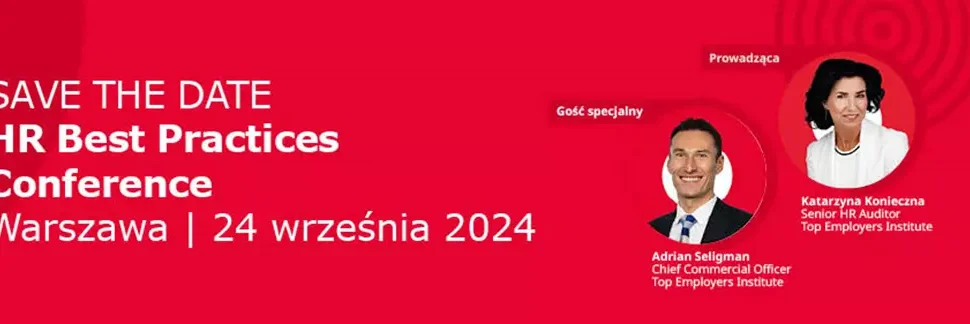
THE NEXT EDITION HR BEST PRACTICES CONFERENCE TACKLING CHALLENGES FOR 2025
HR BEST PRACTICES CONFERENCE: THE FUTURE OF HR IN 2024 AND 2025 REMAINS IN PEOPLE, TRENDS, TECHNOLOGY
We are excited to invite our Top Employers Poland to our upcoming HR Best Practices Conference event. On September 24, 2024 we will meet in Warsaw to share HR industry experts’ insights and discuss the best HR practices for managing and developing a successful workplace.
HR Best Practices Conference 2024 will be initiated with a business breakfast and a “Positive Relationships Session” with the speaker, mentor and networker – Grzegorz Turniak.
HR TRENDS FROM THE PERSPECTIVE OF EXECUTIVE BOARD MEMBER / CCO TOP EMPLOYERS INSTITUTE – ADRIAN SELIGMAN
The first keynote session will be dedicated to the essentials of (re-)humanizing the employee experience in the face of technological advancements, unleashing the power of data in organizational culture. Our Executive Board Member / Chief Commercial Officer at Top Employers Institute – Adrian Seligman will share the latest insights from Top Employers Institute on how HR leaders should balance tech advancements with human centricity, leverage data-driven insights to enhance the employee experience, all while maintaining empathy and connection in the workplace.
During our engaging discussion panel, we will talk about employee loyalty as a key to success in the context of achieving the organizational goals – in other words our HR experts will share insights of recruiting, enhancing employee collaboration with the company and retaining the talents in the workplace.
The Autumn HR Best Practices Conference will be simultaneously fired up by lectures on digitization, reporting and budgeting, HR transformation through AI, activities in the spirit of “Total Experience” (and effective employee engagement). Our speakers will also sparkle a conversation with the topic of the power of women in the current reality as well as we will accommodate the big return to ESG (Environmental, Social and Governance).
LIST OF PANELISTS AND SPEAKERS DURING THE HR BEST PRACTICES CONFERENCE, TAKING PLACE ON SEPTEMBER 24, 2024 IN WARSAW
During the HR Best Practices Conference event, we will have a chance to meet, among othes, the following speakers and panelists: Piotr Cykier, Dyrektor Biura Polityki Wynagrodzeń i Cyfryzacji HR, Bank Gospodarstwa Krajowego; Aleksandra Kubasiewicz, Ekspert, Pion Zasobów Ludzkich, Departament Zarządzania Rozwojem i Kultury Organizacyjnej, Bank Pekao SA; Dorota Benkowska, Senior Director HR, GEA; Małgorzata Makowska, Dyrektor ds. Rekrutacji i Marki Pracodawcy, Auchan Retail Polska; Dorota Zaperty-Łukasik, Senior HR Manager – C.H. Robinson; Łukasz Peliksza, Chief Employee Experience Officer, Santander Bank Polska; Aneta Trzcińska, Kierownik Biura Personalnego, Provident Polska S.A.
HR Best Practices Conference 2024 in Warsaw will be led by Katarzyna Konieczna – Senior HR Auditor at Top Employers Institute.
Insights from the People Summit 2024
Today, 84% of the organisations are defining a vision for how technology contributes to the overall employee experience. That was the focus of the People Summit 2024, hosted by SAP and the Top Employers Institute, which took place on June 12, 2024, at the SAP Labs Campus in Bengaluru, Whitfield in India.
And we’re delighted to share some of the resources shared during the People Summit:
World of Work Trends 2024
Top Employers Institute’s World of Work Trends 2024 analyses the latest trends in people strategies and practices from leading organisations globally. In the report, our analysis showed five significant trends affecting workplaces in 2024. Those trends are:
- The Future Defined with Purpose
- Dialogue for Transformation
- Evolution of Wellbeing Effectiveness
- Broaden the Horizon of DEI
These trends were unpacked by Adrian Seligman, Executive Board Member at the Top Employers Institue. You can download the report here, and watch Adrian’s Keynote here:
Future of Work – Trend Report 2024
Throughout the People Summit, insights were shared by SAP which also featured many insights from the research they’re doing into the future of work. SAP have identified future of work trends three strategic dimensions. You can access an array of resources shared by SAP during the conference here:
- SAP Future of Work – Global Academic Research: Flex Scrum – Hybrid Work and its Impact on Agile Software Engineering
- Future of Work – powered by SAP Booklet
- SAP Flex Team Workshop – This Design Thinking inspired workshop helps teams successfully navigate a hybrid work model
Future-Proofing HR: Trends and Transformations in India
The People Summit also featured a wonderful panel discussion on future-proofing HR and discussing trends and transformations in the Indian Landscape. On the panel was Kavita Kurup, Global Head HR and Corporate Communications at UST, Shilpy Sharma, Regional HR Head at Empower, Kiran Sn, Vice President – HR, HCLTech, Shweta Mohanty, Head of Human Resources: India at SAP and Billy Elliott, Regional Director Asia-Pacific, Top Employers Institute.
They addressed the integration of technology, the distinction and enhancement of employee experience vs. engagement, the importance of diversity, equity, and inclusivity (DE&I), and strategies for skills development and talent management.
Key points included:
- Technological Integration: Shilpy Sharma highlighted the evolving role of technology in HR, emphasizing advancements that boost organizational efficiency while considering potential drawbacks like job displacement and privacy concerns.
- Employee Experience vs. Engagement: Kavita Kurup differentiated between the two concepts, sharing successful UST initiatives to enhance both through personalized approaches and flexible work arrangements.
- Skills Development and Talent Management: Kiran SN discussed HCLTech’s approach to upskilling and reskilling, aligning talent initiatives with strategic goals, and addressing challenges like budget and time constraints.
- Diversity, Equity & Inclusivity: Shweta Mohanty shared effective strategies and impactful programs at SAP to promote DE&I, acknowledging challenges like unconscious bias and tokenism.
To view the complete panel discussion, please visit: Panel discussion – Future-Proofing HR: Trends and Transformations in India
Haier Europe: Elevating its People Practices with the Top Employers Programme
About Haier Europe
Haier Europe is a global leader in home appliances and consumer electronics, recognised for 15 consecutive years as the world’s No.1 brand globally in major appliances, selling under the Candy, Hoover and Haier brands. The organisation comprises of 750 colleagues in the UK&I and 100,000 globally.
Haier Europe’s Top Employers Journey
Haier Europe had been on an improvement journey, investing heavily in people systems, processes and benefits and whilst colleagues inside the business would have seen the transformation, they wanted to receive external recognition in order to attract great talent, and give candidates the confidence to know that they had been certified by an external, independent validation process. They therefore joined the Top Employers Certification Programme, and following completion of the HR Best Practices Survey and Validation Process, were certified as a UK Top Employer 2023.
Elevating its People Practices
“We have definitely seen the profile of our employer brand increase, we see our candidate numbers are very strong and our retention figures are improving in key areas, but the most important outcome from joining the Top Employers Programme is that it has really made Haier Europe a better workplace for our colleagues because it has given us the impetus and direction to keep improving.” Matthew Given, Group HR Director UK & Ireland, Haier Europe
Having achieved Top Employer Certification in year one, the Haier Europe team immediately started work on its action plan to further improve its HR, using the Top Employers Results Dashboard. They did this by:
- Having a dedicated team of specialists within the HR team working on the Top Employers Certification project.
- Aligning the Top Employers HR Best Practices Survey topics and results with the action plans and choosing focus areas which would add most value to the business.
- Regularly reviewing with the team each quarter to ensure that improvements were being made within these focus areas.
Impressive results
In year two, following on from the action planning, Haier Europe increased their score on the Top Employers Best Practices Survey by 20% points.
They had prioritised Employee Listening, wellbeing and DEI, with the new colleague listening strategy bringing great insights and making sure that they really understood how colleagues felt about the business and its programmes. They also mapped, explored and improved many more colleague and candidate journeys.
The leadership team has also taken notice of the tremendous progress and are now championing many new initiatives across engagement, wellbeing and DEI.
How to Manage and Succeed with a Multigenerational Workforce
By Sinakho Dhlamini, HR Content Specialist, Top Employers Institute
Across today’s modern workforce, many organisations are witnessing a unique blend of generations working side by side. From Baby Boomers and Gen Xers to Millennials and Gen Zs, the workplace has become a melting pot of diverse experiences, perspectives, and work styles.
As leaders and managers seek to create a productive, inclusive and welcoming environment for all these different groups, it is essential to understand and effectively manage this multigenerational dynamic to foster collaboration, innovation, and overall team success. Cultivating this understanding will help to better utilise everyone’s talents from an individual and a generational level.
Read More: How Saint-Gobain, Capgemini and Biomerieux are Engaging Employees from a Human-Centric Perspective
What Generations are Currently in the Workforce?
In 2023, there are currently five generations working side-by-side. Those generations are:
- The Silent Generation: This generation was born between 1928 and 1945, making them some of the oldest in the workplace. Many have already retired, but many still choose to participate in the labour force. It is estimated that they still make up 3% of the workforce in the USA. It can be easy to underestimate the number of older people still active in the workplace, especially when you consider that according to the United States Bureau of Labor Statistics, in 2030, 11.1% of those 75 and older will still be active participants in the workforce in 2030.
- Baby Boomers: This generation was born between 1946 and 1964 and currently makes up around a quarter of the working population in the United States. The youngest members of this generation will start retiring in the upcoming years. Still, some of this generation have already begun retiring, this many because they are further along in their careers and often hold higher positions of power at work.
- Gen X: Born between 1965 and 1980, this is one of the smaller generations compared to the ones that came before it and the ones that are coming after it and many in this generation.
- Millennials (also known as Gen Y): Millennials are often quite technologically adept because they have lived through some of the most significant technological advancements. They were born between 1981 and 1996, and they make up the biggest group in the workforce in the USA, making them around 35% of the working population.
- Gen Z: The youngest generation to enter the workforce were born between 1997 and 2012, and they are remarked to be the first actual tech generation as they have never known a world without the internet. While many are still in university, the first groups are becoming active participants in the workforce. As such, organisations need to learn how to support them.
Read More: Nurturing Talent: Retention Strategy Insights from BAT
What are the Benefits of a Multigenerational Workforce?
In many places, we hear about the difficulties of generational differences affecting people’s ability to relate to each other, but there are many benefits for organisations. Those include:
- Skill Diversity: Different generations tend to have distinct skill sets. For example, older employees might excel in interpersonal skills and relationship-building, while younger employees might be adept at leveraging technology and digital tools. This mix of skills can enhance the team’s overall capabilities.
- Knowledge Sharing: Older generations often possess valuable industry experience and institutional knowledge, which they can share with younger team members. This knowledge transfer helps bridge the generation gap and ensures that essential insights are passed down to the next generation. Equally, the younger generation can share knowledge that older generations may have previously ignored, making the sharked knowledge sharing a fruitful opportunity.
- Diverse Perspectives and Ideas: Each generation brings unique life experiences, perspectives, and approaches to problem-solving. This diversity can lead to a broader range of ideas and solutions, fostering innovation and creativity within the team.
- Adaptability: A multigenerational team is often more adaptable to changes in the business landscape. Younger members might embrace new technologies and trends, while older members can provide stability and a long-term perspective during times of transition.
- Reduced Bias and Stereotyping: Working closely with colleagues of various generations challenges stereotypes and biases. Team members learn to appreciate each generation’s strengths and qualities, breaking down preconceived notions.
- Effective Communication: Interacting with colleagues from different generations can improve communication skills. Team members learn to adapt their communication styles to accommodate diverse preferences, leading to more precise and effective information exchanges.
- Enhanced Problem Solving: Multigenerational teams can bring diverse problem-solving approaches to the table. This diversity allows the team to tackle challenges from multiple angles, increasing the likelihood of finding effective solutions.
- Market Insights: Different generations have varying consumer behaviours and preferences. A diverse team can help the organisation better understand and connect with a broader range of target demographics.
- Mentorship Opportunities: Multigenerational teams provide natural mentorship opportunities. Older employees can mentor younger ones, offering guidance and wisdom, while younger employees can offer insights into new technologies and trends.
- Increased Employee Engagement: Recognising and leveraging the strengths of each generation can boost employee engagement. When team members feel valued for their unique contributions, they are more likely to be motivated and committed to their work.
Read More: Inspiring HR Practices from Asia-Pacific’s Top Employers
How Organisations Can Get the Best Out of Their Multigenerational Workforce
The benefits of having a multigenerational workforce show that having a work environment that is diverse in age range creates a positive impact on organisations and their employees; it is still important to figure out how organisations can foster that environment. Some of the ways that HR professionals can learn how to manage their workforce to foster collaboration and innovation effectively include:
- Embracing Diversity and Inclusion: A multigenerational team offers diverse skills and perspectives. By fostering an inclusive environment, HR professionals and leaders can help team members feel valued and respected regardless of age. Encourage open dialogue that celebrates the unique strengths and experiences each generation brings to the table. They can organise cross-generational mentorship programs to facilitate knowledge sharing and skill development.
- Flexibility in Work Arrangements: Different generations often have different expectations regarding work-life balance and remote work options. By offering flexible work arrangements, organisations can accommodate the diverse needs of their multigenerational team. Allowing for flexibility in where employees work, flexible hours, and job-sharing opportunities ensures everyone can maintain a healthy work-life balance.
- Continuous Learning and Development: Promoting a culture of constant learning to keep all team members engaged and up to date. Provide opportunities for professional development, training, and upskilling. Encourage cross-generational learning by pairing experienced employees with newer ones to facilitate knowledge exchange.
- Flexibility in Leadership Styles: Different generations may respond to different leadership styles. Some may appreciate a hands-on approach, while others prefer a more autonomous working environment. HR professionals should understand these preferences and adapt leadership strategies to manage and motivate their multigenerational teams effectively.
- Conflict Resolution and Mediation: Generational differences can sometimes lead to misunderstandings and conflicts. HR professionals and leaders should be equipped with effective conflict resolution and mediation skills to address any issues that may arise. A proactive approach to resolving disputes can prevent them from escalating and disrupting the team’s harmony.
Read More: How Organisations Improve Employee Engagement with Emotionally Engaged Leaders
Final Thoughts
Managing a multigenerational team requires a thoughtful and inclusive approach. By embracing diversity, fostering open communication, offering flexibility, recognising individual contributions, promoting continuous learning, and adapting leadership styles, organisations wanting to get the best out of their people can work to create an environment where everyone thrives. Suppose they successfully create this environment by navigating the complexities of a multigenerational team. In that case, they will not only be able to enhance team performance, but they will also be able to cultivate a workplace where everyone feels valued.
Becoming LGBTQ+ Allies: Going Beyond DEI Initiatives for Pride Month
By Sinakho Dhlamini, HR Content Specialist, Top Employers Institute
Over the past several years, organisations have used Pride month to begin, reinvent or sharpen up their DEI efforts for members of the LGBTQ+. But it only happens once a year; for many people, more is needed beyond this concentration of action once a year. Instead, organisations will need to become active allies for the LGBTIQ+ community throughout the year by creating an inclusive environment at work. The work of becoming an active ally to support co-workers of the LGBTQ community involves more than just celebration, and this article will examine some of the ways businesses can show their commitment to not only raising awareness for the rights of the community but also to prioritise equal rights.
What is an ally?
In a few words, we can understand that being an LGBTQ+ ally means actively supporting and advocating for the rights, dignity, and wellbeing of lesbian, gay, bisexual, transgender, and queer individuals. In the workplace, being an ally involves creating an inclusive and accepting environment where LGBTQ+ colleagues can feel safe, valued, and respected.
Read More: Best Practice | Count Me In: Diversity & Inclusion at Mitie
5 Ways organisations empower their employees to be allies for the LGBTQ+ Community.
- Develop and Enforce Inclusive Policies and Practices: Policies protecting LGBTQ+ employees from discrimination and harassment are essential for organisations, including and supporting community employees. That can be done by ensuring inclusive language in company communications and having policies that ensure that LGBTQ+ individuals have equal opportunities for career advancement, promotion, and leadership roles. Organisations must set the tone for their employees, which requires action and intention.
- Provide Education and Training: Organisations must provide comprehensive education and training on LGBTQ+ issues, terminology, and experiences. That can be done by offering workshops, seminars, or online resources to increase employee awareness and understanding. The education should cover topics such as LGBTQ+ history, intersectionality, and the challenges faced by the community. Educating employees on issues like this will teach them to listen, respect and look at their prejudices – helping them become better allies to their co-workers.
- Create Employee Resource Groups (ERGs): Establishing LGBTQ+ employee resource groups or affinity networks within the organisation to help create a safe space for discussion. These groups provide a safe and supportive space for LGBTQ+ employees and their allies to connect, share experiences, and collaborate on initiatives that promote inclusion. Organisations can support these groups by allocating resources, budget, and executive sponsorship.
- Leadership Support: Leaders and managers should openly support LGBTQ+ employees and allyship efforts. They should set the tone by demonstrating inclusive behaviours, including using inclusive language and addressing any discrimination or bias in the organisation. Leadership support helps create a culture of acceptance and sets expectations for the entire organisation.
- Establish Feedback and Listening Channels: Establish feedback mechanisms where employees can provide suggestions, voice concerns, or share their experiences related to LGBTQ+ inclusion. Actively listen to employee feedback and make necessary improvements based on their input; this demonstrates that the organisation values employee perspectives and is dedicated to continuous improvement.
Read More: Key Takeaways: Embedding Systemic Inclusion with Tata Consultancy Services
Why is it important for Organisations to Support the LGBTQ+ Community?
Supporting the LGBTQ+ community promotes a culture of inclusivity and diversity within the organisation. Embracing and celebrating differences, including sexual orientation and gender identity, fosters a sense of belonging among all employees. In addition, when employees feel valued for who they are, regardless of their sexual orientation or gender identity, it increases employee morale, engagement, and productivity.
It also has additional benefits, including:
- Attracting and Retaining Talent: Creating a supportive environment for the LGBTQ+ community helps attract and retain diverse talent, especially in the current competitive job market, where many candidates actively seek organisations prioritising inclusivity and equality.
- Employee Wellbeing and Mental Health: Supporting the LGBTQ+ community directly contributes to the wellbeing and mental health of LGBTQ+ employees. Employees who feel supported, accepted, and respected experience reduced stress and anxiety levels.
- Brand Image and Reputation: Organisations that champion LGBTQ+ rights and inclusivity contribute to building a positive brand image and reputation. Consumers, clients, and stakeholders increasingly expect businesses to prioritise diversity and social responsibility.
- Social Impact and Corporate Social Responsibility: Organisations can make a positive social impact by supporting the LGBTQ+ community. By actively engaging in initiatives, sponsorships, and partnerships that promote LGBTQ+ rights and equality, companies can contribute to broader social progress.
Final Thoughts
June is a time for celebration, but, more importantly, it is a time to raise awareness for LGBTQ+ people and educate people to become effective allies in the community. It is only one month, but the issues are significant throughout the year. Organisations should use June to be more active in communicating their policies and initiatives, but it should have already been a part of their people practices strategy. It is also critical to allow LGBTQ+ people the space to become powerful voices while their friends and coworkers support them by taking action to become an ally.
Make inclusion a part of your organization, get in touch for free to become an employer of choice!
Balancing AI and Human Expertise in HR: Insights from SABIC India and Top Employers Institute
Artificial Intelligence (AI) is rapidly growing in various industries, including HR. While AI technology offers numerous benefits, such as increased efficiency and reduced bias, it raises concerns about the lack of personal touch. In a recent LinkedIn Live event, Preet Boparai, Head of HR for India, at SABIC and Billy Elliott, Regional Director for APAC at Top Employers Institute, discussed the emerging use of AI in HR and the importance of maintaining a balance between AI and human expertise. The webinar explored examples of how AI has proven beneficial and the potential downsides of relying solely on technology. The session also provided insights into how SABIC India leverages AI while retaining the human element in HR operations. Here are some key learnings from the session:
Read ahead to get a snapshot of some of the session’s highlights; fill in the form to get the recording of the webinar to watch whenever you have a moment.
Balancing the Benefits and Concerns of AI in Human Resources: The Need for Human Oversight and Intervention
Using AI tools in HR has proven successful in saving time and effort. For example, AI tools have proven successful in recruitment by saving time and effort for recruiters and offering personalised feedback to candidates. These tools employ natural language processing and facial analysis technology to evaluate the fit of candidates for job positions. However, a critical issue with AI tools in recruitment is the potential for bias and discrimination. In a notable case, a recruitment tool demonstrated a preference for male candidates over female candidates. Therefore, it is necessary to have human oversight and intervention to ensure that algorithms are not giving biased results.
SABIC Shows How AI Tools Can Help HR in Employee Engagement and Retention
SABIC, a global leader in diversified chemicals, has harnessed the power of AI to enhance employee engagement and retention. Here are some ways they’ve implemented it:
- Development of a chatbot for employee experience: SABIC developed an advanced chatbot called Amber, which has proved invaluable during the pandemic. It acted as a seamless two-way communication tool, promoting connection and dialogue by regularly seeking feedback from SABIC employees about their experiences working in an evolving, flexible environment. The chatbot is used to identify disengaged employees and those who are at risk of leaving. By proactively identifying these employees, SABIC has been able to retain them, thereby reducing its attrition rate. However, SABIC also emphasised the importance of informing employees about the tool and ensuring that conversations between employees and HR are confidential.
- Gathering feedback from employees: SABIC has also used AI tools to gather employee feedback during the COVID-19 pandemic. This feedback was used to launch SABIC Care, a flexible employee health benefits plan.
- Personalised learning journeys: SABIC also uses Percipio, a platform that offers a range of courses and content for employees to upskill and reskill themselves. This platform uses AI to personalise the learning experience and improve the efficiency and effectiveness of the learning process.
Balancing AI and Human Intelligence
While AI tools can provide valuable insights and baseline information, SABIC emphasised the importance of involving human intelligence in decision-making. The solutions SABIC created were well thought through and catered to the entire organisation. SABIC also recognised that AI tools are not infallible and that there may be instances where the predictions made by these tools need to be corrected. Therefore, the company has created a feedback loop where human intelligence can correct and improve the accuracy of AI tools.
Fostering Collaboration Between AI and Humans in the Workplace: HR’s Vital Role
In today’s fast-paced, technologically driven world, it’s easy to get caught up in the idea that machines and algorithms can do everything better than humans. However, as we rely increasingly on artificial intelligence (AI) in the workplace, it’s essential to remember the value of the human touch. Recent studies have shown that many employees negatively perceive their HR departments. Some don’t even know who their HR representative is, while others don’t trust that any action will be taken if they report a concern, such as harassment or discrimination. With the increasing use of digital tools, this gap between HR and employees could widen further.
However, the solution isn’t to eliminate AI and go back to the days of paper forms and in-person meetings. Instead, HR departments need to remember that technology should be used to enhance and support human interaction, not replace it entirely. The key is to maintain honest and meaningful conversations with employees. This means closing the loop and letting employees know what actions are being taken in response to their concerns, even if the news isn’t always positive. No amount of technological advancement or process improvement can replace regular communication and connection between HR and employees.
Ultimately, the best approach is to view AI and humans as a united team working together to empower the future of the workplace. It’s up to us to take responsibility for making positive changes and not depend solely on technology to solve all our problems.