New Top Employers Institute research challenges long-standing workforce boundaries as career paths cross between traditional blue- and white-collar work.
- 85% of workers are satisfied in their current role, yet 41% are considering leaving or actively looking for a new job
- Only around six in ten believe their employer would give them a genuine opportunity to move between hands-on and office-based work
- Top Employers Institute calls on HR leaders to balance job security today with career security for tomorrow
London, UK, 04 November 2026 – A century after it was invented by an Iowa newspaper in homage to the blue work shirts of factory workers and farm labourers, the term ‘blue-collar’ appears to be reaching the end of its working life as a fixed career label.
New research from Top Employers Institute shows the boundary between blue-collar and its ‘white-collar’ counterpart has become increasingly permeable in the AI-powered second quarter of the 21st century. More than three-quarters of blue-collar workers (81%) and almost three-quarters of white-collar workers (74%) have worked in the opposite collar type at some point in their careers.
The research instead points to a new workforce divide emerging across both groups, between employees who can see a realistic route to move between hands-on and office-based roles, and those who are stuck and feel they must stay in their lane.
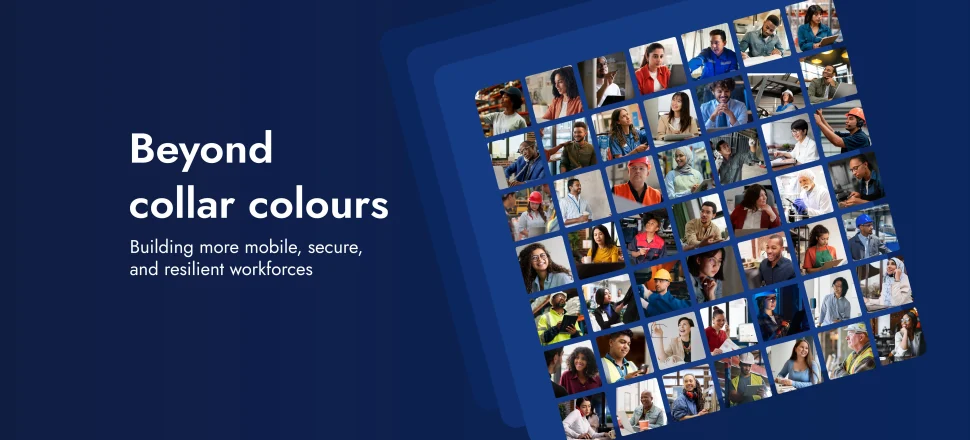
Assembling data from more than 10,000 workers across 15 countries, the Top Employers Institute report, Beyond Collar Colours: Building more mobile, secure, and resilient workforces, challenges the assumption that career progression means moving upwards within the same type of work.
In fact, 59%1 of what would currently be classified as ‘blue-collar’ workers and 56%2 of those who would fall into the traditional ‘white-collar’ bracket believe the two types of work are similar in many ways. And almost a third (32%) of all those surveyed said they would prefer the ‘opposite’ type of work if the pay were equal. However, while 61%2 believe they could move between hands-on and office-based work within their current organisation, significant barriers remain.
Among those who do not see a realistic opportunity to move, 35% of blue-collar workers and 33% of white-collar workers cite the absence of a formal process. For many workers, the reality is that career structures are simply not keeping pace with their ambitions.
The implications for retention are stark. Despite 85%2 of workers saying they are ‘satisfied’ in their current role, a significant proportion (41%3) are considering leaving or actively looking for a new job.
Sebastiaan ter Horst, Chief Certification and Insights Officer, said: “Employers who think satisfaction with a current job equals an employee having confidence in their future prospects should take note.
“This research shows it is dangerous to pigeon-hole workers as ‘blue-collar’ or ‘white-collar’ with entirely separate career paths and structures. Instead, a new divide is emerging across both groups: between those who feel confident in their ability to adapt and progress and those who feel their options are limited.
“These findings challenge employers to make the next career step visible and accessible. Job security and career security both matter. Employers can strengthen career confidence by making future skill requirements clear, expecting managers to support moves across teams and keeping development open throughout working life. For employees already stretched by shortages, that support must also include manageable workloads and protected time to learn.”
To illustrate how differently employees experience this changing landscape, the report identifies five workforce profiles:
- The Switchers, who have already moved between blue- and white-collar work or believe their current employer would give them a genuine opportunity to do so.
- The Stuck White-Collar Professionals, who report lower intent to leave and may be staying put because they see few alternatives. Just 18% of white-collar workers say it would be extremely easy to find an equally good job elsewhere within the next three months, compared with 28% of blue-collar workers.
- The Stretched Blue-Collar Workers, facing staff shortages and workload pressures. 70%2 of blue-collar workers say shortages have increased over the past year, and of these, 58%4 have considered leaving as a result.
- The Experienced Blue-Collar Workers, whose access to development drops sharply from the age of 45. Pride in their contribution is strong: 80%2 of blue-collar workers aged 65+ say they take pride in seeing their own physical effort or handiwork in the finished result of their work.
- The Entrants, whose expectations of flexibility and purpose are shaping their working lives. 72%2 of those with less than 11 years’ experience value schedule flexibility over financial reward.
Together, these findings underline the need for HR leaders to look beyond traditional workforce categories and address the different barriers employees face. Top Employers Institute recommends giving employees opportunities to test moves between hands-on and office-based roles through job shadowing and secondments and recognising managers who develop talent for the wider organisation. It also calls for late-career pathways, including redesigned roles and continued development. It urges employers to give stretched employees protected time for learning and participation in change, alongside action to address unsustainable workloads. Read the full report: Beyond Collar Colours: Building more mobile, secure, and resilient workforces
1‘Strongly agree’ and ‘Somewhat agree’ responses combined. 2Very satisfied’ and ‘Fairly satisfied’ responses combined. 3‘I’m considering leaving because I know I could easily find a better opportunity elsewhere’, ‘I’m actively looking for something else’, ‘I’m considering leaving because of restructuring or job cuts at my organisation’, ‘I’m considering leaving because I’m worried about AI or automation affecting my job’ responses combined. 4‘I’m considering leaving because I know I could easily find a better opportunity elsewhere’, ‘I’m actively looking for something else’, ‘I’m considering leaving because of restructuring or job cuts at my organisation’, ‘I’m considering leaving because I’m worried about AI or automation affecting my job’ responses combined.